


China announced “10 pro-Taiwan measures” on Sunday last week following Chinese Nationalist Party (KMT) Chairwoman Cheng Li-wun’s (鄭麗文) trip to China and meeting with Chinese President Xi Jinping (習近平). While the KMT described the measures as a “gift,” the Mainland Affairs Council warned they are “sugar-coated poison” and a tactic Beijing has repeatedly used for decades.
The measures — easing restrictions on Taiwanese agricultural and fishery products, resuming flights and expanding cultural cooperation, youth exchanges, transport and energy links between China’s Fujian Province and Taiwan’s outlying islands, as well as allowing tourists from Shanghai and Fujian — appear to offer “incentives” for cross-strait engagement.
However, they come with political preconditions tied to Beijing’s “one China” principle, denying Taiwan’s sovereignty. Chinese authorities said inspection and quarantine standards on Taiwanese imports would rely on mechanisms upholding the “1992 consensus” and “opposing Taiwan independence.”
They are also framed through Chinese Communist Party (CCP)-KMT communication, shifting interaction from government negotiations to party-level exchanges. This would sow divisions within Taiwan and recast the issue as China’s internal affair rather than an international matter under global scrutiny.
The measures repackage earlier “united front” efforts. China introduced “31 measures for Taiwan” in 2018, “26 measures” in 2019 and “Fujian 21 measures” in 2023, offering loans, tax waivers, temporary residence permits, housing subsidies and relaxed import rules to attract Taiwanese professionals and businesses.
While promoted as opportunities, the policies aim to draw Taiwan’s capital, talent and technology and deepen reliance on the Chinese market. Alongside military pressure, Beijing has long deployed economic incentives and cross-strait trade — “using business to influence politics” — to advance unification.
On Monday, General Chamber of Commerce chairman Paul Hsu (許舒博), a former KMT legislator, convened representatives from seven business associations to urge acceptance of the measures. However, many past incentives proved to be “empty promises,” repeatedly introduced and withdrawn at China’s discretion, causing losses for Taiwanese industries and farmers.
For example, China banned Taiwanese pineapples and groupers in 2021 and 2022 using inspections lacking scientific basis and contravening international practices after Chinese producers adopted Taiwanese techniques to replace them in global markets. It has also restricted Chinese tourists and students since the Democratic Progressive Party (DPP) took power, imposing full bans during the COVID-19 pandemic and selectively reopening to benefit pro-China forces.
China has applied similar “pump and dump” tactics elsewhere, including restricting tourists to South Korea and Japan.
Taiwan’s economy has strengthened. GDP growth reached 8.7 percent last year, the highest in 15 years and higher than during former president Ma Ying-jeou’s (馬英九) China-focused tenure. The IMF projects GDP per capita at US$42,103, far exceeding China’s estimated below US$15,000.
Since China’s sanctions, the average farm-gate prices for golden diamond pineapple rose from NT$22.1 to NT$29.08 between 2021 and last year, as Taiwan shifted its focus to international markets such as Japan, South Korea and Canada
Official statistics showed that Taiwanese workers in China fell from 430,000 in 2012 to about 231,000 in 2024, while investment dropped from 83 percent of outbound investment in 2010 to below 10 percent last year, and willingness to work in China hit a record low of 1.6 percent last year.
All this evidence shows that China’s “incentives” have failed to sway public sentiment. Taiwan’s economy has outperformed China’s and would improve further as it continues to decouple from the Chinese. Cross-strait engagement should be based on fairness, equality and reciprocity — not dependence on China or compromises to Taiwan’s sovereignty and dignity.
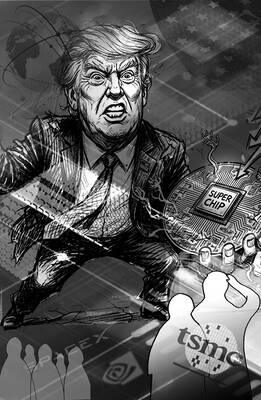
The White House’s decision to take a 9.9 percent stake in Intel Corp is looking like very shrewd business indeed. Since the government bought in at US$20.47 a share last August, the US chipmaker’s surging stock price has delivered the US a US$43 billion return. One of the reasons the investment has so far proved so sound is that the White House has made sure of it. According to The Wall Street Journal, Howard personally pushed deals on Intel’s behalf with some of the most lucrative clients imaginable. They include Nvidia Corp, the company at the heart of the AI
A single photograph can cut through a lot of noise, but it can also be used to misrepresent the truth. At the very least, it can concentrate the mind on something that requires further investigation. On Monday last week, Ma Ying-jeou Foundation CEO Tai Hsia-ling (戴遐齡) and former National Security Council secretary-general King Pu-tsung (金溥聰) held a news conference in which they showed a photograph of former foundation CEO Hsiao Hsu-tsen (蕭旭岑), now Chinese Nationalist Party (KMT) deputy chairman. In the image Hsiao is seated next to Xiamen Taiwan Businessmen Association chairman Han Ying-huan (韓螢煥). The two men were holding
I first met Professor Ray Jiing (井迎瑞) as a film and documentary student at Shih Hsin University’s (SHU) Department of Radio Television and Film in 1988. The following year, he went on to become the director of the Chinese Taipei Film Archive — forerunner of the Taiwan Film and Audiovisual Institute (TFAI). Over his eight-year tenure, Jiing rescued and restored over 200 classic Taiwanese films. In 1997, he established the Graduate Institute of Studies in Documentary and Film Archiving at Tainan National University of the Arts (TNNUA), and I joined the program in his third cohort of students. Beyond a
A recent report concerning a student who is suing his teacher posed the question in its headline: Does failing a student in two subjects constitute bullying? The college student in Chiayi County apparently sought NT$2 million (US$63,603) in state compensation, but a court dismissed the case. The first reaction of many might have been to ask: What has happened to students nowadays? Some say that teachers have lost their authority, while others say students are overindulged. Some even start reminiscing over the days when “whatever the teacher says goes.” However, the real issue might be overlooked if emotional reactions like that are the


 RSS
RSS