


Taiwan’s labor shortage is worsening. The number of job vacancies nationwide has surpassed 1.12 million, with the manufacturing and construction sectors bearing the brunt. At the same time, the combined pressures of a declining birthrate and an aging population have made it nearly impossible to fill the gap in the domestic workforce.
Against that backdrop, the Ministry of Labor announced that the first batch of migrant workers from India could arrive in Taiwan as early as this year as part of an agreement signed in February 2024.
Taiwan’s sources of migrant labor are limited to Indonesia, the Philippines, Vietnam and Thailand. Compared with countries such as Japan, South Korea and Singapore — which each draw from more than 10 source countries — Taiwan’s migrant labor structure appears overly concentrated. The reliance on a few countries carries risks that cannot be ignored: If one of the countries were to suspend labor exports due to political friction or policy shifts, Taiwan’s labor supply would face a shock that would be extremely difficult to remedy in the short term.
Introducing migrant workers from India is a crucial step in diversifying risk and improving the resilience of the labor supply, and it must be planned for.
The agreement with India also carries clear geopolitical significance. In the past few years, the government has advanced its Indo-Pacific strategy, with a key component being deepening ties with India. The signing of the memorandum of understanding on migrant workers — particularly given the constraints of formal diplomacy — lays the foundation for bilateral relations through concrete industrial collaboration.
As India is the world’s largest democracy and one of the most promising emerging economies, labor cooperation with New Delhi is not merely about workforce allocation, it is also a strategic basis for building mutual trust.
Countries such as Japan, South Korea and Germany, as well as Middle East nations, are recruiting labor from India. If Taiwan hesitates, it might fall behind in accessing its labor resources while also missing a strategic window to establish a long-term partnership with India.
Support of opening up to outside labor does not mean acting hastily. The Ministry of Labor has adopted a cautious and gradual approach, with the first batch limited to about 1,000 workers and prioritizing traditional manufacturing industries, with reviews to follow. The pilot model allows the government to accumulate practical experience while allowing society sufficient time to observe and adapt — a pragmatic approach.
However, the real test of governance lies in how the workers are introduced. The government must ensure that the entire recruitment and management mechanism complies with international human rights standards.
Cases of migrant workers being exploited by brokers and charged excessive fees have been all too common. If Taiwan is to successfully introduce migrant workers from India, it must expand the proportion of direct hiring, and establish a transparent and fair recruitment process.
Workers should be able to clearly understand their rights and treatment prior to arriving in Taiwan, rather than becoming victims of information asymmetry.
Moreover, Taiwan’s problem of absconded migrant workers must not be ignored. While advancing the plan to introduce Indian migrant workers, it is essential to simultaneously improve management systems, including an enhancement to employer accountability and updates to complaints channels, ensuring that recruitment and management can proceed in tandem.
Dino Wei works in the information technology industry.
Translated by Kyra Gustavsen
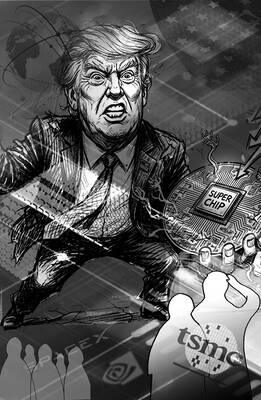
The White House’s decision to take a 9.9 percent stake in Intel Corp is looking like very shrewd business indeed. Since the government bought in at US$20.47 a share last August, the US chipmaker’s surging stock price has delivered the US a US$43 billion return. One of the reasons the investment has so far proved so sound is that the White House has made sure of it. According to The Wall Street Journal, Howard personally pushed deals on Intel’s behalf with some of the most lucrative clients imaginable. They include Nvidia Corp, the company at the heart of the AI
A single photograph can cut through a lot of noise, but it can also be used to misrepresent the truth. At the very least, it can concentrate the mind on something that requires further investigation. On Monday last week, Ma Ying-jeou Foundation CEO Tai Hsia-ling (戴遐齡) and former National Security Council secretary-general King Pu-tsung (金溥聰) held a news conference in which they showed a photograph of former foundation CEO Hsiao Hsu-tsen (蕭旭岑), now Chinese Nationalist Party (KMT) deputy chairman. In the image Hsiao is seated next to Xiamen Taiwan Businessmen Association chairman Han Ying-huan (韓螢煥). The two men were holding
I first met Professor Ray Jiing (井迎瑞) as a film and documentary student at Shih Hsin University’s (SHU) Department of Radio Television and Film in 1988. The following year, he went on to become the director of the Chinese Taipei Film Archive — forerunner of the Taiwan Film and Audiovisual Institute (TFAI). Over his eight-year tenure, Jiing rescued and restored over 200 classic Taiwanese films. In 1997, he established the Graduate Institute of Studies in Documentary and Film Archiving at Tainan National University of the Arts (TNNUA), and I joined the program in his third cohort of students. Beyond a
A recent report concerning a student who is suing his teacher posed the question in its headline: Does failing a student in two subjects constitute bullying? The college student in Chiayi County apparently sought NT$2 million (US$63,603) in state compensation, but a court dismissed the case. The first reaction of many might have been to ask: What has happened to students nowadays? Some say that teachers have lost their authority, while others say students are overindulged. Some even start reminiscing over the days when “whatever the teacher says goes.” However, the real issue might be overlooked if emotional reactions like that are the


 RSS
RSS