


Following Chinese Nationalist Party (KMT) Chairwoman Cheng Li-wun’s (鄭麗文) visit to China last week, the Chinese Communist Party (CCP) has once again resorted to its old tactics, offering to purchase Taiwanese agricultural products as a condition in exchange for support for unification. I strongly disapprove of the KMT’s willingness to accept such a humiliating proposal that undermines our nation’s sovereignty.
Pineapple prices can fluctuate for many reasons, such as the cultivation volume in a given year, overall economic conditions and poor harvests of other fruits caused by natural disasters. When the China factor comes into play, Taiwan sometimes exports pineapples across the Straight, where they are naturally sold at prices exceeding the general market rate.
However, not all farmers have the opportunity to receive this kind of “favor” as the CCP has long treated the importation of Taiwanese agricultural products as part of its “united front” strategy. The purchase of pineapples is typically limited to specific farmers in designated counties and cities and the quantities are often limited.
The CCP’s purchase of Taiwan-grown pineapples can be seen as resembling an ancient monarch bestowing privileges upon subjects that obtain his favor — a practice inconsistent with the principles of a free market.
The purchases can also be suspended at any time with no regard for farmers’ livelihoods. In particular, the CCP has entirely treated the purchase of Taiwanese agricultural products as a tool of “united front” work.
Whenever the government takes actions that hinder “national reunification” or are interpreted as promoting Taiwanese independence, the CCP tends to immediately halt imports of certain agricultural products. Such political intervention leads to the most unpredictable and damaging effects on Taiwan’s farmers.
Even if the CCP had the capacity to fully purchase all Taiwan-grown pineapples and enable farmers to sell at better prices, requiring farmers to accept unification and cause Taiwan to become a state ruled by the CCP would have the most severe consequence — the permanent loss of their dignity and way of life.
After all, sacrificing the stability and dignity of future generations for the sake of earning a slightly higher income is simply not worth it.
Chen Chi-nung is a political commentator.
Translated by Kyra Gustavsen
In recent weeks, Taiwan has witnessed a surge of public anxiety over the possible introduction of Indian migrant workers. What began as a policy signal from the Ministry of Labor quickly escalated into a broader controversy. Petitions gathered thousands of signatures within days, political figures issued strong warnings, and social media became saturated with concerns about public safety and social stability. At first glance, this appears to be a straightforward policy question: Should Taiwan introduce Indian migrant workers or not? However, this framing is misleading. The current debate is not fundamentally about India. It is about Taiwan’s labor system, its
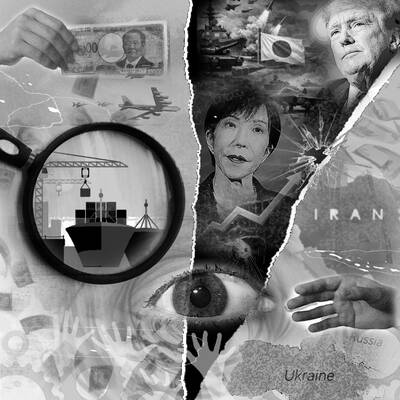
Japan’s imminent easing of arms export rules has sparked strong interest from Warsaw to Manila, Reuters reporting found, as US President Donald Trump wavers on security commitments to allies, and the wars in Iran and Ukraine strain US weapons supplies. Japanese Prime Minister Sanae Takaichi’s ruling party approved the changes this week as she tries to invigorate the pacifist country’s military industrial base. Her government would formally adopt the new rules as soon as this month, three Japanese government officials told Reuters. Despite largely isolating itself from global arms markets since World War II, Japan spends enough on its own
On March 31, the South Korean Ministry of Foreign Affairs released declassified diplomatic records from 1995 that drew wide domestic media attention. One revelation stood out: North Korea had once raised the possibility of diplomatic relations with Taiwan. In a meeting with visiting Chinese officials in May 1995, as then-Chinese president Jiang Zemin (江澤民) prepared for a visit to South Korea, North Korean officials objected to Beijing’s growing ties with Seoul and raised Taiwan directly. According to the newly released records, North Korean officials asked why Pyongyang should refrain from developing relations with Taiwan while China and South Korea were expanding high-level
Swiftly following the conclusion of Chinese Nationalist Party (KMT) Chairwoman Cheng Li-wun’s (鄭麗文) China trip, China’s Taiwan Affairs Office unveiled 10 new policy measures for Taiwan. The measures, covering youth exchanges, agricultural and fishery imports, resumption of certain flights and cultural and media cooperation, appear to offer “incentives” for cross-strait engagement. However, viewed within the political context, their significance lies not in promoting exchanges but in redefining who is qualified to represent Taiwan in dialogue with China. First, the policy statement proposes a “normalized communication mechanism” between the KMT and the Chinese Communist Party (CCP). This would shift cross-strait interaction from


 RSS
RSS