


During Chinese Nationalist Party (KMT) Chairwoman Cheng Li-wun’s (鄭麗文) visit to China to meet Chinese President Xi Jinping (習近平), the large entourage of business leaders that typically accompanies such trips was nowhere to be seen.
This is not merely a snapshot of China’s economic slowdown, but a deeper signal: We are entering an era of comprehensive credit scrutiny.
The global market’s risk-pricing mechanism has fundamentally changed. If people continue using outdated frameworks to explain a world whose rules have been rewritten, they could face misjudgments.
In the past, background checks were largely confined to individual job applications. Now, they have expanded to the corporate level. Today’s “credit” is no longer limited to financial metrics on a balance sheet — it also includes a holistic assessment of a company’s integrity, regulatory compliance, political affiliations and supply chain transparency.
Amid intensifying US-China competition, global supply chains have shifted from prioritizing efficiency to prioritizing security.
International partners now review not only financial and technical factors before signing contracts, but also whether supply chains involve sensitive technologies or high-risk regions and whether management has political associations. These conditions form a company’s new corporate resume.
Who you stand with has become a signal of risk. A single photograph of a handshake or political endorsement can be flagged, potentially affecting access to international markets and cooperation on key technologies.
Taiwanese companies are increasingly unwilling to publicly endorse pro-China politics. It is not that the Chinese market has disappeared, but that once a company is labeled, the impact extends beyond short-term profits to a discounting of its overall creditworthiness. When credit becomes an entry ticket, a stance is no longer merely a choice but a screening mechanism.
In this era, what companies fear most is not market competition, but being labeled unreliable. Once deemed noncompliant with security standards, the outcome is typically exclusion from the supply chain rather than negotiation.
Corporate silence is becoming a risk management strategy. Avoiding political alignment and steering clear of politicized activities are ways to safeguard access to the global system.
The mindset driving the global economy is shifting from “capital determines everything” to “credit determines everything.”
Even if a company remains profitable, if its political credibility is questioned, international capital and technology might still withdraw.
The real choice facing Taiwanese companies has never been a binary decision between China and the US, but something deeper — whether they are still deserving of the world’s trust. Under these rules, the greatest failure is not financial loss, but being judged untrustworthy by the international market.
Hsiao Hsi-huei is a freelancer.
Translated by Kyra Gustavsen
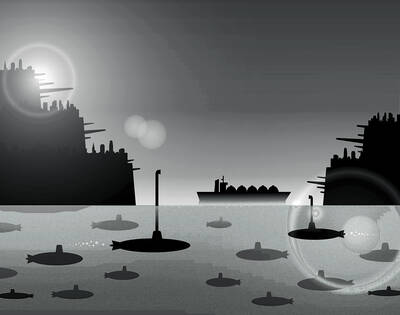
In the event of a war with China, Taiwan has some surprisingly tough defenses that could make it as difficult to tackle as a porcupine: A shoreline dotted with swamps, rocks and concrete barriers; conscription for all adult men; highways and airports that are built to double as hardened combat facilities. This porcupine has a soft underbelly, though, and the war in Iran is exposing it: energy. About 39,000 ships dock at Taiwan’s ports each year, more than the 30,000 that transit the Strait of Hormuz. About one-fifth of their inbound tonnage is coal, oil, refined fuels and liquefied natural gas (LNG),
On Monday, the day before Chinese Nationalist Party (KMT) Chairwoman Cheng Li-wun (鄭麗文) departed on her visit to China, the party released a promotional video titled “Only with peace can we ‘lie flat’” to highlight its desire to have peace across the Taiwan Strait. However, its use of the expression “lie flat” (tang ping, 躺平) drew sarcastic comments, with critics saying it sounded as if the party was “bowing down” to the Chinese Communist Party (CCP). Amid the controversy over the opposition parties blocking proposed defense budgets, Cheng departed for China after receiving an invitation from the CCP, with a meeting with
Chinese Nationalist Party (KMT) Chairwoman Cheng Li-wun (鄭麗文) is leading a delegation to China through Sunday. She is expected to meet with Chinese President Xi Jinping (習近平) in Beijing tomorrow. That date coincides with the anniversary of the signing of the Taiwan Relations Act (TRA), which marked a cornerstone of Taiwan-US relations. Staging their meeting on this date makes it clear that the Chinese Communist Party (CCP) intends to challenge the US and demonstrate its “authority” over Taiwan. Since the US severed official diplomatic relations with Taiwan in 1979, it has relied on the TRA as a legal basis for all
The two major opposition parties, the Chinese Nationalist Party (KMT) and the Taiwan People’s Party (TPP), jointly announced on Tuesday last week that former TPP lawmaker Chang Chi-kai (張啟楷) would be their joint candidate for Chiayi mayor, following polling conducted earlier this month. It is the first case of blue-white (KMT-TPP) cooperation in selecting a joint candidate under an agreement signed by their chairpersons last month. KMT and TPP supporters have blamed their 2024 presidential election loss on failing to decide on a joint candidate, which ended in a dramatic breakdown with participants pointing fingers, calling polls unfair, sobbing and walking


 RSS
RSS