


In the event of a war with China, Taiwan has some surprisingly tough defenses that could make it as difficult to tackle as a porcupine: A shoreline dotted with swamps, rocks and concrete barriers; conscription for all adult men; highways and airports that are built to double as hardened combat facilities.
This porcupine has a soft underbelly, though, and the war in Iran is exposing it: energy.
About 39,000 ships dock at Taiwan’s ports each year, more than the 30,000 that transit the Strait of Hormuz. About one-fifth of their inbound tonnage is coal, oil, refined fuels and liquefied natural gas (LNG), which power 85 percent of the grid and 99 percent of its road fleet. The vast majority passes through a handful of ports, most facing the coast of mainland China as little as 130km away.
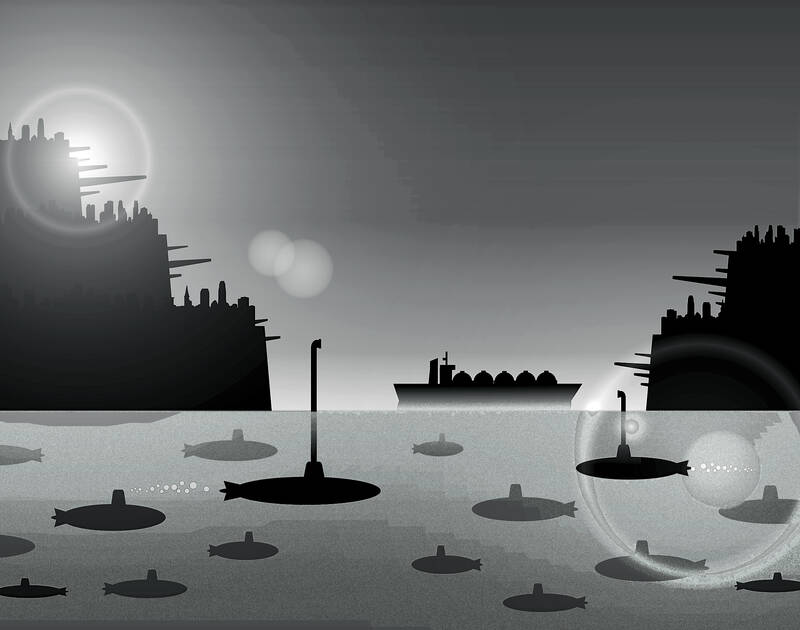
Illustration: Yusha
The conflict in the Middle East is showing how risky that is. Without setting foot on Taiwan’s shores, China could enforce a blockade similar to the one Tehran has been operating in Hormuz. In a matter of weeks, that could black out power on the self-ruled nation.
After years of expansion, Beijing’s fleet is now large enough to cut off trade in raw materials, Taiwan’s latest four-yearly defense review concluded last year.
“PLA [Chinese People’s Liberation Army] forces would mine the approaches and the ports themselves, damage port facilities and the routes for onward movement of material, and sink or scuttle vessels in shipping channels,” Lonnie Henley, a former US intelligence officer focused on Asian security, wrote in a 2023 study of such a fight.
US vessels might have to clear mines under fire and escort slow-moving cargo ships to and from Taiwan’s ports, he added.
“They must do this not once, but repeatedly, many times per week, for as long as the conflict continues,” Henley said.
It is a terrifying scenario, and one that Taiwan’s dependence on imported fossil fuels makes worse. Domestic stockpiles are critically inadequate, with LNG inventories only sufficient to cover 11 days of demand, coal running out after about 40 days and oil buffers lasting 90 days. Once they are exhausted, capitulation would surely follow.
Politicians have failed to grasp the urgency of the situation. Nuclear plants provided more than half of Taiwan’s electricity in the mid-1980s, and only require refueling once every two years. However, opposition to atomic power is deep in the DNA of the ruling Democratic Progressive Party, and the sole remaining reactor was shut down in May last year. Monopoly utility Taiwan Power Co (台電) applied to restart the facility last month, but do not expect a renaissance any time soon.
The opposition Chinese Nationalist Party (KMT) has similarly obstructed wind and solar energy, which do not need imported fuel. Rural interests that form a key plank of the KMT’s power base have worked hard to block utility-scale renewables on farmland and at sea, stymieing cheap, clean power.
It is commonly argued that the densely populated nation simply does not have the space for such installations. That is not right, though. The Netherlands, which is about the same size, generates twice as much power from wind and solar. About 54,000 hectares, representing about 10 percent of Taiwan’s farmland, is given over to agritourism. About the same area is left permanently fallow, because it cannot generate an economic return. Together, that is more than 20 times the 4,684 hectares used by Taiwan’s solar farms.
A further 575,000 hectares consists of forest plantations, which fail in economic and self-sufficiency terms: More than 99 percent of Taiwan’s timber is imported. Forests as a whole cover about 60 percent of the nation, about 2.1 million hectares.
It is unquestionably the case that building secure energy for Taiwan is politically difficult, but that is an explanation of failure, not an excuse for it. If Taiwan had kept its four largely completed nuclear plants in operation and added four more (as South Korea has done since 2012), then atomic power could be generating one-third of its electricity. If it had not let politics and protectionism stymie its offshore wind sector for years, and covered 50,000 hectares of disused farmland and plantations with solar, renewables could be providing another half. With less than 20 percent of its electricity dependent on imports, it would be truly resilient in the event of attack.
Since ancient times, small, rich polities holding out against aggressive rival powers have done everything they could to make themselves self-sufficient. Think the water tanks and granaries of Carthage and Constantinople, or the Chinese cities of Xiangyang and Fancheng, which held out for five years against Kublai Khan’s Mongol armies.
Taiwan’s failure to do the same has left it exposed. Let us hope the current crisis provides the spur to fix this vulnerability, before it is too late.
David Fickling is a Bloomberg Opinion columnist covering climate change and energy. Previously, he worked for Bloomberg News, the Wall Street Journal and the Financial Times. This column reflects the personal views of the author and does not necessarily reflect the opinion of the editorial board or Bloomberg LP and its owners.
Taiwan’s higher education system is facing an existential crisis. As the demographic drop-off continues to empty classrooms, universities across the island are locked in a desperate battle for survival, international student recruitment and crucial Ministry of Education funding. To win this battle, institutions have turned to what seems like an objective measure of quality: global university rankings. Unfortunately, this chase is a costly illusion, and taxpayers are footing the bill. In the past few years, the goalposts have shifted from pure research output to “sustainability” and “societal impact,” largely driven by commercial metrics such as the UK-based Times Higher Education (THE) Impact
History might remember 2026, not 2022, as the year artificial intelligence (AI) truly changed everything. ChatGPT’s launch was a product moment. What is happening now is an anthropological moment: AI is no longer merely answering questions. It is now taking initiative and learning from others to get things done, behaving less like software and more like a colleague. The economic consequence is the rise of the one-person company — a structure anticipated in the 2024 book The Choices Amid Great Changes, which I coauthored. The real target of AI is not labor. It is hierarchy. When AI sharply reduces the cost
I wrote this before US President Donald Trump embarked on his uneventful state visit to China on Thursday. So, I shall confine my observations to the joint US-Philippine military exercise of April 20 through May 8, known collectively as “Balikatan 2026.” This year’s Balikatan was notable for its “firsts.” First, it was conducted primarily with Taiwan in mind, not the Philippines or even the South China Sea. It also showed that in the Pacific, America’s alliance network is still robust. Allies are enthusiastic about America’s renewed leadership in the region. Nine decades ago, in 1936, America had neither military strength
The Presidential Office on Saturday reiterated that Taiwan is a sovereign, independent nation after US President Donald Trump said that Taiwan should not “go independent.” “We’re not looking to have somebody say: ‘Let’s go independence because the United States is backing us,’” Trump said in an interview with Fox News aired on Friday. President William Lai (賴清德) on Monday said that the Republic of China (ROC) — Taiwan’s official name — and the People’s Republic of China (PRC) are not subordinate to each other. Speaking at an event marking the 40th anniversary of the establishment of the Democratic Progressive Party (DPP), Lai said


 RSS
RSS