


Beijing cannot shout about it, but the US and Israeli attacks on Iran stand to benefit Chinese President Xi Jinping (習近平) — by helping fend off the specter of deflation. The conflict might do some of the Chinese central bank’s work for it. Once a fairly uncontroversial prediction, interest rate cuts look less of a sure thing.
Unlike most economies, China did not see the sharp spurt in inflation that followed reopening from the COVID-19 pandemic. Nor did the People’s Bank of China (PBOC) need to boost borrowing costs like the US Federal Reserve or European Central Bank; it worried more that demand was languishing. However, the spike in energy costs that followed the assault on Iran, and its retaliation, might give consumer prices the nudge they need to propel them from the danger zone. The PBOC could be more comfortable biding its time.
China, as the world’s biggest buyer of foreign oil and gas, is particularly exposed to higher prices. While the second-largest economy has made strides toward energy independence, a major chunk of its crude imports transited the Strait of Hormuz before traffic through the narrow waterway slowed to a crawl after the war began on Feb. 28.
The PBOC lowered its key rate just once last year, contrary to the large easing tipped by many economists. Calls for further reductions this year have sensibly also been wound back. Consumer prices gained the most in more than three years in February, and would probably get a further assist from the jump in oil prices. The long stretch of declines in producer prices might also soon be over.
Markets are signaling that something has changed for the better. In its daily operations, the PBOC actually drained money from the financial system over the course of last month. That is an important shift; authorities spent the past few years trying to ensure there was sufficient liquidity rather than worrying about too much. The bond market is also indicating something is afoot: The yield spread between China’s five-year and 30-year notes, a gauge of inflation expectations and supply pressures, reached its widest in about four years. Interest rate swaps signal waning investor bets on the PBOC paring borrowing costs.
This moves China closer to global norms. While a hike by the PBOC is a long way off, the case for a cut is nowhere near as clear as it looked. The Fed, which began the year in a mood to ease, is now suggesting it is in no rush. Kevin Warsh, tapped by the White House to succeed Fed Chair Jerome Powell, would strain to persuade the Federal Open Market Committee to reduce rates right away. In Europe, officials are adamant they would not allow inflation to escape as it did after the COVID-19 pandemic and Russia’s invasion of Ukraine. Australia has hiked, and tightening is likely in Singapore and Japan, Bloomberg Economics said.
So what does “good” inflation look like in China? There is little chance that it would approach even half the post-COVID-19 pandemic high of 9.1 percent, notched in mid-2022. As optimistic as economists are that the bottom has been reached, the projections are still modest. Bank of America, which scrapped its forecast for two cuts by the PBOC, upgraded its estimates for consumer inflation to 0.7 percent this year from 0.1 percent, and anticipates producer prices to edge 0.3 percent higher. That might not sound like much, but measured against a prior call for a retreat of 0.7 percent, it is noteworthy (unlike many of its counterparts, the PBOC does not have a formal inflation target).
The improved environment is not happening in a vacuum, nor could it all be attributed to Iran. Beijing has tried to discourage fierce discounting by firms, part of its so-called “anti-involution” campaign. Earnings by industrial companies showed modest gains last year after years of declines, and in January and February, profits climbed 15 percent from a year earlier. The property market is showing some signs of stabilization after a debilitating period of weakness. The conflict with Tehran has come along at a very opportune time.
The tendency has been to focus on the negatives in the past few years, just as it was considered impolite to talk about what might go wrong during China’s long boom. There are challenges: The trade war has eroded exports to the US and a declining birthrate is likely to challenge fiscal policy. And, if the disruption from the Iran conflagration tips the world into recession, China would also suffer. It has benefited enormously from freedom of movement on the high seas, and exports to the Middle East have performed strongly.
Let us acknowledge for now that the shifting global inflation landscape has not passed China by. It might even let the PBOC out of a tricky spot. If they do surprise us by easing, any reduction would be more of choice than dire necessity.
Daniel Moss is a Bloomberg Opinion columnist covering Asian economies. Previously, he was executive editor for economics at Bloomberg News. This column reflects the personal views of the author and does not necessarily reflect the opinion of the editorial board or Bloomberg LP and its owners.

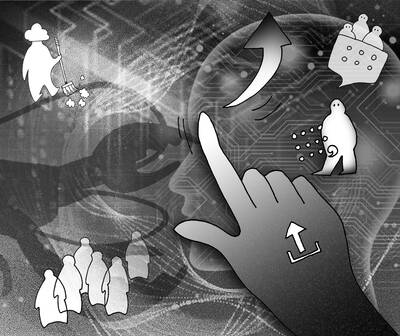
Weeks into the craze, nobody quite knows what to make of the OpenClaw mania sweeping China, marked by viral photos of retirees lining up for installation events and users gathering in red claw hats. The queues and cosplay inspired by the “raising a lobster” trend make for irresistible China clickbait. However, the West is fixating on the least important part of the story. As a consumer craze, OpenClaw — the AI agent designed to do tasks on a user’s behalf — would likely burn out. Without some developer background, it is too glitchy and technically awkward for true mainstream adoption,
On Monday, the day before Chinese Nationalist Party (KMT) Chairwoman Cheng Li-wun (鄭麗文) departed on her visit to China, the party released a promotional video titled “Only with peace can we ‘lie flat’” to highlight its desire to have peace across the Taiwan Strait. However, its use of the expression “lie flat” (tang ping, 躺平) drew sarcastic comments, with critics saying it sounded as if the party was “bowing down” to the Chinese Communist Party (CCP). Amid the controversy over the opposition parties blocking proposed defense budgets, Cheng departed for China after receiving an invitation from the CCP, with a meeting with
Chinese Nationalist Party (KMT) Chairwoman Cheng Li-wun (鄭麗文) is leading a delegation to China through Sunday. She is expected to meet with Chinese President Xi Jinping (習近平) in Beijing tomorrow. That date coincides with the anniversary of the signing of the Taiwan Relations Act (TRA), which marked a cornerstone of Taiwan-US relations. Staging their meeting on this date makes it clear that the Chinese Communist Party (CCP) intends to challenge the US and demonstrate its “authority” over Taiwan. Since the US severed official diplomatic relations with Taiwan in 1979, it has relied on the TRA as a legal basis for all
A delegation of Chinese Nationalist Party (KMT) officials led by Chairwoman Cheng Li-wun (鄭麗文) is to travel to China tomorrow for a six-day visit to Jiangsu, Shanghai and Beijing, which might end with a meeting between Cheng and Chinese President Xi Jinping (習近平). The trip was announced by Xinhua news agency on Monday last week, which cited China’s Taiwan Affairs Office (TAO) Director Song Tao (宋濤) as saying that Cheng has repeatedly expressed willingness to visit China, and that the Chinese Communist Party (CCP) Central Committee and Xi have extended an invitation. Although some people have been speculating about a potential Xi-Cheng


 RSS
RSS