


Three words uttered on Monday from Mission Control to Artemis II commander Reid Wiseman perfectly capture the groundswell of emotion many of us have experienced over the past week as a team of astronauts flew beyond the previous reaches of human space travel: “Amaze. Amaze. Amaze.”
That line, borrowed from Rocky, the hero of the science fiction blockbuster Project Hail Mary, came as Wiseman took in, for the first time, the full, majestic scale of the moon. Our nearest neighbor and nightly companion loomed large before them, appearing several times bigger than home, which was a mere crescent off in the distance.
Less than an hour earlier, at roughly 1:56pm Eastern time, Wiseman and his three fellow crew members had broken the previous record for human space travel. They would not touch down on the moon — this is more of a dress rehearsal for future landings. Yet, just boomeranging around it is a monumental feat.
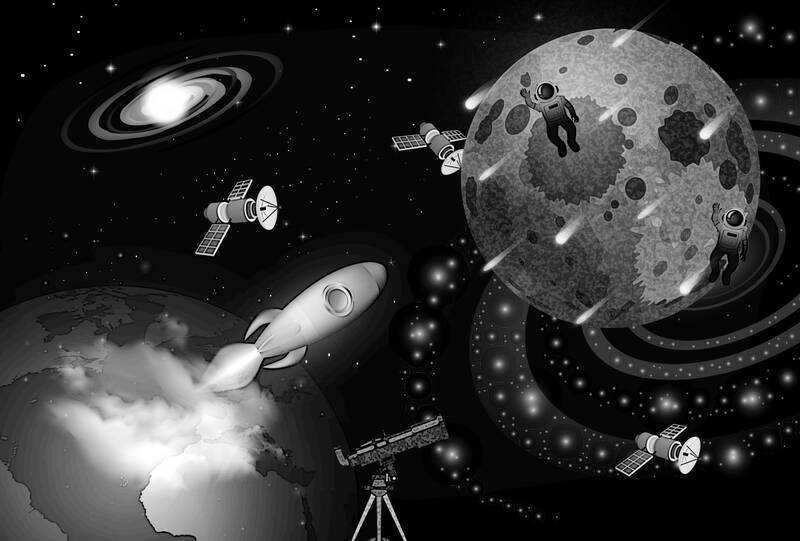
Illustration: Louise Ting
Remarkably, we mere mortals get to watch it all unfold in real time. We can tune into the NASA feed and hear the astronauts’ first impressions of a meteor hitting the surface of the moon, see the photos they share on Instagram — from space — and take in their near-giddy descriptions of a solar eclipse from the far side of the moon.
“No matter how long we look at this, our brains are not processing this image in front of us,” Wiseman said of their view. “It is absolutely spectacular, surreal, there’s no adjectives. We’re going to need to invent some new ones.”
That was one of several moments over the past few days when I was overcome by the profundity of the mission. It welled up inside me as I watched the astronauts get buckled into their seats in the 8.5m3 capsule that is their home for the 10-day trip. It overflowed as the countdown to liftoff began — and again when enough time had passed to feel comfortable that everything was unfolding as planned (minus a bathroom snafu). And it resurged several days in as the astronauts circled the moon and spent hours describing things no human has ever witnessed.
Is science not spectacular?
Artemis II is a desperately needed reminder of the magic that could happen when humans come together to realize a lofty goal. The examples of what scientists have accomplished in just the past quarter century astound: They have planted rovers on Mars and detected the subatomic particle long considered fundamental to understanding the universe; leapt from completing the first map of our genome to discovering tools that could fix minute errors in it; invented vaccines responsible for eliminating cervical cancer in parts of the world and ending a global pandemic. And now, of course, we have sent four humans on a 406,711km trip to the far side of the moon.
All those successes have something in common: They are the product of decades of curiosity, ingenuity and perseverance by teams of researchers, made possible by a government that believes in taking big scientific swings.
Yet, the ability to do this kind of work has never felt so tenuous — in the US, at least. Artemis II is making its journey at a time when science feels under siege. Last year, the administration of US President Donald Trump made painful cuts across scientific agencies, including NASA. Researchers have been demoralized by doubt over the value of their work — much of that coming from government leaders.
That perplexing desire to hobble the US scientific enterprise has not abated. Just two days after Artemis set off toward the moon, Trump released his proposed budget for next year, a wish list that once again included big cuts to science. Some, such as the National Science Foundation, would see their budget cut by half or more. For its part, NASA could be looking at a US$5.6 billion drop in funding next year.
The US Congress keeps pushing back against those cuts, yet the Trump administration keeps finding ways to slow down the flow of money appropriated for science. It is a perplexing tug-of-war that would only slow down scientific progress — and could mean the US is not at the center of the next awe-inspiring event.
On Monday, after Mission Control officially informed the Artemis crew of their record-breaking feat, Wiseman said that their achievement was built on the backs of generations of scientists and explorers.
He ended with a crucial message: “We most importantly choose this moment to challenge this generation and the next to make sure this record is not long-lived.”
Indeed, scientists — and aspiring scientists — must keep pushing the boundaries, whether that is by expanding our knowledge of the universe or finding a cure for a now incurable disease. And Americans must insist that their government keep nurturing that spirit of ingenuity and innovation.
Lisa Jarvis is a Bloomberg Opinion columnist covering biotech, healthcare and the pharmaceutical industry. Previously, she was executive editor of Chemical & Engineering News. This column reflects the personal views of the author and does not necessarily reflect the opinion of the editorial board or Bloomberg LP and its owners.
What began on Feb. 28 as a military campaign against Iran quickly became the largest energy-supply disruption in modern times. Unlike the oil crises of the 1970s, which stemmed from producer-led embargoes, US President Donald Trump is the first leader in modern history to trigger a cascading global energy crisis through direct military action. In the process, Trump has also laid bare Taiwan’s strategic and economic fragilities, offering Beijing a real-time tutorial in how to exploit them. Repairing the damage to Persian Gulf oil and gas infrastructure could take years, suggesting that elevated energy prices are likely to persist. But the most
Taiwan should reject two flawed answers to the Eswatini controversy: that diplomatic allies no longer matter, or that they must be preserved at any cost. The sustainable answer is to maintain formal diplomatic relations while redesigning development relationships around transparency, local ownership and democratic accountability. President William Lai’s (賴清德) canceled trip to Eswatini has elicited two predictable reactions in Taiwan. One camp has argued that the episode proves Taiwan must double down on support for every remaining diplomatic ally, because Beijing is tightening the screws, and formal recognition is too scarce to risk. The other says the opposite: If maintaining
Chinese Nationalist Party (KMT) Chairwoman Cheng Li-wun (鄭麗文), during an interview for the podcast Lanshuan Time (蘭萱時間) released on Monday, said that a US professor had said that she deserved to be nominated for the Nobel Peace Prize following her meeting earlier this month with Chinese President Xi Jinping (習近平). Cheng’s “journey of peace” has garnered attention from overseas and from within Taiwan. The latest My Formosa poll, conducted last week after the Cheng-Xi meeting, shows that Cheng’s approval rating is 31.5 percent, up 7.6 percentage points compared with the month before. The same poll showed that 44.5 percent of respondents
India’s semiconductor strategy is undergoing a quiet, but significant, recalibration. With the rollout of India Semiconductor Mission (ISM) 2.0, New Delhi is signaling a shift away from ambition-driven leaps toward a more grounded, capability-led approach rooted in industrial realities and institutional learning. Rather than attempting to enter the most advanced nodes immediately, India has chosen to prioritize mature technologies in the 28-nanometer to 65-nanometer range. That would not be a retreat, but a strategic alignment with domestic capabilities, market demand and global supply chain gaps. The shift carries the imprimatur of Indian Prime Minister Narendra Modi, indicating that the recalibration is


 RSS
RSS