


Taiwan has witnessed a stark and highly controversial shift. On one hand, Ocean Affairs Council (OAC) Minister Kuan Bi-ling (管碧玲) on Monday publicly revealed the locations of eight Chinese naval ships and coast guard vessels operating around Taiwan, making it clear to the public that the Taiwan Strait is far from calm and peaceful.
On the other hand, the Chinese Nationalist Party (KMT) posted an artificial intelligence-generated promotional video touting the idea that “only with peace” could Taiwanese “lie flat” (tang ping, 躺平). The video uses casual language — suggestive of avoidance — to downplay the severity of Taiwan’s situation.
The disparity between the OAC’s actions and the KMT’s rhetoric is not merely a misperception. Rather, it shows how the KMT is deliberately distorting national security realities. While agencies on the front lines are exposing very real threats and urging the public to remain vigilant even in times of apparent stability, some politicians are using misleading rhetoric to package the crisis. That is deception.
The Taiwanese army has long maintained a clear and consistent stance regarding cross-strait issues — prepare for war without seeking it and respond without provoking. The military is not unaware of the Chinese People’s Liberation Army’s (PLA) activities. It has exercised a high degree of restraint in balancing the disclosure of information with social stability.
The absence of frequent public reports detailing Chinese naval encirclements does not mean the threat is nonexistent, but reflects risk management guided by professional judgement. In reality, from the normalization of PLA air and naval harassment around Taiwan to the “gray zone” operations of China Coast Guard vessels crossing established boundaries, the Chinese Communist Party (CCP) has already turned the waters and airspace around Taiwan into a testing ground for pressure tactics.
The reason the military has chosen a steady and measured response is to preserve the normal functioning of society rather than allowing panic to dominate public sentiment. It is precisely for this reason that, when the government begins to more explicitly disclose such threats, it should be understood as an escalation of warning signals — not the manufacture of a crisis.
However, when the KMT reduces “peace” to the notion of “lying flat,” it is stripping national security issues of reality and strategic depth. This argument implies a dangerous premise — that by reducing confrontation and signaling goodwill, the CCP would reciprocate by scaling back its actions.
However, reality suggests the opposite. The CCP has not once ruled out the use of force to resolve the Taiwan issue. Instead, it has continuously employed a multilayered approach — a combination of military coercion, legal warfare, disinformation campaigns and economic penetration — to erode Taiwan’s will to resist.
The idea that Taiwanese can “lie flat in exchange for peace” effectively amounts to surrender — treating one’s own defensive resolve as a bargaining chip. This would not only do nothing to reduce risk, but could also lead the opponent to misjudge the determination of Taiwanese society, thereby intensifying pressure even further.
Even more absurd is that some politicians seem to believe that, through personal or party-to-party exchanges, they can somehow persuade Beijing to alter its Taiwan strategy — or even secure a public commitment from its top leadership to renounce the use of military force.
Such claims not only lack basic international political judgement, but also ignore the very nature of the CCP’s system. China’s Taiwan policy has never been something that individual politicians can meaningfully influence: It is a core issue deeply rooted in the regime’s legitimacy and broader national narrative. Thus, any expectation that “good relations” or a “softer stance” could yield strategic concessions reflects a fundamental misunderstanding of how authoritarian regimes operate — and, even further, a self-serving political illusion.
What Taiwan truly needs is peace grounded in strength and sober awareness — not a temporary calm built atop false expectations and self-imposed complacency. The Taiwanese army maintains year-round readiness and intensifies training precisely to prevent the outbreak of war, not to pave the way for conflict. Those who genuinely hope for peace are the soldiers standing on the front line to defend the nation, not politicians hiding in the rear and relying on slogans to project the illusion of security.
As the threat has never disappeared — and is, rather, steadily intensifying — “lying flat” is not a strategy for avoiding war: It is the first step to abandoning self-defense altogether. Taiwanese must clearly distinguish between what constitutes responsible peace and what is nothing more than sugar-coated surrender.
Elliot Yao is a reviewer.
Translated by Kyra Gustavsen

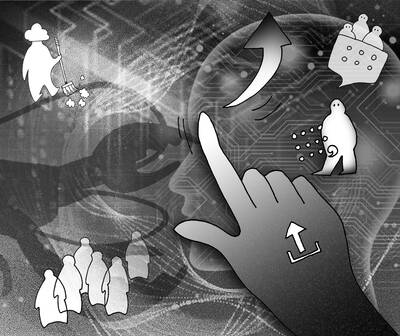
Weeks into the craze, nobody quite knows what to make of the OpenClaw mania sweeping China, marked by viral photos of retirees lining up for installation events and users gathering in red claw hats. The queues and cosplay inspired by the “raising a lobster” trend make for irresistible China clickbait. However, the West is fixating on the least important part of the story. As a consumer craze, OpenClaw — the AI agent designed to do tasks on a user’s behalf — would likely burn out. Without some developer background, it is too glitchy and technically awkward for true mainstream adoption,
A delegation of Chinese Nationalist Party (KMT) officials led by Chairwoman Cheng Li-wun (鄭麗文) is to travel to China tomorrow for a six-day visit to Jiangsu, Shanghai and Beijing, which might end with a meeting between Cheng and Chinese President Xi Jinping (習近平). The trip was announced by Xinhua news agency on Monday last week, which cited China’s Taiwan Affairs Office (TAO) Director Song Tao (宋濤) as saying that Cheng has repeatedly expressed willingness to visit China, and that the Chinese Communist Party (CCP) Central Committee and Xi have extended an invitation. Although some people have been speculating about a potential Xi-Cheng
Chinese Nationalist Party (KMT) Chairwoman Cheng Li-wun (鄭麗文) is leading a delegation to China through Sunday. She is expected to meet with Chinese President Xi Jinping (習近平) in Beijing tomorrow. That date coincides with the anniversary of the signing of the Taiwan Relations Act (TRA), which marked a cornerstone of Taiwan-US relations. Staging their meeting on this date makes it clear that the Chinese Communist Party (CCP) intends to challenge the US and demonstrate its “authority” over Taiwan. Since the US severed official diplomatic relations with Taiwan in 1979, it has relied on the TRA as a legal basis for all
The ongoing Iran conflict is putting Taiwan’s energy fragility on full display — the island of 23 million people, home to the world’s most advanced semiconductor manufacturing, is highly dependent on imported oil and gas, especially that from the Middle East. In 2025, 69.6 percent of Taiwan’s crude oil and 38.7 percent of liquified natural gas were sourced from the Middle East. In the same year, 62 percent of crude oil and 34 percent of LNG to Taiwan went through the Strait of Hormuz. Taiwan’s state-run oil company CPC Corp’s benchmark crude oil price (70 percent Dubai, 30 percent Brent)


 RSS
RSS