


The political order of former president Lee Teng-hui (李登輝) first took shape in 1988. Then-vice president Lee succeeded former president Chiang Ching-kuo (蔣經國) after he passed, and served out the remainder of his term in office.
In 1990, Lee was elected president by the National Assembly, and in 1996, he won Taiwan’s first direct presidential election. Those two, six and four-year terms were an era-defining 12-year presidential tenure. Throughout those years, Lee served as helmsman for Taiwan’s transition from martial law and authoritarianism to democracy. This period came to be known as the “quiet revolution,” leaving a legacy containing light and shadow.
This year marks the 30th anniversary of that first direct presidential election. Lee’s advancement of democratization was originally intended to transform the Chinese Nationalist Party (KMT) into a Taiwanese party and lay the foundations for the beginning of a new chapter of national history. However, he was instead forced out of the KMT after it lost power, led by his designated successor, former vice-president Lien Chan (連戰).
Similarly, former president Ma Ying-jeou (馬英九), after Lee had publicly taken his hand and declared him to be among the “new Taiwanese” in the lead-up to his election, rushed to embrace China after his victory in 2008.
As a somewhat unexpected successor to Chiang, Lee is vividly portrayed in Japanese writer Fuyuko Kamisaka’s The President in the Tiger’s Mouth. His life is also contrasted with that of late pioneer democracy activist Peng Ming-min (彭明敏) in my own historical novel, Two Paths of a Dream, which saw Lee as more of a pragmatist choosing compromise for survival, while Peng opted for principle at the cost of personal sacrifice.
Peng, who had initially been valued and trusted in the era of Chiang Kai-shek (蔣介石), in 1964 released his manifesto, A Declaration of Formosan Self-salvation. In it, he called on Taiwanese to establish their own state and abandon the unrealistic and unnecessary national policy of “retaking the mainland,” and was thus imprisoned and exiled.
In contrast, whether by luck or by design, Lee emerged as a trusted political figure under Chiang Ching-kuo and went on to build a significant political legacy. The two would later come head-to-head in the first direct presidential election, representing the Democratic Progressive Party (DPP) and the KMT respectively. In 2001, they held a landmark dialogue at the Taipei International Convention Center, titled “A Centennial Conversation Between Two Political Prophets: Their Lives Experienced in Two Nations.”
In the 1996 election, Lee won about 54 percent of the vote, while Peng received nearly 21 percent. The KMT breakaway tickets of former vice premier Lin Yang-kang (林洋港) and former premier Hau Pei-tsun (郝柏村) garnered about 15 percent, while former Control Yuan president Chen Li-an (陳履安) and former Control Yuan member Wang Ching-feng (王清峰) received close to 10 percent. That meant about 75 percent of voters leaned toward a pro-Taiwan platform, versus 25 percent who were more China-oriented.
While some KMT voters split off in favor of Lin or Chen as independents, Lee’s support was otherwise bolstered by pro-Taiwan voters, including those aligned with the DPP. This was a direct reflection of national identity alignment in Taiwan.
Lee’s new political order began to take shape following Chiang’s death, although his succession to power was by no means smooth sailing.
It began fraught with internal party rivalries, political intrigue and factional tensions, which he navigated and leveraged. With former Taiwan provincial governor James Soong’s (宋楚瑜) strategic operations and assistance from former National Security Bureau chief Sung Hsin-lien (宋心濂), Lee managed to successfully consolidate his leadership. He further cemented his position by exploiting tensions between Hau and then-KMT premier Lee Huan (李煥).
In responding to the Wild Lily student movement of 1990, Lee Teng-hui advanced direct presidential elections and the full re-election of the legislature, laying the groundwork for democratization. Unfortunately, his efforts to “Taiwanize” the KMT ultimately fell short. The split between Soong and Lien in their in presidential bids in 2000 led to the KMT losing power, similar to the 1992 Taipei mayoral race, when media personality and politician Jaw Shaw-kong (趙少康) and presidentially-appointed incumbent Huang Ta-chou (黃大洲) split the vote. These splits paved the way for electoral victories for the DPP’s Chen Shui-bian (陳水扁).
Lee Teng-hui once invoked the idea of a collective shared destiny to appeal to migrants who came from China with the KMT after the war. He also sought to win over local factions within the KMT and worked in tandem with the DPP to advance democratic reforms.
However, after that quiet revolution, democratized Taiwan faced a KMT that aligned itself with the Chinese Communist Party in ways contrary to the nation’s interests. Local factions, driven primarily by power and private interests, lacked a sense of national identity.
Added to this are the political ambitions of opportunistic figures such as former Taiwan People’s Party chairman Ko Wen-je (柯文哲) — who once sought Lee Teng-hui’s endorsement for his bid as Taipei mayor and was described by the former president as being a bit odd — as well as the havoc wrecked by corruption scandals. These forces have all contributed to a shadow over Taiwan that persists to this day.
Twelve years under Lee Teng-hui initiated, but did not fully consolidate, the “Taiwanization” of the Republic of China. Having faced a lengthy martial law period and the constraints that came with the party-state military intelligence apparatus, including those on education and media, Taiwan’s development of a modern civic national consciousness was restricted and a shared national vision was not quite formed.
Taiwanese who dream of a nation and politicians who aspire to build must recognize this reality and work toward creating the conditions for its development. Taiwan belongs to its people, regardless of when they arrived, and they should be jointly protected.
The colonized and colonialists-in-exile should build on the foundations of the quiet revolution to seek the normalization of Taiwan as a nation. Only then could the light take shape and the shadows of history fade at last.
Lee Min-yung is a poet.
Translated by Gilda Knox Streader
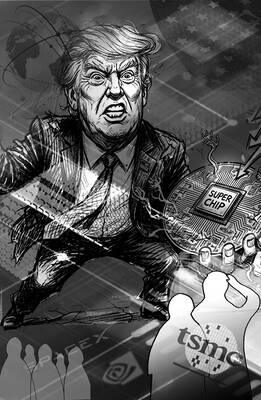
The White House’s decision to take a 9.9 percent stake in Intel Corp is looking like very shrewd business indeed. Since the government bought in at US$20.47 a share last August, the US chipmaker’s surging stock price has delivered the US a US$43 billion return. One of the reasons the investment has so far proved so sound is that the White House has made sure of it. According to The Wall Street Journal, Howard personally pushed deals on Intel’s behalf with some of the most lucrative clients imaginable. They include Nvidia Corp, the company at the heart of the AI
A single photograph can cut through a lot of noise, but it can also be used to misrepresent the truth. At the very least, it can concentrate the mind on something that requires further investigation. On Monday last week, Ma Ying-jeou Foundation CEO Tai Hsia-ling (戴遐齡) and former National Security Council secretary-general King Pu-tsung (金溥聰) held a news conference in which they showed a photograph of former foundation CEO Hsiao Hsu-tsen (蕭旭岑), now Chinese Nationalist Party (KMT) deputy chairman. In the image Hsiao is seated next to Xiamen Taiwan Businessmen Association chairman Han Ying-huan (韓螢煥). The two men were holding
I first met Professor Ray Jiing (井迎瑞) as a film and documentary student at Shih Hsin University’s (SHU) Department of Radio Television and Film in 1988. The following year, he went on to become the director of the Chinese Taipei Film Archive — forerunner of the Taiwan Film and Audiovisual Institute (TFAI). Over his eight-year tenure, Jiing rescued and restored over 200 classic Taiwanese films. In 1997, he established the Graduate Institute of Studies in Documentary and Film Archiving at Tainan National University of the Arts (TNNUA), and I joined the program in his third cohort of students. Beyond a
A recent report concerning a student who is suing his teacher posed the question in its headline: Does failing a student in two subjects constitute bullying? The college student in Chiayi County apparently sought NT$2 million (US$63,603) in state compensation, but a court dismissed the case. The first reaction of many might have been to ask: What has happened to students nowadays? Some say that teachers have lost their authority, while others say students are overindulged. Some even start reminiscing over the days when “whatever the teacher says goes.” However, the real issue might be overlooked if emotional reactions like that are the


 RSS
RSS