


With the world reverberating to the risks of an oil-price shock, Latin America is actually poised to advance its geopolitical position. If it wants to capitalize on this moment, it needs to sharpen its collective bargaining power, set aside its ideological divisions and bolster domestic policy, particularly on crime and insecurity.
A report by Goldman Sachs Group Inc said that Latin America is one of the few parts of the world where persistently higher oil prices could translate into stronger economic growth. The impact would not be uniform: Large net exporters such as Brazil, Guyana or Colombia stand to benefit far more than major importers of fuel and natural gas like Mexico or Chile.
Food and gasoline price pressures could still trigger social unrest and force governments to expand subsidies amid fiscal constraints. And to be sure, a world of heightened financial volatility is rarely kind to emerging markets.
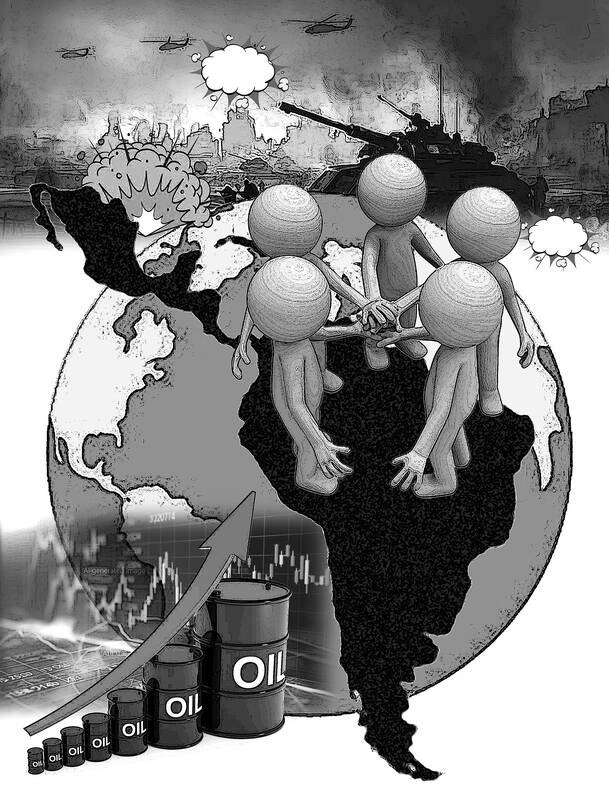
Illustration: Constance Chou
Still, the conflict arrives at a time when Latin America’s macroeconomic foundations are far more resilient than in past decades. Inflation has largely returned to low single digits and is expected to be only marginally affected by increasing crude prices. Labor markets remain solid, and central banks hold sizable international reserves amid strong investor confidence and prudent monetary policy.
The depreciation that Latin American currencies have experienced in recent days as tensions have escalated merely reverses a small portion of the substantial gains recorded over the last year. Even Argentina, historically the weakest link during bouts of global volatility but now a net energy exporter, stands to receive a hard-currency windfall from the oil spike and higher agriculture prices. Its fiscal surplus also gives the government a financial cushion it lacked a few years ago.
More broadly, the dramatic images of missiles targeting several Gulf countries, a reminder of the conflict in Europe after Russia’s invasion of Ukraine in 2022, highlight Latin America’s enduring value as a region of relative peace, strategic geography and abundant resources. This continent of roughly 670 million people, already the focus of a great-power rivalry, is becoming even more important for trade partners seeking key commodities, multinationals looking to build shorter and more reliable supply chains to the US and institutional investors searching for the next generation of large projects to finance.
Think of it in real-estate terms: If the world were a conflict-ridden megalopolis, the relatively calm and disconnected Latin American neighborhood would suddenly appreciate in value. And that is even before considering more extreme scenarios (in the event of a World War III, you would likely find me safe in the solitude of Mendoza.) Proof of that benign isolation is the minimal logistics and airspace disruption the region has experienced so far during the Iran conflict.
That said, Latin American policymakers and strategists should weigh their region’s advantages carefully. The region has missed seemingly unmissable opportunities before, from the wave of post-Soviet economic globalization to the commodity super-cycle of the early 2000s.
The key to avoiding another lost moment requires thinking about the value of Latin America as a whole. Instead of being consumed by a polarizing left-right divide, governments should work pragmatically to raise the value of their shared neighborhood, boosting intra-regional trade, integrating energy markets, building common infrastructure and improving democratic institutions.
Maintaining close ties with the US is important: There are many shared threats and opportunities, including cooperation against organized crime and narcotrafficking, perhaps the most urgent concern among Latin American voters today. US-driven political shifts in Venezuela and the possibility of a transition in Cuba could also open space for more practical leaderships.
Yet regional leaders should not be naive or overly credulous: Washington would understandably pursue its own interests in what it considers its sphere of influence, and those interests do not necessarily align with those of individual Latin American nations, particularly with a White House that flip-flops as quickly as this one.
The pompous “Shield of the Americas” summit hosted by US President Donald Trump at his golf club near Miami over the weekend was a clumsy attempt to divide the region between friends and foes. As tempting as ideological purity might be, any regional effort that excludes Brazil, Mexico and Colombia is bound to fail and ultimately weakens Latin America’s strategic hand.
The political shift to the right might indeed produce more investment-friendly policies —
Morgan Stanley described as a Latin American “spring.” However, full ideological alignment across more than 30 countries is a chimera. The real convergence should be around something simpler: enlarging the region’s economic pie through dialogue and cooperation.
Furthermore, the US confrontation with Iran might soon reduce the extraordinary attention that Washington has lavished on Latin America. And even as the US pushes to curb China’s influence, Trump is heading to Beijing this month with a long list of unfinished bilateral business. Latin American leaders should wake up and smell the realpolitik coffee: Interests, particularly among neighbors, should prevail over ideology.
Latin America’s current moment might have a short shelf life. Francisco de Santibanes, president of Buenos Aires-based international relations think tank CARI, warns that as US-China competition deepens, it would become harder for the region to balance economic and geopolitical interests. “Today we can implement this strategy and it’s working; my concern is the evolution of the US-China conflict in three or four years,” he said. “Beyond differences, there must be an agreement that Latin America remains a place of peace. And for that, diplomacy is key.”
In an increasingly fragmented and dangerous world, Latin America holds several winning cards. This time, it should play them wisely.
JP Spinetto is a Bloomberg Opinion columnist covering Latin American business, economic affairs and politics. He was previously Bloomberg News’ managing editor for economics and government in the region. This column reflects the personal views of the author and does not necessarily reflect the opinion of the editorial board or Bloomberg LP and its owners.
The conflict in the Middle East has been disrupting financial markets, raising concerns about rising inflationary pressures and global economic growth. One market that some investors are particularly worried about has not been heavily covered in the news: the private credit market. Even before the joint US-Israeli attacks on Iran on Feb. 28, global capital markets had faced growing structural pressure — the deteriorating funding conditions in the private credit market. The private credit market is where companies borrow funds directly from nonbank financial institutions such as asset management companies, insurance companies and private lending platforms. Its popularity has risen since
The Donald Trump administration’s approach to China broadly, and to cross-Strait relations in particular, remains a conundrum. The 2025 US National Security Strategy prioritized the defense of Taiwan in a way that surprised some observers of the Trump administration: “Deterring a conflict over Taiwan, ideally by preserving military overmatch, is a priority.” Two months later, Taiwan went entirely unmentioned in the US National Defense Strategy, as did military overmatch vis-a-vis China, giving renewed cause for concern. How to interpret these varying statements remains an open question. In both documents, the Indo-Pacific is listed as a second priority behind homeland defense and
In an op-ed published in Foreign Affairs on Tuesday, Chinese Nationalist Party (KMT) Chairwoman Cheng Li-wun (鄭麗文) said that Taiwan should not have to choose between aligning with Beijing or Washington, and advocated for cooperation with Beijing under the so-called “1992 consensus” as a form of “strategic ambiguity.” However, Cheng has either misunderstood the geopolitical reality and chosen appeasement, or is trying to fool an international audience with her doublespeak; nonetheless, it risks sending the wrong message to Taiwan’s democratic allies and partners. Cheng stressed that “Taiwan does not have to choose,” as while Beijing and Washington compete, Taiwan is strongest when
US Secretary of the Treasury Scott Bessent and Chinese Vice Premier He Lifeng (何立峰) are expected to meet this month in Paris to prepare for a meeting between US President Donald Trump and Chinese President Xi Jinping (習近平). According to media reports, the two sides would discuss issues such as the potential purchase of Boeing aircraft by China, increasing imports of US soybeans and the latest impacts of Trump’s reciprocal tariffs. However, recent US military action against Iran has added uncertainty to the Trump-Xi summit. Chinese Minister of Foreign Affairs Wang Yi (王毅) called the joint US-Israeli airstrikes and the


 RSS
RSS