


Critics of the attack on Iran by the US and Israel say that US President Donald Trump has no plan for what comes next. They are not wrong: When Trump boasts that he can resolve wars in a single day, he merely exposes the limits of his attention span. The real problem is not the shortness of Trump’s time horizon; it is the narrowness of his threat perception.
While Trump’s bombing campaign reflects no strategy in any traditional sense, it is based on a clear operating assumption: The Iranian regime poses a threat to US security, and destroying the regime eliminates that threat. It is the same basic belief that animated previous US wars of choice, from Iraq to Libya. The assumption was wrong then, and it is likely to prove catastrophically wrong now.
The US possesses an extraordinary capacity to destroy centralized state power from the air, but no comparable capacity to manage what follows. Because power vacuums cannot be targeted by precision munitions or mapped by satellite imagery, US strategic thinking systematically underestimates the danger they pose.

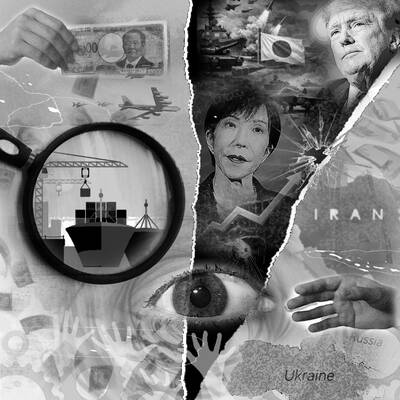
Illustration: Mountain People
That reflects a recurring cognitive bias in the US: Threats we cannot address militarily receive less weight than those we can. However, the gravest and most durable risks often emerge after centralized control collapses, when arsenals are dispersed, custodial chains fracture and accountability disappears.
The Iraq war should have made this clear. In 2003, the US destroyed the Iraqi state on the premise that former Iraqi president Saddam Hussein’s regime posed a direct and acute danger to US security. What followed the regime’s fall was not safety, but chaos. Hundreds of arms depots were looted within days. Black markets were flooded with small arms, rocket-propelled grenades (RPGs) and mortar rounds, which landed in the hands of actors who were far less predictable, visible, and deterrable than Saddam’s regime.
That included the Islamic State, which eventually rose from the rubble of Iraq’s dissolved institutions. When it overran Mosul in 2014, it captured large stocks of US-supplied weaponry from Iraqi army bases — a second generation of proliferation cascading from the original act of state destruction. The pattern was structural, not accidental.
Libya should have reinforced that lesson. After NATO in 2011 helped topple then-Libyan leader Muammar Qaddafi, state institutions swiftly collapsed, and 3,000 to 12,000 portable shoulder-launched surface-to-air missiles (MANPADS) capable of downing civilian airliners vanished, only to reappear in the arms markets of the Sahel region, the Sinai Peninsula, Gaza and beyond.
The episodes bear out what every systematic study of leadership decapitation in weakly institutionalized regimes has found: The aftermath is fragmentation, not stabilization. The same would be true of Iran, but what will be dispersed after the regime’s fall could be far more dangerous than RPGs or MANPADS.
Before the US-Israeli strikes in June last year, the Islamic republic possessed 441kg of uranium enriched to 60 percent purity, a short technical step from weapons grade. That is enough, by expert estimates, for about 10 nuclear devices. The International Atomic Energy Agency, whose inspectors have been effectively barred from Iran’s nuclear sites since the strikes, has said that it cannot account for the current size or whereabouts of Iran’s stockpile of enriched uranium. Some analysts think that it was entombed in collapsed underground facilities; others believe it was relocated to undisclosed sites before the bombings. Both assessments rest on fragmentary evidence — satellite imagery, signals intelligence and Iranian government statements, all of which are vulnerable to manipulation. Yet, they cast doubt on the Trump administration’s claim of “total obliteration.”
The strategic irony at the heart of the regime-destruction logic is that damaged facilities, scattered nuclear material, and demoralized or absent custodial personnel are precisely the conditions most conducive to diversion. In other words, far from ending the risk of proliferation, the US-Israeli strikes have compounded it.
Even if the probability of diversion remains low, it must be handled with the utmost seriousness. This is the cardinal principle of nuclear security: Fissile material that is not under secure state control must be evaluated on the basis of worst-case potential, not average likelihood. When terrorist networks gained access to MANPADS, it was a catastrophe. If they secure weapons-usable nuclear material, the logic of nuclear deterrence itself would be broken.
Deterrence requires a return address — even if the address is a hostile state. Even a hostile state has a capital, a leadership and a population it wishes to preserve. Remove them, and the architecture that has prevented nuclear use since 1945 begins to collapse. You cannot negotiate safeguards with a vacuum. You cannot sign an agreement with a fragmented territory. You cannot verify compliance by a state that no longer exists.
The state that currently maintains custodianship over Iran’s nuclear material — however imperfect or hostile — is the only entity with which an enforceable constraint could be achieved. Destroy it, and you make resolving the nuclear threat both more urgent and effectively impossible.
The Soviet precedent is instructive. When the USSR dissolved in 1991, the degradation of security systems left nuclear materials vulnerable. Following the lead of George Soros, who created a foundation to support Soviet scientists with the aim of preventing brain drain and mitigating the risk of nuclear proliferation, the US began to invest heavily in cooperative threat-reduction programs.
Iran’s situation is, in some respects, more precarious, as its nuclear infrastructure has long combined declared and clandestine elements. Physical material is not the only concern. Iran has trained a substantial cadre of nuclear scientists over the decades. In a state-collapse scenario, such specialists become free agents, available to anyone willing to pay. Meanwhile, lower-grade nuclear material could be repurposed into radiological dispersal devices (“dirty bombs”) capable of contaminating urban areas. In the absence of institutional custody, each enrichment site, research facility and reactor implies distinct risks.
The US sees regimes it can strike and concludes that striking them resolves the dangers they pose. However, eliminating a visible adversary does not neutralize the underlying threat; it merely transforms that threat into something elusive, opaque, decentralized, unaccountable and impossible to negotiate with or monitor. Until the US recognizes this — until it internalizes the lessons of Baghdad and Tripoli, and potentially of Tehran — it will continue to generate dangers that no missile can reach.
Stephen Holmes, professor of law at New York University School of Law and the Richard Holbrooke Fellow at the American Academy in Berlin, is the coauthor (with Ivan Krastev) of The Light that Failed: A Reckoning (Penguin Books, 2019).
Copyright: Project Syndicate
Minister of Labor Hung Sun-han (洪申翰) on April 9 said that the first group of Indian workers could arrive as early as this year as part of a memorandum of understanding (MOU) between the Taipei Economic and Cultural Center in India and the India Taipei Association. Signed in February 2024, the MOU stipulates that Taipei would decide the number of migrant workers and which industries would employ them, while New Delhi would manage recruitment and training. Employment would be governed by the laws of both countries. Months after its signing, the two sides agreed that 1,000 migrant workers from India would
On March 31, the South Korean Ministry of Foreign Affairs released declassified diplomatic records from 1995 that drew wide domestic media attention. One revelation stood out: North Korea had once raised the possibility of diplomatic relations with Taiwan. In a meeting with visiting Chinese officials in May 1995, as then-Chinese president Jiang Zemin (江澤民) prepared for a visit to South Korea, North Korean officials objected to Beijing’s growing ties with Seoul and raised Taiwan directly. According to the newly released records, North Korean officials asked why Pyongyang should refrain from developing relations with Taiwan while China and South Korea were expanding high-level
Japan’s imminent easing of arms export rules has sparked strong interest from Warsaw to Manila, Reuters reporting found, as US President Donald Trump wavers on security commitments to allies, and the wars in Iran and Ukraine strain US weapons supplies. Japanese Prime Minister Sanae Takaichi’s ruling party approved the changes this week as she tries to invigorate the pacifist country’s military industrial base. Her government would formally adopt the new rules as soon as this month, three Japanese government officials told Reuters. Despite largely isolating itself from global arms markets since World War II, Japan spends enough on its own
When 17,000 troops from the US, the Philippines, Australia, Japan, Canada, France and New Zealand spread across the Philippine archipelago for the Balikatan military exercise, running from tomorrow through May 8, the official language would be about interoperability, readiness and regional peace. However, the strategic subtext is becoming harder to ignore: The exercises are increasingly about the military geography around Taiwan. Balikatan has always carried political weight. This year, however, the exercise looks different in ways that matter not only to Manila and Washington, but also to Taipei. What began in 2023 as a shift toward a more serious deterrence posture


 RSS
RSS