


As we enter a new year, 2.13 million primary-school-aged children remain out of school in Afghanistan, while 2.2 million girls have been excluded from secondary education since the Taliban’s 2021 ban, part of a broader campaign to erase women from public life, but despite this egregious abuse of human rights, which UN Special Rapporteur on Human Rights in Afghanistan Richard Bennett has labeled “gender apartheid,” nations have begun resuming relations with the Taliban regime.
The UN mission to Afghanistan noted in a 2025 human rights report that the Taliban regime has intensified its restrictions on girls and women. International negotiations, including the Doha meetings hosted by the UN and Qatar, have made no progress on the matter, owing to the Taliban’s insistence on excluding women’s organizations from any talks and refusal even to discuss girls’ rights. Given this, it is hardly surprising that global mediators and the Taliban have not established a working group focused on female education.
Worse, restoring normal relations with the Taliban regime means relinquishing nations’ only leverage — international isolation, further diminishing prospects for restoring access to education. Russia in July last year became the first nation to recognize the Taliban government and restore full diplomatic relations — without securing any concessions on girls’ and women’s rights. This followed the Russian Supreme Court’s decision in April last year to remove the Taliban’s classification as a terrorist organization, allowing for closer security cooperation against the Islamic State affiliate in Afghanistan that attacked Russia in 2024.
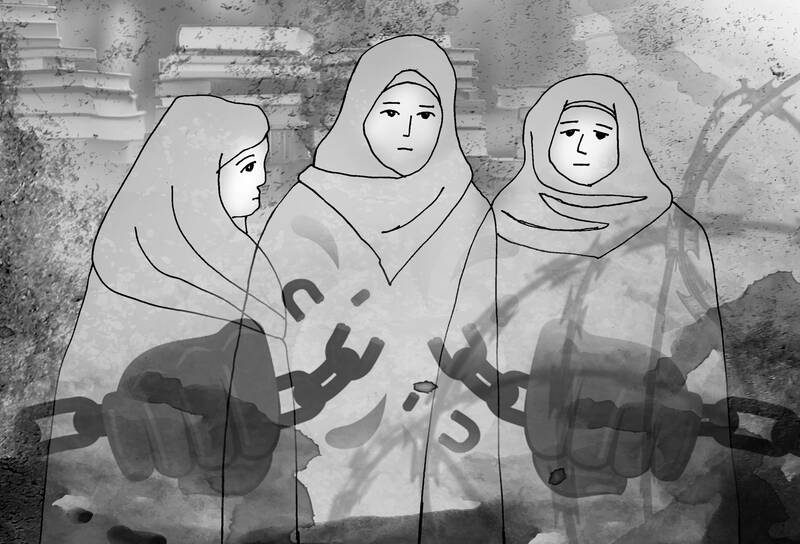
Illustration: Tania Chou
China, for its part, accepted the credentials of an ambassador from the Taliban regime in January 2024, but stopped short of de jure recognition of the government, some key members of which remain under UN sanctions. That has not prevented China from pursuing closer economic ties with Afghanistan. Chinese companies have made significant investments in Afghanistan’s resource sectors. Chinese Minister of Foreign Affairs Wang Yi (王毅) in August last year visited Kabul to discuss the nation joining the Belt and Road Initiative.
After Afghanistan’s falling out with Pakistan, previously the Taliban’s biggest supporter, in October last year, India upgraded its ties with the regime, including by formally reopening its embassy in Kabul. That same month, Afghan Minister of Foreign Affairs Amir Khan Muttaqi, a sanctioned official who required a travel waiver from the UN Security Council, visited India and proclaimed that “the future of India-Afghanistan relations seems very bright.”
Even more concerning, some European nations have increased engagement with the Taliban as part of a push to deport failed Afghan asylum seekers, lending credibility to the regime, despite its persecution of girls and women. This stands in stark contrast to the efforts to make gender apartheid an international crime, which in Afghanistan’s case would imply the imposition of further sanctions. The Pre-Trial Chamber of the International Criminal Court (ICC) in July last year issued arrest warrants for Haibatullah Akhundzada and Abdul Hakim Haqqani, two senior Taliban officials charged with gender-based persecution.
Despite this progress, outside powers have become less interested in confronting the regime, appearing to justify this, at least in part, by weak internal opposition. Whereas India, Iran and Russia backed forces that put the Taliban under real pressure in the 1990s, there is no organized armed opposition in Afghanistan at this time.
However, the US has taken a hostile attitude toward Afghanistan, which US President Donald Trump called “a hellhole” after an Afghan man killed two National Guard members. As a result, the administration has stopped issuing visas to Afghan nationals and vowed to re-examine every immigrant from Afghanistan who entered the nation under Trump’s predecessor, former US president Joe Biden.
Up until now, negotiations at the UN on gender apartheid in Afghanistan have focused more on advocacy than on binding agreements, although there have been calls to classify it as a crime against humanity. The 59th session of the UN Human Rights Council, held in June and July last year, debated this matter, and Bennett has persistently advocated referring such crimes to the ICC, making girls’ rights a condition for engagement with the Taliban and devising mechanisms to hold the regime accountable.
While no treaty amendments or sanctions have been adopted yet, the UN’s Sixth Committee (Legal) has advanced a draft global treaty targeting crimes against humanity. Further discussions about the treaty, expected later this month, should consider codifying gender apartheid as a crime under international law. Such a move would bolster efforts to pressure the Taliban. The UN Security Council, to its credit, has sought to do this in its briefings, but the UN system lacks a unified enforcement strategy.
Pressuring the Taliban to end its gender apartheid is not only a moral imperative; it is also a strategic one. Afghanistan’s population has swelled to more than 42 million and is only growing: Iran and Pakistan forcibly returned 2.6 million Afghan refugees last year alone. This huge influx has strained an already teetering economy, but escaping poverty would be impossible so long as the Taliban denies half its population the chance to be educated and join the labor force.
UN Assistant Secretary-General Kanni Wignaraja, the UN Development Programme’s regional director for Asia and the Pacific, put it best: “The primary issue facing Afghanistan’s economic future” is girls’ and women’s rights.
“That is the issue that will kill the country, economically, socially, politically,” she said.
Gordon Brown, a former British prime minister, is WHO ambassador for global health financing.
Copyright: Project Syndicate
KMT Chairwoman Cheng Li-wun’s (鄭麗文) recent visit to Beijing and her upcoming visit to Washington will serve as a high-level test of her diplomatic mettle. In Beijing, Cheng was received with symbolic gestures, a warm reception, and high-level access. In Washington, she will receive far less pomp and far sharper questions about the KMT’s vision for the future of Taiwan. Her challenge will be to persuade Washington that the KMT’s engagement with China can coexist with strong deterrence. Cheng’s April 7-12 visit to mainland China coincided with an intense period of conflict in Iran. Despite the strategic significance of Cheng’s trip,

The closure of the Strait of Hormuz has sent the vast Asian chemicals industry into a tailspin. Deprived of the likes of Qatari natural gas and Saudi Arabian oil, the region’s fertilizer and plastics plants are slowing production or even shutting down. Everywhere except China, that is. In petrochemicals, China is unique. As well as a traditional industry that uses oil and gas as feedstock, it has parallel output that relies on its abundant domestic coal. Unsurprisingly, India and other regional powers want to copy and paste the Chinese method. This would not be easy — or climate friendly. The
Indonesian President Prabowo Subianto says he knows how to fix the problems facing Indonesia. Yet his economic mismanagement and authoritarian tendencies are steering the nation toward a familiar mix of currency instability and political chaos. The world’s fourth-most populous nation risks reversing the hard-won democratic and business reforms that came after the Asian Financial Crisis in 1997. At that time, the rupiah collapsed and the political upheaval that followed forced former president Haji Mohamed Suharto from power. Prabowo’s administration is ignoring similar warning signs. That disconnect was apparent in a national address on Wednesday, when Prabowo projected the swagger that has
“Of course you can choose not to be Taiwanese, just do not stay here,” chairwoman of Taipei 101 operator Taipei Financial Center Corp Janet Chia (賈永婕) said in an online interview with local entertainer Tai Chih-yuan (邰智源), triggering intense discussion on social media, with politicians across party lines weighing in. In the interview, which was aired on May 14, Chia and Tai’s discussion over a meal in Taipei 101 covered Chia’s career change from entertainer to chairwoman and US climber Alex Honnold’s free solo climb up the Taipei 101 building. During the interview, Chia said, “Being on this land, we


 RSS
RSS