

A labor broker last week was fined more than NT$10 million (US$318,279) for illegally charging migrant workers job-placement fees. The Ministry of Labor said that the broker over-collected about NT$1 million in “end-of-contract transfer” and “contract renewal” fees — a blatant contravention of regulations. Unfortunately, the case is far from unique.
The Employment Service Act (就業服務法) stipulates that brokers are only permitted to charge employers placement and registration fees, while migrant workers can only be charged monthly service fees capped at NT$1,800 in their first year, with the amount declining in subsequent years. “Job-buying” or placement fees are illegal.
However, multiple investigations suggest that such fees remain widespread.
Reports by labor rights groups and international organizations have found migrant workers paying US$5,000 to US$6,600 to secure jobs in Taiwan, often before they even arrive.
For most, the sums are impossible to cover without taking out a loan. The debt can take years to repay, leaving workers financially trapped and unable to legally leave abusive or exploitative situations.
The International Labour Organization has identified debt bondage as a key indicator of forced labor. When migrant workers are already deeply indebted upon their arrival, their ability to refuse unreasonable demands or seek help is severely constrained.
Financial exploitation is often accompanied by other forms of control. Investigations into the manufacturing and textile industries have documented restrictions on workers’ movement, confiscation of important documents such as passports and rigid rules governing free time outside of work. These practices create an environment in which migrant workers are treated less as employees with rights and more as assets to be managed.
This issue matters not only on moral grounds, but also for Taiwan’s economic future. As birthrates remain low, migrant labor has become essential across sectors ranging from manufacturing to hospitality and port operations. Welcoming more migrant workers is increasingly framed as an economic necessity, but high demand would not sustain supply if Taiwan’s reputation for exploitative recruitment practices and weak labor rights enforcement fails to improve.
One plausible solution is the establishment of government-to-government hiring systems. The ministry is preparing to open Taiwan’s first cross-border recruitment center in the Philippines within the next few months, enabling employers to hire workers directly without relying on private brokers.
Under this new system, costs such as airfares, visas and health checks would in principle be borne by employers rather than workers, thereby reducing recruitment debt and limiting opportunities for illegal fee collection. If successful, the approach could mark a significant shift away from a broker-dominated model that has long drawn criticism from labor rights advocates, although it is too early to judge the initiative’s effectiveness.
This underscores the need for stronger enforcement alongside structural reform. The ministry announced that it plans to conduct 2,500 inspections to uncover illegal brokerage practices this year, up from 2,200 last year.
However, inspections alone are not enough. Penalties must be strict and consistently applied so that illegal charges are no longer commonplace in the recruitment system.
Reports of forced labor indicators in Taiwanese supply chains have already drawn scrutiny from international buyers and human rights organizations. Failure to address recruitment abuses could undermine Taiwan’s standing as a responsible trading partner at a time when global attention on labor standards is intensifying.
However, reforming the broker system would not be simple. It would require coordination with source countries, sustained commitment and a willingness by authorities to challenge entrenched interests that profit from the system as it is.
Inaction carries its own costs. Allowing exploitative recruitment processes and weak worker protections to persist would distort labor markets and erode trust in regulatory institutions.
The nation’s growing dependence on migrant labor makes reform increasingly urgent. Fair recruitment is not a concession, but a prerequisite for a sustainable workforce. If Taiwan hopes to remain an attractive destination for migrant workers while meeting its labor needs, it must confront abusive brokerage practices head-on. That means pairing new and direct hiring pathways with rigorous enforcement and clear accountability.
Last week’s hefty fine should set a precedent — and mark the beginning of dismantling a system that has long imposed illegal and immoral costs on those least able to bear them.

EDITORIAL CARTOON
Spain is having a good summer. The economy is forecast to grow 2.6 percent this year, far higher than the eurozone in general, and is expected to keep expanding by more than 2 percent in each of the next few years. The country has doubled its wind and power capacity since 2019, and is riding out Iran-related energy price turbulence far better than its European peers. And its football team just won the World Cup with a display of teamwork that stifled the world’s best attacking team, France, and then the belligerent Argentinians. Spain, and its long-serving center-left premier, Pedro Sanchez,
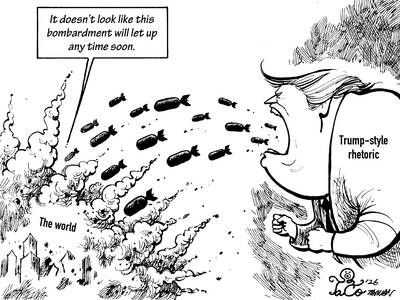
EDITORIAL CARTOON

War in the Middle East drags on, while Ukraine’s fortunes are improving despite Mr. Putin’s ongoing assault on Ukrainian sovereignty. Meanwhile, a great deal of energy is focused on China’s behavior in the western Pacific and the threat it poses both to global peace and security and to the free people of Taiwan. Taiwan’s open economy, vibrant democracy, and commitment to its national sovereignty through robust defense stand as a beacon in the Indo-Pacific. Like-minded countries, like the United States, can and should continue to support Taiwan through relationships underpinned by mutual interest and shared trust. Trust is the glue that


 RSS
RSS