


What connects the word “vape,” the crying-laughing emoji and the phrase “squeezed middle”? No, it is not just a biting crossword clue for “millennial”: They have all previously been crowned word of the year. Admittedly, there are now so many “words of the year” that, if they were physical objects, they could make a decent-sized museum collection. Which, as it happens, is exactly how I like to imagine them — artefacts of their time, telling a story of a changing society.
This year’s winners — from “parasocial” (Cambridge Dictionary’s choice) to “rage bait” (Oxford English Dictionary), “67 (six-seven)” (Dictionary.com) and “slop” (Merriam-Webster) — would join the group, although where in the “museum” remains to be seen. Would they sit in the permanent collection, along with 2005’s “podcast” and 2015’s “binge-watch”? Or the archive, where irrelevances such as 2007’s “w00t” are packed off to, to see out their days alongside former British prime minister David Cameron’s lesser-remembered very bad idea: not Brexit (Collins, 2016), but “big society” (Oxford, 2010).
Play curator with me, and let us take a tour.
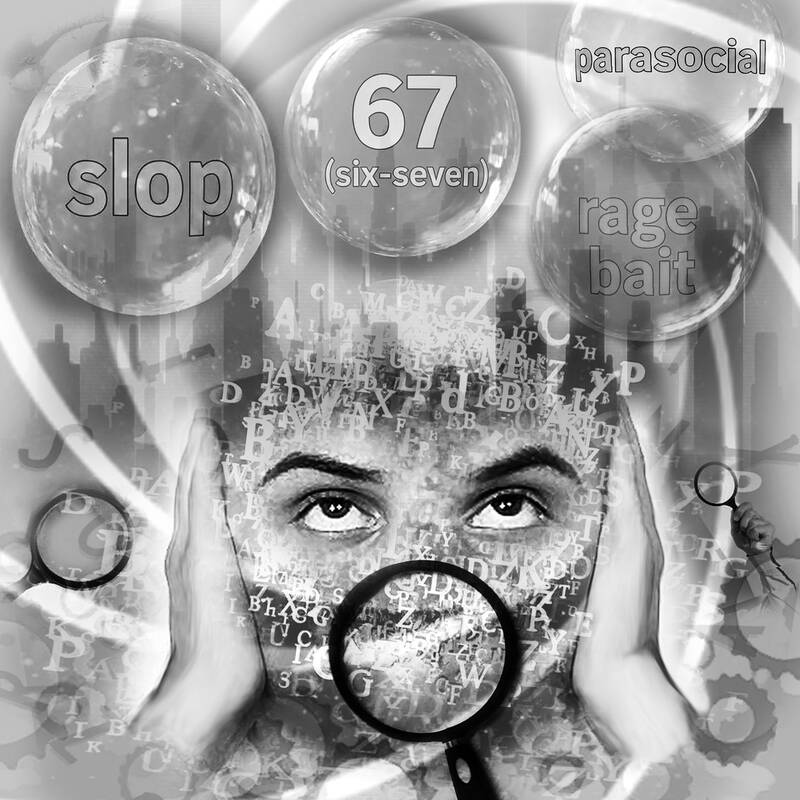
Illustration: Kevin Sheu
To look back at the winning words from the past 20 years is to look back at life through rose-tinted glasses. Seriously, people bang on about the hope and optimism of the 2012 Olympics opening ceremony, but how about a 2006 UK seemingly so untroubled that its Oxford word of the year was “bovvered”? Or a country where, in contrast to last year’s shared cultural experience of “enshittification,” it was “sudoku” (Oxford, 2005)? Were these times really much simpler — sorry, “simples” (a 2009 winner)?
Surely not, given some words feel like prophecy. Indeed, when in 2009 I graduated into a recession, blissfully unaware of how it would define my generation, I would have done well to have registered 2008’s “credit crunch” and “bailout.” Still, earlier winners feel almost innocent: Merriam-Webster’s 2013 “science” (that is right, no particular field, just science) or Dictionary.com’s “change” (2010). See also: “youthquake” (Oxford, 2017), “occupy” (American Dialect Society, 2011) and “feminism” (Merriam-Webster, 2017). These words speak to a hunger for progress, even as darker terms such as “fake news” (Collins, 2017) or “post-truth” (Oxford, 2016) emerged.
However, it is 2018 where it gets really bleak. Words that would suit an apocalyptic horseman dominate (“climate emergency,” “permacrisis,” “toxic,” “gaslighting,” “polarization”), before giving way to the language of fleeting tech crazes (“NFT,” “homer”) and variations on the theme of ennui (“quiet quitting,” “existential”). Which I suppose would at least give future visitors to the museum an understanding of not only what burned Rome, but the soundtrack coming from the metaphorical fiddle (Charli XCX, duh: “brat” was Collins’ winner last year).
As for this year’s words, many fit right in. “Rage bait” surely belongs in the central gallery, given it is a now-permanent fixture of online life, and a neat summary of how algorithms reward emotional manipulation. Meanwhile, I only hope “slop” — the grim churn of mind-numbing artificial intelligence video (AI) — goes the way of “metaverse” (Oxford runner-up, 2021) as another bit of overhyped ephemera, quietly scrubbed from our lives once we all realize how rubbish it is. To the basement with thee!
What about “parasocial,” this year’s darkest winner? It might need a room of its own. It gained relevance amid stories of users bonding with AI and peak fan moments such as Taylor Swift’s engagement dominating the Internet. Personally, it is not the “fan” element that gives me the chills, but rather how parasocial is replacing real human connection, as we continue to retreat from lives lived with one another to something far lonelier.
Which brings me to “six-seven.” Where to place a “word” such as that? Dictionary.com’s choice, it is the first-ever word of the year that is near-exclusively used by teenagers. Meaning “so-so,” but mainly deployed at random to annoy adults, it is a joke without a punchline. So there is only one place for it: the Mona Lisa spot.
Hear me out. You see, there is one other trend that has emerged from word of the year recently, and it is one I can get behind: the fun words. “Goblin mode,” a term for slobbing out (Oxford, 2022)? A truly poetic self-effacement. How about “rizz” (2023)? One could argue it should not be included given it is just an abbreviation of another word (charisma), but what could be more now than a word that works quickly, flexibly (“rizz” is also a verb) and I am sure from home too, if it could.
Some might regard this slang as “brain rot” (Oxford, last year). However, humor is precious. It is human, even if distilled through tech. Crucially, it is full of potential, because if you can share a joke, you can truly connect, and if you can connect, you can rebuild.
So we return to “six-seven.” How does this sound for its exhibition placard? “This form of ‘anti-humor,’ although it appears senseless and even nihilistic, is in fact a piece of guerilla performance art exposing the meaninglessness of our times.”
OK, OK, maybe I have taken this curator thing a bit too far, because it is actually quite simple: Saying “six-seven” at random is just a very, very teenage thing to do, and that is great.
I say this as someone who was at school during the height of the Budweiser advert frenzy, in which schoolkids would burst into “wassupppp” at quite literally any time. Yes, it was random — that was the point, as was the fact no one else was laughing bar the perpetrator and their friends.
With “six-seven,” we see the hallmarks of this same daft, kind of annoying and quintessentially teenage energy. It might be Internet slang, but its power is in real life — forging social bonds with other teens, and creating a shared identity. Given everything we hear about teens being worryingly self-conscious, lacking friendship and paralyzed by anxiety, this harmless bit of fun heartens me. Maybe the kids really are alright.
Could it be the most hopeful word of this year? The one that symbolized the beginning of something beautiful again, a triumph of human nature as we start to rebuild a new world? We shall see. For now, we shall consider it on display, pending further review.
Coco Khan is a freelance writer and cohost of the politics podcast Pod Save the UK.

Is a new foreign partner for Taiwan emerging in the Middle East? Last week, Taiwanese media reported that Deputy Minister of Foreign Affairs Francois Wu (吳志中) secretly visited Israel, a country with whom Taiwan has long shared unofficial relations but which has approached those relations cautiously. In the wake of China’s implicit but clear support for Hamas and Iran in the wake of the October 2023 assault on Israel, Jerusalem’s calculus may be changing. Both small countries facing literal existential threats, Israel and Taiwan have much to gain from closer ties. In his recent op-ed for the Washington Post, President William
Taiwan-India relations appear to have been put on the back burner this year, including on Taiwan’s side. Geopolitical pressures have compelled both countries to recalibrate their priorities, even as their core security challenges remain unchanged. However, what is striking is the visible decline in the attention India once received from Taiwan. The absence of the annual Diwali celebrations for the Indian community and the lack of a commemoration marking the 30-year anniversary of the representative offices, the India Taipei Association and the Taipei Economic and Cultural Center, speak volumes and raise serious questions about whether Taiwan still has a coherent India
A stabbing attack inside and near two busy Taipei MRT stations on Friday evening shocked the nation and made headlines in many foreign and local news media, as such indiscriminate attacks are rare in Taiwan. Four people died, including the 27-year-old suspect, and 11 people sustained injuries. At Taipei Main Station, the suspect threw smoke grenades near two exits and fatally stabbed one person who tried to stop him. He later made his way to Eslite Spectrum Nanxi department store near Zhongshan MRT Station, where he threw more smoke grenades and fatally stabbed a person on a scooter by the roadside.
Recent media reports have again warned that traditional Chinese medicine pharmacies are disappearing and might vanish altogether within the next 15 years. Yet viewed through the broader lens of social and economic change, the rise and fall — or transformation — of industries is rarely the result of a single factor, nor is it inherently negative. Taiwan itself offers a clear parallel. Once renowned globally for manufacturing, it is now best known for its high-tech industries. Along the way, some businesses successfully transformed, while others disappeared. These shifts, painful as they might be for those directly affected, have not necessarily harmed society


 RSS
RSS