


While trying to work at a cafe the other day, I experienced the real war on Christmas. Hoping for the familiar hum of conversation and music, I was surprised upon entering that no one was talking. Still, I sat down with my notebook and attempted to focus my thoughts, but something was playing havoc with my concentration. The music seemed eerie. I lifted my head, listened and became disturbed.
What seemed at first to be a playlist of winter classics and Christmas carols offered something else entirely. The melodies were more or less the same — recognizable as Silent Night, The First Noel and Winter Wonderland, but the voice was generically earnest, a bland baritone straining, I felt, from nowhere to nowhere.
Worse, the lyrics were wrong. Not a mistake here or there, but a pattern of errors. References to the nativity were expunged, replaced with metaphysical blather. The human parts had gone missing as well. In the love song Winter Wonderland, we should hear this nice couplet about a pair taking a walk: “In the meadow we can build a snowman / Then pretend that he is Parson Brown.”
However, the song I heard in the cafe garbled the lyrics: “In the meadow we can find a snowman, then pretend that he is a nice old guy.”
This was followed by some meaningless verbiage about dancing the night away, where “guy” is lamely rhymed with the sun being “high.”
Again, the actual song: “In the meadow we can build a snowman / Then pretend that he is Parson Brown / He’ll say: ‘Are you married?’ We’ll say: ‘No man’ / But you can do the job when you’re in town.”
These four lines carry so much meaning. The young couple are telling a story to each other about a shared experience. In this tale, Parson Brown is a specific person, whose physical attributes can be gathered from the reference to the snowman. Their attitude toward him is as playful as it is respectful.
These lovers, who are not yet married, but want to be, are skirting around the rules for the moment, acting out their love in public before conforming to the era’s conventions. The layers in these lines descend gently upon the listener, like snowfall in sunlight.
My mind was awaiting all that; the vacuum of “nice old guy” strained the neurons — or the soul.
I first heard Winter Wonderland about 40 years after its lyricist, Richard Bernhard Smith, died in 1935; another 50 years have passed since then. Behind these lyrics is a young man, inspired by snowfall in a park, who undoubtedly knew something about romance. Smith died of tuberculosis not long after writing the song, which lives after him, preserving his playful sense of how we might be together, passed on from those who sing to those who listen.
Art lives until it is killed. In this case, the death of Winter Wonderland — and Christmas music more generally — was caused by a set of algorithms that we flatteringly call artificial intelligence (AI). My guess is that someone, somewhere, prompted an AI model to generate winter and Christmas songs that avoided “controversial” subjects such as divine and human love, resulting in mush. In a reverse sublimation, the sacred becomes slop.
Many US conservatives have latched onto the idea that Christmas has somehow been sullied by foreigners, particularly non-Christians, but who are the true aliens in this Christmas story? The non-human entities.
The tortured version of Winter Wonderland which I was forced to listen to is just the tip of the iceberg. The assault of algorithms designed to monopolize attention has severely weakened many basic cultural forms: music and holiday ritual, but also classroom teaching, the sharing of food and simple conversation.
Of course, a few people make a lot of money from this. In some notable cases, those who profit from the culture-wrecking machine are the same ones who blame foreigners for taking Christmas away from us and destroying our civilization. Meanwhile, the people who actually sing the songs have trouble finding listeners.
Winter Wonderland is a bit of light music, with a subtle message about romance that requires some patience and experience, as well as a sense of humor. Any references to the holiday are indirect and playful: the imaginary parson with the melting reproof, the wandering unmarried couple.
Christmas bears a message of love: “And she brought forth her firstborn son, and wrapped him in swaddling clothes, and laid him in a manger; because there was no room for them in the inn.”
No machine can comprehend this emotion — a fact that those who tout the inevitability of machine superiority do not want us to grasp. Instead, they want us to turn on one another, while their algorithms desecrate a fundamental part of our humanity, one song at a time.
Timothy Snyder, the inaugural chair in modern European history at the Munk School of Global Affairs and Public Policy at the University of Toronto and a permanent fellow at the Institute for Human Sciences in Vienna, is the author or editor of 20 books.
Copyright: Project Syndicate
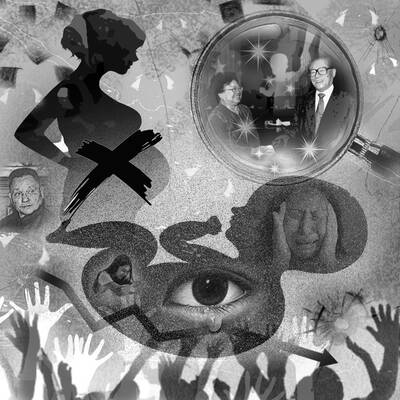
Jan. 1 marks a decade since China repealed its one-child policy. Just 10 days before, Peng Peiyun (彭珮雲), who long oversaw the often-brutal enforcement of China’s family-planning rules, died at the age of 96, having never been held accountable for her actions. Obituaries praised Peng for being “reform-minded,” even though, in practice, she only perpetuated an utterly inhumane policy, whose consequences have barely begun to materialize. It was Vice Premier Chen Muhua (陳慕華) who first proposed the one-child policy in 1979, with the endorsement of China’s then-top leaders, Chen Yun (陳雲) and Deng Xiaoping (鄧小平), as a means of avoiding the

The last foreign delegation Nicolas Maduro met before he went to bed Friday night (January 2) was led by China’s top Latin America diplomat. “I had a pleasant meeting with Qiu Xiaoqi (邱小琪), Special Envoy of President Xi Jinping (習近平),” Venezuela’s soon-to-be ex-president tweeted on Telegram, “and we reaffirmed our commitment to the strategic relationship that is progressing and strengthening in various areas for building a multipolar world of development and peace.” Judging by how minutely the Central Intelligence Agency was monitoring Maduro’s every move on Friday, President Trump himself was certainly aware of Maduro’s felicitations to his Chinese guest. Just
A recent piece of international news has drawn surprisingly little attention, yet it deserves far closer scrutiny. German industrial heavyweight Siemens Mobility has reportedly outmaneuvered long-entrenched Chinese competitors in Southeast Asian infrastructure to secure a strategic partnership with Vietnam’s largest private conglomerate, Vingroup. The agreement positions Siemens to participate in the construction of a high-speed rail link between Hanoi and Ha Long Bay. German media were blunt in their assessment: This was not merely a commercial win, but has symbolic significance in “reshaping geopolitical influence.” At first glance, this might look like a routine outcome of corporate bidding. However, placed in
China often describes itself as the natural leader of the global south: a power that respects sovereignty, rejects coercion and offers developing countries an alternative to Western pressure. For years, Venezuela was held up — implicitly and sometimes explicitly — as proof that this model worked. Today, Venezuela is exposing the limits of that claim. Beijing’s response to the latest crisis in Venezuela has been striking not only for its content, but for its tone. Chinese officials have abandoned their usual restrained diplomatic phrasing and adopted language that is unusually direct by Beijing’s standards. The Chinese Ministry of Foreign Affairs described the


 RSS
RSS