


Most of the world knows how to respond to the US’ new National Security Strategy. As my colleague Marc Champion has written, Russia loves it. Liberal Europeans are dismayed and the Gulf monarchies are overjoyed.
In the rest of Asia — and what, until now, Washington has called the Indo-Pacific — the dominant emotion is uneasiness. There are words, phrases and entire sections in the document that are exactly what we want to hear, but the underlying worldview is at odds with its rhetoric.
The strategy promises that the US would build a military capable of deterrence in the First Island Chain and the Taiwan Strait, and an insistence that the South China Sea cannot be controlled by any one actor. There is a promise to defend “global and regional balances of power,” and to fight “predatory” economic practices.
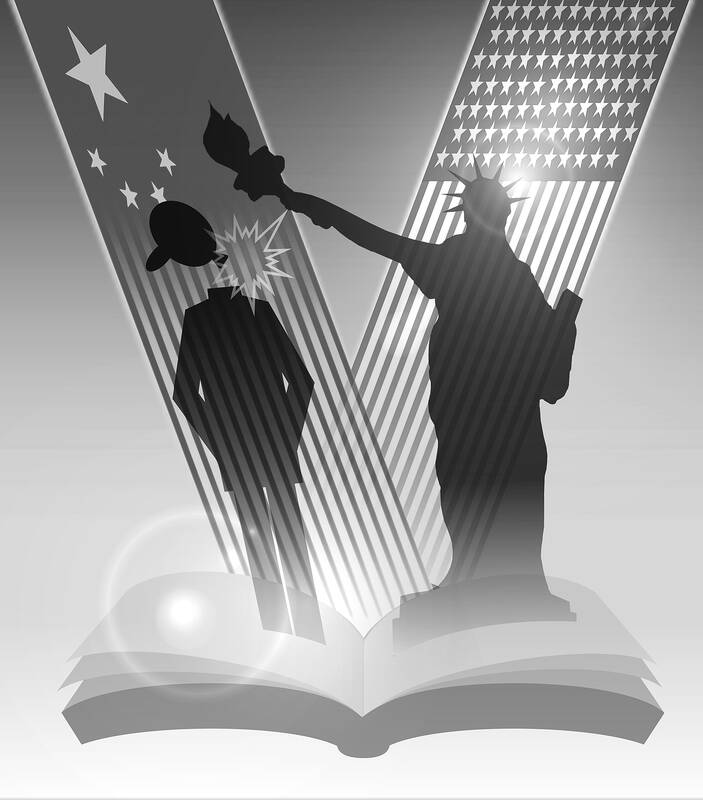
Illustration: Yusha
The Indo-Pacific shares all these priorities, and many are relieved that the administration of US President Donald Trump has taken the trouble to restate them. And yet there is disquiet, because some of these commitments look like they have been grafted on to a strategy that could push US policy in a fundamentally different direction.
This is a startlingly ideological document even by the standards of today’s Washington. It extends “Make America Great Again” (MAGA) domestic obsessions — the border, diversity and equality initiatives, climate denialism — beyond America’s shores. US soft power is listed as one of its greatest assets, without the recognition that illiberalism and xenophobia erode its value daily.
But MAGA’s most dangerous export, as far as the security of the Indo-Pacific is concerned, is its distaste for the liberal order.
The US might not always have lived up to its ideals, but since the Second World War, it has defined its role in the world as promoting them — defending the practice of liberal democracy and evangelizing the benefits of global norms. They include shared prosperity, for Americans and the citizens of partner nations.
It is here that the 2025 National Security Strategy makes its most impactful break with the past. The security and stability of the Indo-Pacific might remain a stated priority, but not because freedom and openness would enrich the region and keep it loyal to the rules-based order that benefits Americans more than anyone else. Instead, a much narrower and more fragile link is being drawn, between deterring China and Trump-era economic priorities: Big Tech profits, the securing of global resources and a “rebalanced” global economy that forces production back onshore.
This link could snap at any time — particularly if Trump is deceived into thinking that cooperation with Xi Jinping (習近平) would not cost the US in the short run, while confronting Beijing’s designs in Asia might. He is certainly being tempted down that path: Nvidia Corp being granted permission to sell high-end chips to China is not a good sign. Trump has said it is “good business,” as long as the federal government gets a 25 percent cut. A short-term revenue boost is sufficient to risk US tech leadership, apparently. How can we take the solemn pronouncements in the NSS seriously?
The president’s mercantilist instincts are well-known. This piece of paper reminds us that he believes in another throwback theory, that of spheres of influence. The strategy states that “the outsized influence of larger, richer and stronger nations is a timeless truth of international relations.”
A revanchist Russia is not the only beneficiary of this belief. China is larger, richer and stronger than anyone else in its region; why not permit it a sphere of influence in Asia, if it gives Trump an economic deal “better” than his predecessors could extract? Beijing might break that promise later, but by then it would be some other administration’s problem.
Over the past few decades, a bipartisan consensus had developed in Washington that China was a systemic rival, and not just another economic challenger. But those running policy in the second Trump term are arguing from different premises. It is centered on domestic economic considerations and not to preserve the world order. They do not fear the loss of global leadership; they might even welcome the dissolution of economic arrangements. All they want is to contain the economic shocks accompanying China’s rise.
Written into the silences in this document is an unpalatable truth: An establishment in Washington that intimidates large companies, that conscripts tech into politics, that guards its domestic markets and weaponizes its trade would hardly see the Chinese system as an ideological threat.
This is what unnerves Asian capitals. One day soon, MAGA’s ideologues and populists might decide that granting Beijing overlordship of Asia would not affect jobs or profits in the US. From that day on, they will not lift a finger in defense of the Indo-Pacific.
Mihir Sharma is a Bloomberg Opinion columnist. A senior fellow at the Observer Research Foundation in New Delhi, he is author of Restart: The Last Chance for the Indian Economy. This column reflects the personal views of the author and does not necessarily reflect the opinion of the editorial board or Bloomberg LP and its owners.
A gap appears to be emerging between Washington’s foreign policy elites and the broader American public on how the United States should respond to China’s rise. From my vantage working at a think tank in Washington, DC, and through regular travel around the United States, I increasingly experience two distinct discussions. This divergence — between America’s elite hawkishness and public caution — may become one of the least appreciated and most consequential external factors influencing Taiwan’s security environment in the years ahead. Within the American policy community, the dominant view of China has grown unmistakably tough. Many members of Congress, as
The Hong Kong government on Monday gazetted sweeping amendments to the implementation rules of Article 43 of its National Security Law. There was no legislative debate, no public consultation and no transition period. By the time the ink dried on the gazette, the new powers were already in force. This move effectively bypassed Hong Kong’s Legislative Council. The rules were enacted by the Hong Kong chief executive, in conjunction with the Committee for Safeguarding National Security — a body shielded from judicial review and accountable only to Beijing. What is presented as “procedural refinement” is, in substance, a shift away from
The shifting geopolitical tectonic plates of this year have placed Beijing in a profound strategic dilemma. As Chinese President Xi Jinping (習近平) prepares for a high-stakes summit with US President Donald Trump, the traditional power dynamics of the China-Japan-US triangle have been destabilized by the diplomatic success of Japanese Prime Minister Sanae Takaichi in Washington. For the Chinese leadership, the anxiety is two-fold: There is a visceral fear of being encircled by a hardened security alliance, and a secondary risk of being left in a vulnerable position by a transactional deal between Washington and Tokyo that might inadvertently empower Japan
After declaring Iran’s military “gone,” US President Donald Trump appealed to the UK, France, Japan and South Korea — as well as China, Iran’s strategic partner — to send minesweepers and naval forces to reopen the Strait of Hormuz. When allies balked, the request turned into a warning: NATO would face “a very bad” future if it refused. The prevailing wisdom is that Trump faces a credibility problem: having spent years insulting allies, he finds they would not rally when he needs them. That is true, but superficial, as though a structural collapse could be caused by wounded feelings. Something


 RSS
RSS