


Renewed hostilities between Thailand and Cambodia are a wake-up call for Southeast Asia about the costs of letting historical border disputes fester. The century-old conflict, rooted in colonial-era cartography, is flaring at a moment when the region is already under strain from US President Donald Trump’s trade war and intensifying great-power rivalry between the US and China.
Fighting erupted over the weekend along their shared frontier and so far has killed at least 11 people. Both sides have exchanged artillery fire, and Thailand carried out air strikes with F-16 jets after accusing Cambodia of firing rockets into civilian areas.
The neighbors have clashed repeatedly before, most recently in July, when dozens were killed and tens of thousands displaced. A fragile ceasefire — brokered in part with Trump’s self-touted involvement — has collapsed, and there is no clear diplomatic off-ramp in sight.
Washington has said it is concerned by the continued clashes and casualties along parts of the 800km border. Secretary of State Marco Rubio urged both sides to immediately cease hostilities and to return to the measures outlined Oct. 26 in the Kuala Lumpur Peace Accords, which were one of Trump’s more prominent successes in branding himself a global peacemaker.
However, a return to calm looks unlikely, at least in the near term. Both governments are leaning on deeply rooted nationalist sentiment to shore up support at home. The rhetoric lays the groundwork for a prolonged and destructive conflict.Like many disputes in Asia, this one is a hangover from Western imperialism, though the roots go back further. The once-powerful Khmer Empire declined and what was left was in the process of disappearing, nibbled away for centuries by the ascendant Siam in the west and what is now Vietnam in the east. In colonizing Indochina, France made “the land in-between” a protectorate in 1863 and expanded its shrunken frontiers. Siam, now Thailand, remained independent in the face of heavy pressure from France and Britain, which ruled to the west over Burma and India.
A Franco-Siamese treaty signed in 1904 proposed the frontier would follow the watershed line of the Dangrek Mountains. Another map produced by French officials in 1907 deviated from that, placing key landmarks, including the 11th-century Preah Vihear temple, on the Cambodian side. Thailand later said the map was never properly approved, while Cambodia maintained it was binding because Siam did not formally object at the time.
In 1962, the International Court of Justice (ICJ) ruled in favor of Phnom Penh, a decision it reaffirmed in 2013. The surrounding border area was never fully demarcated, laying the groundwork for recurrent tensions.
The danger this time is how much more firepower is being used. Thailand’s forces are far larger and better equipped; the country is a longstanding ally of the US. Much-poorer Cambodia fields a smaller military and relies on Chinese assistance.
The risks of escalation cannot be overstated. The 10-member Association of Southeast Asian Nations has historically avoided wading into the affairs of other members because of its policy of non-interference. However, fighting between two member countries cannot help but be of concern, and as it intensifies, voices within the region are calling for stronger intervention. This year’s chair, Prime Minister Anwar Ibrahim of Malaysia, says he is ready to help, as he did with the Trump deal, and is urging de-escalation. His efforts are sensible, but ultimately insufficient.
It is a longstanding complaint, but the bloc has to stop managing crises and start resolving them. Installing an independent observer mission along the border and creating a mechanism to verify and publicly report violations would be a start toward real accountability. ASEAN states have already been involved in monitoring the ceasefire, but that is a long way from enforcement.
Resolving the border dispute would be even harder. It would need buy-in from both governments. Any demarcation process should be conducted by neutral surveyors, anchored in the ICJ rulings. Bangkok and Phnom Penh would need to commit publicly to accept the outcome, and refrain from inciting nationalist sentiment.
This would not be easy. There are compelling domestic incentives for both sides to let the fighting continue. Thai Prime Minister Anutin Charnvirakul is using the conflict to tap nationalist sentiment before an election that could come as early as 2026.
Cambodia’s most influential politician, Hun Sen, has exploited the violence to more closely reassert himself in politics, portraying himself as a national defender. That is a role he has played many times since starting his climb to power in the Vietnamese-backed regime that toppled the genocidal Khmer Rouge in 1979.
It should not require Trump, although he says he plans a new peacemaking phone call. However, until Southeast Asia confronts its unresolved borders with real determination, the war over a line on a map is going to remain a recurring threat the region can no longer afford.
Karishma Vaswani is a Bloomberg Opinion columnist covering Asia politics with a special focus on China. Previously, she was the BBC’s lead Asia presenter and worked for the BBC across Asia and South Asia for two decades. This column reflects the personal views of the author and does not necessarily reflect the opinion of the editorial board or Bloomberg LP and its owners.
A gap appears to be emerging between Washington’s foreign policy elites and the broader American public on how the United States should respond to China’s rise. From my vantage working at a think tank in Washington, DC, and through regular travel around the United States, I increasingly experience two distinct discussions. This divergence — between America’s elite hawkishness and public caution — may become one of the least appreciated and most consequential external factors influencing Taiwan’s security environment in the years ahead. Within the American policy community, the dominant view of China has grown unmistakably tough. Many members of Congress, as
The Hong Kong government on Monday gazetted sweeping amendments to the implementation rules of Article 43 of its National Security Law. There was no legislative debate, no public consultation and no transition period. By the time the ink dried on the gazette, the new powers were already in force. This move effectively bypassed Hong Kong’s Legislative Council. The rules were enacted by the Hong Kong chief executive, in conjunction with the Committee for Safeguarding National Security — a body shielded from judicial review and accountable only to Beijing. What is presented as “procedural refinement” is, in substance, a shift away from
The shifting geopolitical tectonic plates of this year have placed Beijing in a profound strategic dilemma. As Chinese President Xi Jinping (習近平) prepares for a high-stakes summit with US President Donald Trump, the traditional power dynamics of the China-Japan-US triangle have been destabilized by the diplomatic success of Japanese Prime Minister Sanae Takaichi in Washington. For the Chinese leadership, the anxiety is two-fold: There is a visceral fear of being encircled by a hardened security alliance, and a secondary risk of being left in a vulnerable position by a transactional deal between Washington and Tokyo that might inadvertently empower Japan
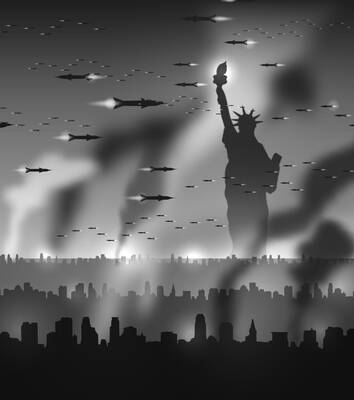
After declaring Iran’s military “gone,” US President Donald Trump appealed to the UK, France, Japan and South Korea — as well as China, Iran’s strategic partner — to send minesweepers and naval forces to reopen the Strait of Hormuz. When allies balked, the request turned into a warning: NATO would face “a very bad” future if it refused. The prevailing wisdom is that Trump faces a credibility problem: having spent years insulting allies, he finds they would not rally when he needs them. That is true, but superficial, as though a structural collapse could be caused by wounded feelings. Something


 RSS
RSS