


What are Labubus? It is a question the luckiest among you have likely never had to ask or answer; I, as a parent of two preteens, have had to do both. They are the latest inexplicably fashionable trend in overpriced toys — tiny creatures that look something like a cross between Keebler elves and Tasmanian devils. And now, apparently, they are going to be movie stars.
The Hollywood Reporter on Nov. 14 said that Sony Pictures has inked a deal securing the screen rights to the Pop Mart International Group Ltd doll brand. Details about the creative personnel involved have not been announced, nor even whether the feature film would be animated or live-action.
In other words, it appears that the deal came first, and Sony will figure out those nagging little details down the line.
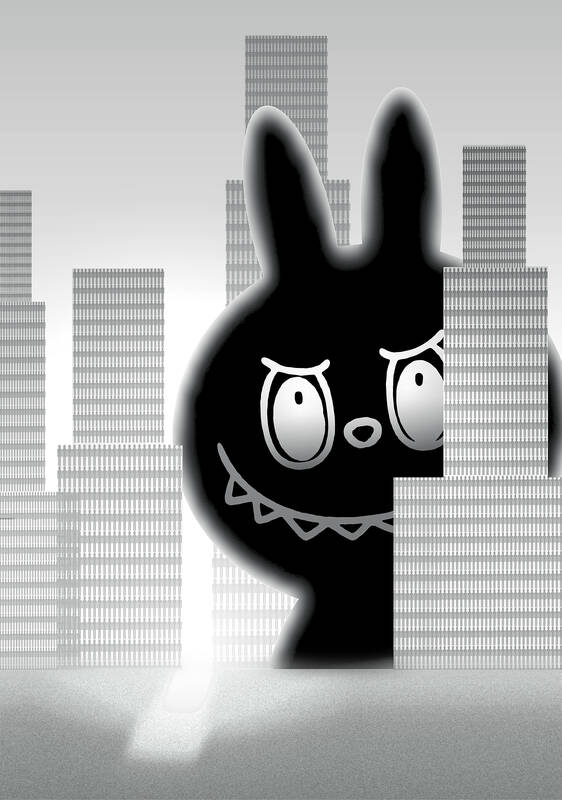
Illustration: Yusha
A lack of clarity comes with the territory for projects in early development, but this particular film — based on a toy introduced in 2015 that became a global force only in the past year — makes the unknowns a little more striking. There are few Hollywood endeavors as futile as chasing flash-in-the-pan trends — and few flash-in-the-pan trends have proven as commercially disappointing for filmmakers as toy brands.
Bratz: The Movie is a particularly apt example, as it too was based on a line of popular small dolls. The brand debuted in 2001, and the film followed six years later, grossing US$26 million worldwide — barely covering its estimated US$20 million budget. However, going back to the 1980s helps paint a clearer picture. In 1987, live-action Masters of the Universe — based on toys that hit shelves in 1982 — pulled in US$17.3 million, not even enough to cover its US$22 million budget. A year later, Pound Puppies and the Legend of Big Paw, based on the Pound Puppy line created in 1984, cost an estimated US$6 million to make, but barely hit half a million dollars in ticket sales.
The list goes on. Even toy brands that have become nostalgic favorites initially failed to convert their popularity with kids into ticket sales. Transformers, for example, has become a lucrative and long-running movie franchise, but it took years of ubiquity (and, possibly, the aging of its initial target audience from kids to parents) to set the stage for that success. The toys hit shelves in 1984, and the initial cinematic outing, 1986’s The Transformers: The Movie, stalled out badly enough (US$5.8 million against a US$6 million budget) to short-circuit the brand’s multiplex ambitions for decades.
These quickie cash-grabs frequently failed because audiences recognized what they were: feature-length commercials, often extensions of the after-school cartoon shows based on the same toys, which kids could watch ... for free.
Despite repeated flops, studio executives remain subservient to intellectual property, ignoring what should be obvious financial and creative risks — even as recent examples prove that intellectual property does not always guarantee profitability. This faith in brand familiarity might explain why Sony appears to be overlooking the toy-to-film pipeline’s well-documented failures and — as other outlets have noted — seemingly focusing instead on the most obvious counterexamples: 2014’s The Lego Movie and 2023’s Barbie.
The desire to chase their success is understandable. The Lego Movie grossed US$470 million worldwide on a US$60 million budget, and was nominated for an Oscar and a Golden Globe, while Barbie brought in US$1.4 billion worldwide on an estimated US$100 million budget and was nominated for eight Oscars (winning one) and nine Golden Globes (winning two).
However, those two hits are barely applicable for one key reason: timing. It is a factor that comes into play in two ways.
First, there is proven brand longevity. The Lego Group was established in 1932, while Ruth Handler, cofounder of the Mattel Inc toy company, introduced the Barbie doll in 1959. So by the time their high-profile movie adaptations were released, Lego and Barbie were both beloved toy brands that had been entertaining children (and emptying the wallets of their parents) across multiple decades and generations. The films did not just appeal to kids either — mature plots and a wave of nostalgia made them attractive to grown-ups reminiscing about their childhoods, many of whom still collect or even play with the toys.
Meanwhile, analysts are already questioning whether the mania surrounding Labubus can last, which brings us to the second piece of the timing puzzle. Motion pictures, as a general rule, are not ideal for rapid responses to cultural trends, because the production period for a major movie is inevitably and inherently slow. It typically takes a minimum of a calendar year to get a movie from a green light through development, scripting, casting, production and editing — and often, it takes longer. For a toy that has not yet proven its staying power, a year can feel like an eternity in a market where so many companies fight for the public’s ever-shrinking attention span.
Every film must weather its own specific circumstances, of course. Can the Labubu craze last long enough to overcome the historical precedents? Will the celebrities and luxury brands that have boosted and/or partnered with the brand keep those little monsters in the public eye long enough to make The Labubu Movie (or whatever title they settle on) into a Barbie-sized hit?
The answers, at best, are maybe. And that kind of uncertainty around the financial prospects of a film like this, seemingly driven by commerce over art, means that Sony might soon experience buyer’s remorse.
Jason Bailey is a film critic and historian. He is the author, most recently, of Gandolfini: Jim, Tony, and the Life of a Legend. This column reflects the personal views of the author and does not necessarily reflect the opinion of the editorial board or Bloomberg LP and its owners.

Is a new foreign partner for Taiwan emerging in the Middle East? Last week, Taiwanese media reported that Deputy Minister of Foreign Affairs Francois Wu (吳志中) secretly visited Israel, a country with whom Taiwan has long shared unofficial relations but which has approached those relations cautiously. In the wake of China’s implicit but clear support for Hamas and Iran in the wake of the October 2023 assault on Israel, Jerusalem’s calculus may be changing. Both small countries facing literal existential threats, Israel and Taiwan have much to gain from closer ties. In his recent op-ed for the Washington Post, President William
Taiwan-India relations appear to have been put on the back burner this year, including on Taiwan’s side. Geopolitical pressures have compelled both countries to recalibrate their priorities, even as their core security challenges remain unchanged. However, what is striking is the visible decline in the attention India once received from Taiwan. The absence of the annual Diwali celebrations for the Indian community and the lack of a commemoration marking the 30-year anniversary of the representative offices, the India Taipei Association and the Taipei Economic and Cultural Center, speak volumes and raise serious questions about whether Taiwan still has a coherent India
A stabbing attack inside and near two busy Taipei MRT stations on Friday evening shocked the nation and made headlines in many foreign and local news media, as such indiscriminate attacks are rare in Taiwan. Four people died, including the 27-year-old suspect, and 11 people sustained injuries. At Taipei Main Station, the suspect threw smoke grenades near two exits and fatally stabbed one person who tried to stop him. He later made his way to Eslite Spectrum Nanxi department store near Zhongshan MRT Station, where he threw more smoke grenades and fatally stabbed a person on a scooter by the roadside.
Recent media reports have again warned that traditional Chinese medicine pharmacies are disappearing and might vanish altogether within the next 15 years. Yet viewed through the broader lens of social and economic change, the rise and fall — or transformation — of industries is rarely the result of a single factor, nor is it inherently negative. Taiwan itself offers a clear parallel. Once renowned globally for manufacturing, it is now best known for its high-tech industries. Along the way, some businesses successfully transformed, while others disappeared. These shifts, painful as they might be for those directly affected, have not necessarily harmed society


 RSS
RSS