


Indonesia’s decision to honor former president Suharto as a hero is a stark reminder that authoritarianism’s appeal endures in Southeast Asia. Enabled in part by a younger generation that might not fully grasp the dangers of autocratic rule, this collective amnesia threatens hard-won democratic gains.
Indonesian President Prabowo Subianto — Suharto’s former son-in-law — on Monday last week posthumously awarded him the title of National Hero, the country’s highest civilian honor. It is a recognition typically reserved for citizens who have made extraordinary contributions to the nation. Previous presidents, including Susilo Bambang Yudhoyono and Joko Widodo, had considered the move, but ultimately declined.
This willingness to whitewash history is reflective of a broader trend across the region.
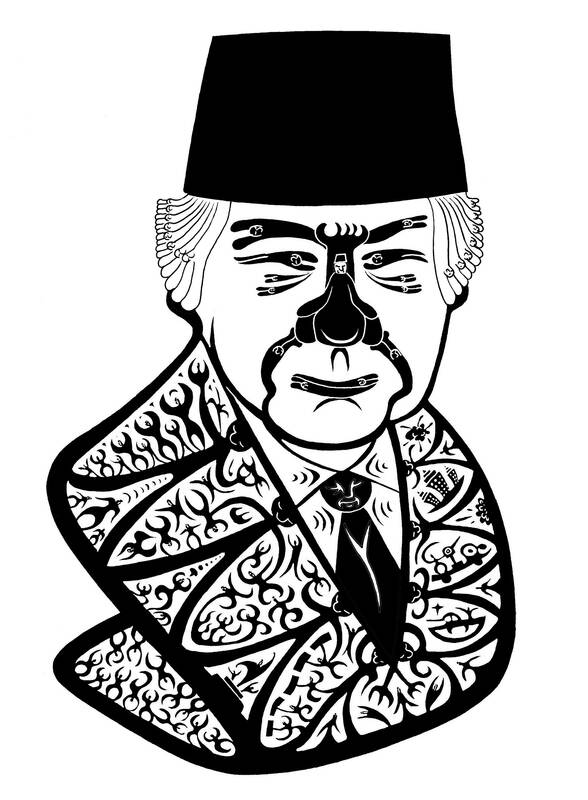
Illustration: Mountain People
The announcement provoked outrage from human rights groups, but perhaps more striking was the relatively muted public response. In a country famous for street protests, there were no mass demonstrations. That is a sharp contrast to the student-led uprising that brought down Suharto’s regime (known as Orde Baru, or New Order) in 1998, and the more recent Gen Z protests over a slowing economy and perks for politicians.
Suharto presided over more than three decades of military-backed rule, an era marked by rapid economic growth, but also corruption, cronyism and human rights abuses. His government, backed by a brutal army, controlled the press, and jailed or disappeared political opponents.
His rehabilitation today is remarkable.
“This is part of how we honor our predecessors — especially our leaders who, despite everything, made extraordinary contributions to the nation,” Indonesian Secretary of State Prasetyo Hadi said.
Indonesia has form when it comes to rewriting history. I grew up in Jakarta during the years of the dictatorship, and by then the historical sanitization was fully entrenched.
Suharto’s regime glossed over the 1965-1966 anti-communist massacres, framing them as killings committed by ordinary civilians, rather than the army. Restive provinces such as Papua and Aceh were depicted as rebellious, rather than victims of military suppression.
In that dominant narrative, Suharto was not dictator, but “Bapak Pembangunan,” the father of development. To be fair, he did bring about strong economic growth, but that was built on shaky foundations, corroded by nepotism and profiteering. By 1998, the Asian Financial Crisis exposed the fragility of the system, and his power collapsed, plunging the country into economic and political turmoil.
The ensuing chaos is one of the reasons many Indonesians view the Suharto era as a time of stability, despite its many problems. Citizens of all ages remember his era fondly, the authors of a study on authoritarian nostalgia released last year said. They might also be less likely to support democratic institutions.
Prabowo has tapped into that sentiment. A former special-forces commander accused of human rights abuses (allegations he denies), he recast himself during his presidential campaign as a cute and cuddly grandfather, an image that resonated with younger voters born after the dictatorship ended. Since taking office, Prabowo has shown flashes of the New Order style: centralizing power, sidelining critics and expanding the military’s role in public life.
There are more worrying signs. Earlier this year, the government said it would issue new textbooks to promote national pride, but that was postponed after backlash from historians who warned the books would likely omit key events, including those tied to Prabowo’s past, and downplay mass killings.
The phenomenon of authoritarian nostalgia is not isolated to Indonesia. In the Philippines, the dictatorship of Ferdinand Marcos Sr has been whitewashed through a widespread campaign of social-media disinformation, paving the way for his son’s return to power in 2022.
A population too young to remember martial law has helped sustain the myth that those years were a golden age of peace and prosperity. Thailand’s recurring coups and Cambodia’s dynastic rule are sold as stability, not stagnation.
China’s model of smart authoritarianism is offering proof that economic growth and innovation without political freedom is possible. That has emboldened leaders in the global south and further afield who see democracy as inconvenient.
Civil society must push back before further ground is ceded. Teaching the darker chapters of history in schools and universities is essential. When young citizens do not know what dictatorship looks like, they become more vulnerable to its return.
The risk of that kind of nostalgia goes beyond politics. Authoritarian systems often go hand in hand with a lack of transparency. Suharto’s Indonesia should serve as a warning sign of how perceived stability can crumble overnight. Investors and policymakers alike should note that weak institutions and selective memory make for a volatile mix.
Indonesia’s decision to celebrate Suharto is being sold as an attempt to reconcile with history. It is not. It is a reminder that when nations forget their authoritarian pasts, they risk inviting them back.
Karishma Vaswani is a Bloomberg Opinion columnist covering Asia politics with a special focus on China. Previously, she was the BBC’s lead Asia presenter and worked for the BBC across Asia and South Asia for two decades. Ruth Pollard is a Bloomberg Opinion managing editor. Previously, she was South and Southeast Asia government team leader at Bloomberg News and Middle East correspondent for the Sydney Morning Herald. This column reflects the personal views of the author and does not necessarily reflect the opinion of the editorial board or Bloomberg LP and its owners.
Chinese Nationalist Party (KMT) Chairwoman Cheng Li-wun (鄭麗文) in San Francisco on Tuesday last week said if she had not met with Chinese President Xi Jinping (習近平), she would have been “just a plain” and “even negligible” KMT chairperson, bluntly signaling the role she is playing in her visit to the US — Beijing’s messenger from Taiwan. Cheng and her delegation arrived in the US on Monday last week for a two-week visit across five major cities. Her party said the group is scheduled to meet with US lawmakers, officials, policy experts and businesspeople. Before departing, Cheng said her trip
The Comedy Club on Fuxing N Road in Taipei was vandalized with paint bombs mixed with feces on May 29, allegedly because one of its performers had satirized Chinese President Xi Jinping (習近平). The incident has triggered concerns about the growing threat from China’s cross-border repression within Taiwan. On the day of the attack, a comedian surnamed Huang (黃), who is known for mocking Xi, was the headline performer. The Comedy Club founder said the assault was obviously politically motivated. China, which Freedom House said “conducts the most sophisticated, extensive and far-reaching campaign of transnational repression in the world,” has
In 1935, the German Reich led by the National Socialist Party officially created the Nuremberg Race Laws, a “legal cage”, for German Jews, stripping them of citizenship, criminalizing their personal relationships, barring them from public life, and transforming them into stateless subjects and isolating them from the rest of society. Similarly, in March 2026, the People’s Republic of China (PRC) National People’s Congress adopted the “Promoting Ethnic Unity and Progress” law, which represents the most significant shift in Chinese domestic governance since the era of Mao Zedong (毛澤東). Ostensibly designed as domestic legislation to manage China’s 56 officially recognized ethnic groups,
China’s Taiwan Affairs Office spokesperson Zhu Fenglian (朱鳳蓮) at a press conference last week repeated the same, tired line, claiming that Taiwan’s future should be “decided jointly by the more than 1.4 billion Chinese people, including Taiwan compatriots.” The statement is absurd. Virtually every word is incorrect, with some parts mistaken to an astonishing degree. First, the People’s Republic of China (PRC) has never included Taiwan. When the Republic of China’s (ROC) original five-colored flag was established in 1912, Taiwan was still under Japanese rule. When the PRC was founded in 1949, Taiwan was under the control of president Chiang


 RSS
RSS