


Ahead of US President Donald Trump and Chinese President Xi Jinping’s (習近平) meeting today on the sidelines of the APEC summit in South Korea, an op-ed published in Time magazine last week maliciously called President William Lai (賴清德) a “reckless leader,” stirring skepticism in Taiwan about the US and fueling unease over the Trump-Xi talks.
In line with his frequent criticism of the democratically elected ruling Democratic Progressive Party — which has stood up to China’s hostile military maneuvers and rejected Beijing’s “one country, two systems” framework — Lyle Goldstein, Asia engagement director at the US think tank Defense Priorities, called Lai “reckless” for reiterating Taiwan’s sovereignty in a June speech, which Goldstein said angered China and would likely come back to burn the US.
The same day Time published an op-ed by retired Chinese People’s Liberation Army senior colonel Zhou Bo (周波), who claimed that “time is not on the American side thanks to China’s growing [military] capability,” adding that Trump should pressure Taiwan to accept the so-called “1992 consensus.”
Goldstein’s and Zhou’s articles are part of escalating cognitive warfare narratives by pro-China forces to compel Washington to give up its support for Taiwan in exchange for potential trade concessions from Beijing. They also seek to spread skepticism of the US in Taiwan and build momentum for China ahead of the meeting.
In criticizing Lai, Goldstein quoted Taipei Times columnist Courtney Donovan Smith (“Lai’s ‘nation’ speech a multi-faceted strategic strike,” June 28, page 12) as saying that “never before has a Taiwanese president devoted an entire speech to laying out clearly, point-by-point and unequivocally how Taiwan is unquestionably a sovereign nation.”
Smith’s column actually concluded that Lai delivered a “strategically brilliant speech,” showing how Taiwan meets the definition of a state codified in the 1933 Montevideo Convention that soundly refuted Beijing’s false claims on Taiwan. Lai’s speech would only be considered “reckless” for those oblivious to Taiwan’s sovereignty, or to those fearful of Taiwan’s democracy and self-determination to decide its own future.
While the “Taiwan issue” would unsurprisingly be brought up in the meeting, as Xi has made the most of any opportunity to reiterate China’s ambitious claims over Taiwan, Trump would likely seek to ease tensions in the region. Following the Gaza peace plan and Thailand-Cambodia ceasefire agreement, Trump would be eager to promote peace in the Indo-Pacific region. Any discussion of Taiwan at the meeting should be focused on de-escalating cross-strait and regional tensions.
Trump on Friday last week said he would bring up Taiwan with Xi, and expressed “a lot of respect for Taiwan.” China would not make any move on Taiwan, the US president said, adding that “it would be very dangerous for them to do.”
US trade representatives said the US aims to reach a trade deal in the meeting, covering tariffs, fentanyl, rare earths, TikTok and agriculture products. US Secretary of State Marco Rubio stressed that Taiwan should not be worried about being used as “a bargaining chip,” adding that the US would not seek a favorable trade agreement with China at the price of “walking away from Taiwan.”
Taiwan has long been a sensitive issue in US-China relations, but not necessarily an urgent one, especially for a China facing a weakening economy and domestic market slump. Any deliberate move by Xi on Taiwan in the meeting with Trump would only prove that China is the true “reckless” troublemaker.
On March 22, 2023, at the close of their meeting in Moscow, media microphones were allowed to record Chinese Communist Party (CCP) dictator Xi Jinping (習近平) telling Russia’s dictator Vladimir Putin, “Right now there are changes — the likes of which we haven’t seen for 100 years — and we are the ones driving these changes together.” Widely read as Xi’s oath to create a China-Russia-dominated world order, it can be considered a high point for the China-Russia-Iran-North Korea (CRINK) informal alliance, which also included the dictatorships of Venezuela and Cuba. China enables and assists Russia’s war against Ukraine and North Korea’s
After thousands of Taiwanese fans poured into the Tokyo Dome to cheer for Taiwan’s national team in the World Baseball Classic’s (WBC) Pool C games, an image of food and drink waste left at the stadium said to have been left by Taiwanese fans began spreading on social media. The image sparked wide debate, only later to be revealed as an artificially generated image. The image caption claimed that “Taiwanese left trash everywhere after watching the game in Tokyo Dome,” and said that one of the “three bad habits” of Taiwanese is littering. However, a reporter from a Japanese media outlet
Taiwanese pragmatism has long been praised when it comes to addressing Chinese attempts to erase Taiwan from the international stage. “Taipei” and the even more inaccurate and degrading “Chinese Taipei,” imposed titles required to participate in international events, are loathed by Taiwanese. That is why there was huge applause in Taiwan when Japanese public broadcaster NHK referred to the Taiwanese Olympic team as “Taiwan,” instead of “Chinese Taipei” during the opening ceremony of the Tokyo Olympics. What is standard protocol for most nations — calling a national team by the name their country is commonly known by — is impossible for
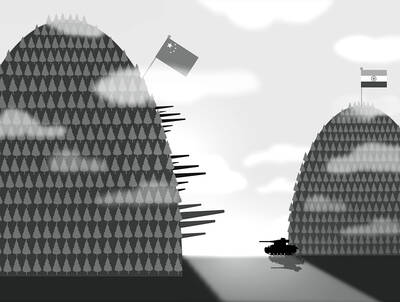
India is not China, and many of its residents fear it never will be. It is hard to imagine a future in which the subcontinent’s manufacturing dominates the world, its foreign investment shapes nations’ destinies, and the challenge of its economic system forces the West to reshape its own policies and principles. However, that is, apparently, what the US administration fears. Speaking in New Delhi last week, US Deputy Secretary of State Christopher Landau warned that “we will not make the same mistakes with India that we did with China 20 years ago.” Although he claimed the recently agreed framework


 RSS
RSS