


One year after its corporatization, the state-owned Taiwan Railway Corp (TRC) is estimated to have sustained NT$12 billion (US$366.24 million) in losses, exceeding the NT$11.4 billion it lost in 2023. The company’s financial report after its corporatization showed that asset depreciation accounted for more than 30 percent of cost expenditure.
However, during the financial reforms of the Kaohsiung MRT and Taiwan High Speed Rail Corp, the central and local governments put a lot of effort into reducing the expenses accrued for depreciation. If the government can help reduce the depreciation of TRC’s expenses, it would fundamentally improve its cost structure and improve its financial performance.
TRC has not adjusted its ticket prices for nearly 30 years. If the ticket prices are not adjusted to reasonably reflect operating costs, it would be difficult for the rail operator to improve its service quality, or provide good salary packages to employees to retain them. That is not a sustainable solution for improving employee morale, customer service quality or safety.
Therefore, the government should assist TRC in creating a reasonable operating service environment and establish a mechanism to automatically adjust its fare rate structure — such as a pricing system based on the consumer price index — to reasonably reflect operating costs.
Ancillary business income is an important source of finance for railway companies in many countries. For example, Kyushu Railway Co, a constituent company of the Japan Railways Group, earns more than half of its total income from its ancillary business.
Most TRC stations are in city centers. Therefore, they should not only function as a railway station, but also strive to be the center of life for the surrounding area. The space around TRC stations can be better developed to provide food, clothing and hotels, so that tourism, travel, education and entertainment needs can be effectively met, thereby creating revenue for ancillary businesses and generating more travel and transportation demand.
Talent must be at the core of TRC for its sustainable development, because personnel play key roles in the organization’s growth. The company must prove to be profitable after corporatization, so that its employees will have confidence in the enterprise while the reasonable benefits and incentive systems would motivate them to stay. Through effective talent promotion, development and training, a learning-oriented organizational culture can be established.
In addition, the safety management system already introduced should be implemented by station staff, conductors, and maintenance and driving personnel, so that risk-management mechanisms are reflected in the daily work routines of frontline railway workers.
The labor union should also play an important role in the sustainable development of TRC. In addition to participating in the company’s development decisions, it should also consider the difficulties and disadvantages of TRC’s current operations and assist management personnel in communicating with colleagues at different organizational levels. A proper mechanism for terminating unsuitable employees must also be established. That would enable the development of a positive corporate culture, which would facilitate TRC to provide the public with a safer, more reliable, faster, more comfortable and friendlier transportation service.
Cheng Yung-hsiang is a professor in National Cheng Kung University’s Department of Transportation and Communication Management Science.
Translated by Lin Lee-kai
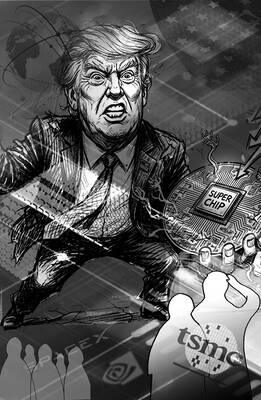
The White House’s decision to take a 9.9 percent stake in Intel Corp is looking like very shrewd business indeed. Since the government bought in at US$20.47 a share last August, the US chipmaker’s surging stock price has delivered the US a US$43 billion return. One of the reasons the investment has so far proved so sound is that the White House has made sure of it. According to The Wall Street Journal, Howard personally pushed deals on Intel’s behalf with some of the most lucrative clients imaginable. They include Nvidia Corp, the company at the heart of the AI
A single photograph can cut through a lot of noise, but it can also be used to misrepresent the truth. At the very least, it can concentrate the mind on something that requires further investigation. On Monday last week, Ma Ying-jeou Foundation CEO Tai Hsia-ling (戴遐齡) and former National Security Council secretary-general King Pu-tsung (金溥聰) held a news conference in which they showed a photograph of former foundation CEO Hsiao Hsu-tsen (蕭旭岑), now Chinese Nationalist Party (KMT) deputy chairman. In the image Hsiao is seated next to Xiamen Taiwan Businessmen Association chairman Han Ying-huan (韓螢煥). The two men were holding
I first met Professor Ray Jiing (井迎瑞) as a film and documentary student at Shih Hsin University’s (SHU) Department of Radio Television and Film in 1988. The following year, he went on to become the director of the Chinese Taipei Film Archive — forerunner of the Taiwan Film and Audiovisual Institute (TFAI). Over his eight-year tenure, Jiing rescued and restored over 200 classic Taiwanese films. In 1997, he established the Graduate Institute of Studies in Documentary and Film Archiving at Tainan National University of the Arts (TNNUA), and I joined the program in his third cohort of students. Beyond a
A recent report concerning a student who is suing his teacher posed the question in its headline: Does failing a student in two subjects constitute bullying? The college student in Chiayi County apparently sought NT$2 million (US$63,603) in state compensation, but a court dismissed the case. The first reaction of many might have been to ask: What has happened to students nowadays? Some say that teachers have lost their authority, while others say students are overindulged. Some even start reminiscing over the days when “whatever the teacher says goes.” However, the real issue might be overlooked if emotional reactions like that are the


 RSS
RSS