

Former legislative speaker Wang Jin-pyng (王金平) on Sunday proposed a new cross-strait narrative, saying: “The two sides of the Taiwan Strait are not subordinate to each other in terms of governance, but share sovereignty without division (兩岸治權互不隸屬,主權同而不分).”
Jurisdiction is one of the necessary conditions included in the definition of sovereignty. According to the 1648 Treaty of Westphalia, the sufficient and necessary condition for sovereignty is that the local government has full and substantial independent authority to govern its region in terms of politics, economy, national security, public affairs and even foreign relations — free from external interference. Therefore, without jurisdiction, there is no sovereignty — period. Jurisdiction is merely a necessary sub-element of sovereignty. How can the two be separated? This is International Relations 101 — a foundational concept taught in introductory political science courses. Are there any Taiwanese academics who can honestly deny this common knowledge?
The Treaty of Westphalia provides a simple formula — first, sovereignty necessarily entails jurisdiction and second, without jurisdiction, there can be no sovereignty.
How can there be two governments claiming sovereignty over the same regions — China and Taiwan? Can even the principle of the indivisibility of sovereignty be distorted?
China has neither sovereignty nor jurisdiction over Taiwan.
Under this principle, the Republic of China holds sovereignty and jurisdiction over Taiwan, while it has no jurisdiction over China and, therefore, no sovereignty over it. Conversely, the People’s Republic of China, both de facto and de jure, holds neither sovereignty nor jurisdiction over Taiwan.
In contrast, Belarus — even though it exercises jurisdiction over its territory — does not have true sovereignty because its foreign affairs are completely controlled by Russia.
This deliberate distortion of such a simple concept explains why domestic and international political and academic circles find other Chinese Nationalist Party (KMT) propositions — including the so-called “1992 consensus” — confusing and murky.
Wang must reconsider before advocating for the distortion of this fundamental concept again.
Simon Tang is an adjunct professor at California State University, Fullerton, who lectures on international relations.
Taiwan’s domestic political situation is following recognizable political rhythms, while the international environment surrounding Taiwan is undergoing a major transformation. Within Taiwan, there are ongoing battles between the legislative and executive branches over the budget, and between cities and the central government over resources. Tensions between political parties dominate headlines and consume much of the attention of party leaders. Jockeying is underway for local elections this November and national elections in 2028. And the longstanding philosophical debate inside Taiwan over how best to protect Taiwan and promote the good life remains unresolved. Amidst all of this, Taiwan continues to function well. It
In an article published on Tuesday in The Atlantic, titled “Will Taiwan Just Give Up?”, journalist Simon Shuster emphasizes the unpredictability of the US as an ally under US President Donald Trump and cites diminishing faith in the US as a contributor to what he sees as waning determination to resist China. As the title suggests, Shuster views a deal between Taiwan and China as an increasingly inevitable alternative to a costly war — one that Taiwan, lacking reliable allies and military capabilities, would eventually be destined to lose. He focuses on Chinese Nationalist Party (KMT) Chairwoman Cheng Li-wun (鄭麗文) — her
With candidate registration for this year’s local elections closed on Sept. 4 and the elections less than 80 days away, Democratic Progressive Party (DPP) Legislator and Taipei mayoral candidate Puma Shen’s (沈伯洋) rapidly growing popularity has become the focus of political talk shows and online discussions over the past week, heating up the mayoral election race in Taipei. Local media headlines and political pundits have picked up his supporters’ slogan “ocean current” (洋流) — a play on the last character of Shen’s name, which literally means “ocean” (洋), and the character (流), which can mean “current,” “flow” or “trend” — to
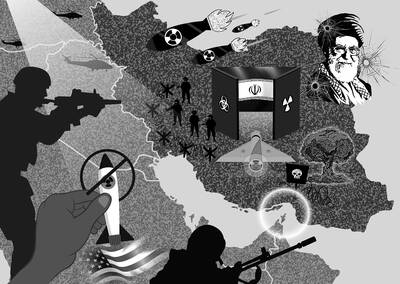
When was the last time you heard a meaningful proposal to prevent Iran from developing a nuclear arsenal? There has been nothing on the subject since the June Memorandum of Understanding between the US and Iran; the promised 60 days of talks to settle questions around Tehran’s uranium-enrichment program never began and have long since expired. When the war was launched, on Feb. 28, a resolution of the nuclear dispute was prominent among the dizzying array of US and Israeli aims to explain the attack. But as should be clear by now, the attempt was entirely reliant on achieving regime change. That


 RSS
RSS