


The International Longshoremen’s Association (ILA) scored a victory for its 45,000 dockworkers this month: After its three-day strike against the consortium of companies that operate ports in the eastern half of the US, it secured a significant raise for members.
However, while the dockworkers won this battle, it seems more than likely that they would ultimately lose the war. That is because this strike was about more than pay — it was also about an even bigger threat to workers’ livelihoods: automation.
If history is any guide, stopping the automation of US ports would be an uphill struggle. The idea that machines and technology could improve shipping is nothing new. In fact, it took root almost 70 years ago, when an outsider transformed the business, and eventually, the global economy.
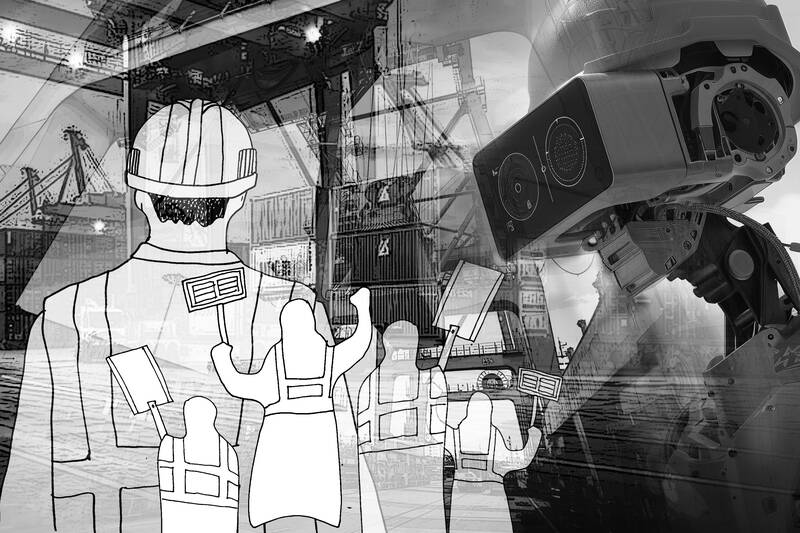
Illustration: Tania Chou
Prior to the 1950s, getting products from a factory in the US to consumers in, say, India, was a difficult proposition. Goods would arrive by train or truck at a warehouse near a port, where workers unloaded each item to await shipment. When a freighter arrived in port, workers would then load the goods back on trucks and train cars and bring them to the docks to be unloaded yet again.
Then the fun began. The dockworkers — known as longshoremen — would take items destined for the same part of the world and place them on wooden pallets. Once the pallet was piled high, it would be carried aloft by a crane and deposited in the hold of the ship. More longshoremen would then unload the pallet, piece by piece, placing each in its assigned place within the hold. When the vessel reached its destination, the entire process would be repeated in reverse.
The work of the men who made this system function was dirty, dangerous and time-consuming, depending more on muscle than anything else. Labor accounted for about half the total cost of shipping goods by sea and it was needed in bulk: In the 1950s, for example, New York City had more than 50,000 longshoremen toiling on the docks. (Compare that with today, when the ILA’s total membership — spanning the east and central coasts from Maine to Texas — is about 45,000 workers.)
A man named Malcolm McLean consigned this system to history’s dustbin. As Marc Levinson explains in his history of containerization, McLean was an unlikely revolutionary: While he had made a small fortune building a trucking business, he knew next to nothing about shipping.
In the 1950s, McLean had a serious problem on his hands: highway congestion. In response, he formulated an unusual plan to avoid high-traffic areas: truckers would drive their vehicles directly onto freighters at one port — and leave behind the trailer and cargo. When the ship reached its destination, other trucks from the fleet could take the trailers back on land.
This plan, though, wasted a lot of space in the cargo hold. McLean concluded it would be better if he could detach the body of the trailer and simply stack them on the deck of the freighter. These rectangular boxes could then be unloaded at the destination and placed back on trailers. There was no loading or unloading of goods, just big containers moving from one place to another.
To test the idea, McLean needed containers and a ship. He got the former from Brown Industries, based in Spokane, Washington, where the company’s chief engineer, Keith Tantlinger, had developed lightweight aluminum shipping containers.
The ship was nothing special: a cast-off oil tanker from World War II. McLean rebuilt the deck to accommodate his containers and christened it the Ideal-X. On April 26, 1956, cranes in the port of Newark deposited a container onto the ship’s deck every seven minutes. The Ideal-X then made its way to Houston, Texas, where cranes plucked the boxes from the deck and set them on the trailers of waiting trucks.
Until this voyage, the cost of loading loose cargo on a ship of this size averaged about US$5.83 per tonne. The cost of loading the Ideal-X, by contrast, was US$0.16 per tonne — a cost reduction of 97 percent. That savings was largely labor: McLean’s boxes eliminated most of the muscle required to load and unload ships.
His experiment launched a revolution in the business of moving goods to market. As Levinson wrote: “McLean understood that reducing the cost of shipping goods required not just a metal box but an entire new way of handling freight.”
In the past, trains, trucks and ships operated as discontinuous enterprises linked by human labor. Now they began to coalesce into a single system, with the container at its core.
The longshoremen quickly grasped what containerization meant for their way of life. By 1958, New York’s chapter of the ILA resolved that it would no longer service any cargo arriving in containers.
The New York Times described the battle as a “show-down fight against the ‘off-pier’ containerization of freight ... and the automation of dockside cargo handling.”
In a series of tense negotiations that played out over the following decade, the longshoremen unions came to an agreement with the shipping companies. In exchange for allowing containerization and automation to proceed, the shipping companies would effectively guarantee employment at a healthy wage for a small number of full-time workers. Instead of toiling on the docks, the longshoremen would operate the cranes, forklifts and other machines.
This agreement, hammered out in the wake of strikes and walkouts that erupted in the late 1950s and 1960s, dramatically thinned the ranks of longshoremen in the US, even as it left behind a smaller cohort of well-paid, full-time workers. It also enabled McLean’s containers, once a novelty, to conquer the world.
It is this deeper history that helps explain what is happening now. The longshoremen, facing a new threat — robots and artificial intelligence — have secured a pay raise and some promise of security, much as they did many decades ago. Yet this victory, however impressive, should not obscure the fact that the dockworkers have been fighting a rearguard action ever since the Ideal-X set sail so many decades ago. The future will almost certainly be defined by more automation, fewer workers, and yes, more containers.
Stephen Mihm, a professor of history at the University of Georgia, is coauthor of Crisis Economics: A Crash Course in the Future of Finance.
This column does not necessarily reflect the opinion of the editorial board or Bloomberg LP and its owners.
The image was oddly quiet. No speeches, no flags, no dramatic announcements — just a Chinese cargo ship cutting through arctic ice and arriving in Britain in October. The Istanbul Bridge completed a journey that once existed only in theory, shaving weeks off traditional shipping routes. On paper, it was a story about efficiency. In strategic terms, it was about timing. Much like politics, arriving early matters. Especially when the route, the rules and the traffic are still undefined. For years, global politics has trained us to watch the loud moments: warships in the Taiwan Strait, sanctions announced at news conferences, leaders trading
The saga of Sarah Dzafce, the disgraced former Miss Finland, is far more significant than a mere beauty pageant controversy. It serves as a potent and painful contemporary lesson in global cultural ethics and the absolute necessity of racial respect. Her public career was instantly pulverized not by a lapse in judgement, but by a deliberate act of racial hostility, the flames of which swiftly encircled the globe. The offensive action was simple, yet profoundly provocative: a 15-second video in which Dzafce performed the infamous “slanted eyes” gesture — a crude, historically loaded caricature of East Asian features used in Western

Is a new foreign partner for Taiwan emerging in the Middle East? Last week, Taiwanese media reported that Deputy Minister of Foreign Affairs Francois Wu (吳志中) secretly visited Israel, a country with whom Taiwan has long shared unofficial relations but which has approached those relations cautiously. In the wake of China’s implicit but clear support for Hamas and Iran in the wake of the October 2023 assault on Israel, Jerusalem’s calculus may be changing. Both small countries facing literal existential threats, Israel and Taiwan have much to gain from closer ties. In his recent op-ed for the Washington Post, President William
A stabbing attack inside and near two busy Taipei MRT stations on Friday evening shocked the nation and made headlines in many foreign and local news media, as such indiscriminate attacks are rare in Taiwan. Four people died, including the 27-year-old suspect, and 11 people sustained injuries. At Taipei Main Station, the suspect threw smoke grenades near two exits and fatally stabbed one person who tried to stop him. He later made his way to Eslite Spectrum Nanxi department store near Zhongshan MRT Station, where he threw more smoke grenades and fatally stabbed a person on a scooter by the roadside.


 RSS
RSS