


Taiwan brought home seven medals from the Paris Olympics, the nation’s second-highest medal tally in Olympic history. Taiwanese watched as their athletes took to the Olympic stage with fearlessness and confidence.
If Taiwan is to build on this success and achieve greater things four years from now, it needs the right strategy. The government should implement more specific and effective policies:
First, sports associations must fulfill their duties, as they are Taiwan’s primary link to international sports competitions such as the Asian and Olympic games. Under the current system, associations almost exclusively oversee selection processes and participation rights of national athletes.
However, their methods often create confusion. Are they cultivating sports talent or using athletes to secure funding?
The Legislative Yuan has passed revisions to the National Sports Act (國民體育法) in an attempt to improve athletes’ rights, as well as promote institutionalization and transparency within sports associations, but the effectiveness of the legislation remains to be seen.
South Korea’s dominance in archery is an example of how a well-organized and transparent system can produce winners.
“The archery training system in South Korea is very well-developed. Through elementary school, junior high, high school and into professional teams, athletes can continuously advance in the sport because the Korea Archery Association operates fairly,” athlete Kim Woo-jin said after securing one of his golds in Paris. “Everyone has the same starting point.”
Second, increased support for the sports industry would increase employment opportunities, providing long-term career paths for athletes. Just as the Ministry of Culture supports cultural endeavors, the government should systematically develop the sports sector so that outstanding athletes can continue growing professionally even after retirement.
Many parents do not support their children’s pursuit of sports because they see it as only offering limited opportunities and short-lived careers. They believe the path to a professional career and winning medals is too narrow and the threshold too high. If a child cannot succeed as an athlete, what other options do they have?
This, along with Taiwan’s declining birthrate, has contributed to a shortage of student athletes. Helping athletes make full use of their skills to continue contributing to sports beyond their peak competitive years will provide them with more options.
The development of professional sports and a steady rise in spectator numbers have provided a glimmer of hope. Participation in events such as marathons has also reached record highs.
In general, there is more public engagement in sports, so the government should help parents envision a positive future for their children in sports. This is the best solution to the shortage of student athletes.
Third, unused space should be utilized to build national-level training venues, while sports centers — which lag behind those in Japan and South Korea — should be upgraded.
In addition, the government should work with local governments to revitalize state-owned land and make effective use of idle public facilities. By assessing resources and implementing rolling management, diversified use of sports facilities can be promoted. This would improve grassroots support for sports.
Short-term and long-term strategies must be developed to establish national-level training centers that reflect the unique characteristics of Taiwan.
Charles Yu is a professor and head of National Chung Hsing University’s Graduate Institute of Sports Health and Management.
Translated by Nicole Wong
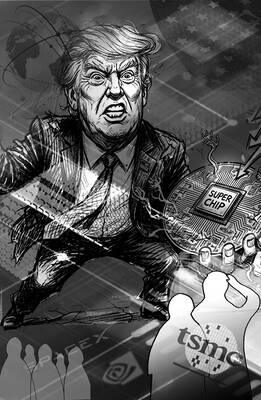
The White House’s decision to take a 9.9 percent stake in Intel Corp is looking like very shrewd business indeed. Since the government bought in at US$20.47 a share last August, the US chipmaker’s surging stock price has delivered the US a US$43 billion return. One of the reasons the investment has so far proved so sound is that the White House has made sure of it. According to The Wall Street Journal, Howard personally pushed deals on Intel’s behalf with some of the most lucrative clients imaginable. They include Nvidia Corp, the company at the heart of the AI
A single photograph can cut through a lot of noise, but it can also be used to misrepresent the truth. At the very least, it can concentrate the mind on something that requires further investigation. On Monday last week, Ma Ying-jeou Foundation CEO Tai Hsia-ling (戴遐齡) and former National Security Council secretary-general King Pu-tsung (金溥聰) held a news conference in which they showed a photograph of former foundation CEO Hsiao Hsu-tsen (蕭旭岑), now Chinese Nationalist Party (KMT) deputy chairman. In the image Hsiao is seated next to Xiamen Taiwan Businessmen Association chairman Han Ying-huan (韓螢煥). The two men were holding
I first met Professor Ray Jiing (井迎瑞) as a film and documentary student at Shih Hsin University’s (SHU) Department of Radio Television and Film in 1988. The following year, he went on to become the director of the Chinese Taipei Film Archive — forerunner of the Taiwan Film and Audiovisual Institute (TFAI). Over his eight-year tenure, Jiing rescued and restored over 200 classic Taiwanese films. In 1997, he established the Graduate Institute of Studies in Documentary and Film Archiving at Tainan National University of the Arts (TNNUA), and I joined the program in his third cohort of students. Beyond a
A recent report concerning a student who is suing his teacher posed the question in its headline: Does failing a student in two subjects constitute bullying? The college student in Chiayi County apparently sought NT$2 million (US$63,603) in state compensation, but a court dismissed the case. The first reaction of many might have been to ask: What has happened to students nowadays? Some say that teachers have lost their authority, while others say students are overindulged. Some even start reminiscing over the days when “whatever the teacher says goes.” However, the real issue might be overlooked if emotional reactions like that are the


 RSS
RSS