


The ukiyo-e artist Hokusai was famed for his Thirty-six Views of Mount Fuji, woodblock prints deeply symbolic of Japan — but one famous view of the mountain, this time from the modern era, has just been blocked off.
Local authorities in Fujikawaguchiko, a holiday town in the mountain’s shadow, this week erected a barrier obstructing a sight of the landmark that, from the right angle, made it appear to float above a convenience store in perhaps the ultimate illustration of traditional and modern Japan.
Although it might have been gold for Instagram, the rush of tourists was not appreciated by residents, who complained that visitors were littering, blocking access to services used by residents and spilling out dangerously onto the road in the quest for the perfect shot.
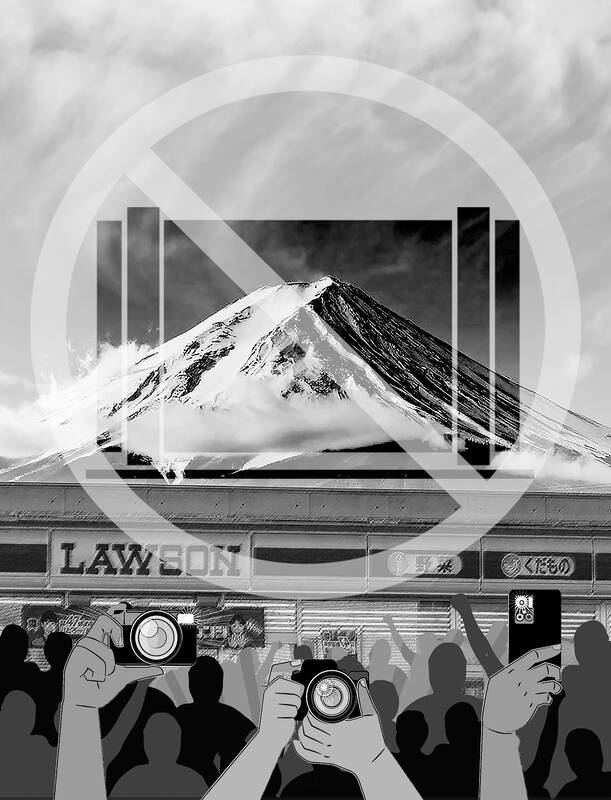
Illustration: Louise Ting
The end result: No one gets to enjoy the view. It is a solution to the problem that would make The Simpsons’ Mr Burns proud.
The government has been promoting the country to foreign visitors for years with immense success. Arrivals this year are expected to surpass the 2019 pre-COVID-19 record, travel agency JTB Corp said. Yet from increasingly unaffordable hotels to suitcase-clogged streets becoming nigh-unwalkable, the downsides are mounting for ordinary residents.
That dissatisfaction was articulated by one acerbic restaurant owner who last month took to social media to express mounting frustration with having to deal with tourists looking for English menus and service in their native language.
The time and hassle involved in dealing with them did not make sense for travelers who do not spend much anyway, the owner said.
The complaints split opinion, with some sympathizing, while others defended the country’s vaunted omotenashi — a word so synonymous with the Japanese welcome that it just made it into the Oxford English Dictionary (“good hospitality, characterized by thoughtfulness, close attention to detail, and the anticipation of a guest’s needs,” in case you were wondering).
However, just as in Fujikawaguchiko, that courtesy might be reaching its limits. Frustrated authorities and small-business owners are turning to new solutions to preserve their way of life. In Kyoto, where over-tourism is most acute, visitors have been banished from the backstreets of the geisha district of Gion (although it is unclear how this would be enforced), while the city is belatedly adding special buses for travelers amid complaints that elderly residents cannot access public transportation.
In Hiroshima, one restaurant serving the local soul food of okonomiyaki (coincidentally, another word just added to the dictionary) has declared visitors verboten on Friday evenings, limiting entrance to prefectural residents and regulars.
Part of the problem is that the pain of dealing with tourists is readily apparent, but the benefits — whether increased tax revenue or booming businesses — are often less visible. With about 40 percent of visitors traveling to Japan for the first time and social media pushing people to the same locations, some destinations are deserted, while others are well past capacity.
Especially with the yen trading at about ¥156 to the US dollar, foreigners can live like kings without spending that much. That exacerbates the frustration in a country where real wages have been stagnant for decades and are declining.
Many of the country’s iconic experiences, from the Mount Fuji convenience store to shooting video at Shibuya’s “Scramble Crossing,” simply do not cost any money.
Japan is far from alone in grappling with the issue. Barcelona has removed a bus route from map apps due to overcrowding. Venice just introduced a 5 euro (US$5.39) entrance tax during peak hours. Advocates in Mallorca have even erected fake signs in English, hoping to scare off vacationers by warning them of nonexistent dangers (an approach I am seriously considering imitating in Shibuya).
It is the pace of change where things are different. Countries such as Italy and Spain have had decades to get used to a tourist influx. Japan became one of the world’s most desired destinations practically overnight. The number of visitors to those European countries grew by about 20 percent between 2014 and 2019. In Japan, that figure more than doubled Of course, the former get two countries three to four times the absolute number.
Locals had only just started to get used to the arrivals when the unforeseen interregnum of COVID-19, reducing visitors to practically zero. Their sudden return has only intensified residents’ discontent.
Now the downsides keep stacking up. Hotel prices are surging, up 20 percent from last year, leaving some business travelers struggling to find lodging. Hotels are finding it relatively easy to raise prices to cope with a growing labor shortage in the services sector. Other industries that do not get a boost from tourist demand are not so lucky.
The country needs to grapple with these problems before over-tourism replaces omotenashi. The weak yen might be a tailwind now, but more than 30 million people still visited Japan in 2019 even with the currency closer to ¥100 to the dollar.
There are a couple of possible quick wins. The country charges a paltry ¥1,000 departure tax: That needs to be quadrupled or more. Ditto with the accommodation tax that some areas charge, including Tokyo, levied at only ¥100 to ¥200 per night.
Services only used by foreigners should impose much higher prices, such as the 70 percent increase levied last year on the Japan Rail Pass, a product only for tourists, which gives unlimited rides on the main Shinkansen line. The duty-free system, which exempts the 10 percent consumption tax for purchases of more than ¥5,000, has long since outlived its usefulness, with billions of yen being lost to scalpers. The system should be scrapped or the minimum spend hugely increased.
Ultimately, these are short-term solutions to make putting up with the pain a little easier. Japan needs fixes better than simply blocking everything off.
Gearoid Reidy is a Bloomberg Opinion columnist covering Japan and the Koreas. He previously led the breaking news team in North Asia, and was the Tokyo deputy bureau chief. This column does not necessarily reflect the opinion of the editorial board or Bloomberg LP and its owners.

On March 22, 2023, at the close of their meeting in Moscow, media microphones were allowed to record Chinese Communist Party (CCP) dictator Xi Jinping (習近平) telling Russia’s dictator Vladimir Putin, “Right now there are changes — the likes of which we haven’t seen for 100 years — and we are the ones driving these changes together.” Widely read as Xi’s oath to create a China-Russia-dominated world order, it can be considered a high point for the China-Russia-Iran-North Korea (CRINK) informal alliance, which also included the dictatorships of Venezuela and Cuba. China enables and assists Russia’s war against Ukraine and North Korea’s
After thousands of Taiwanese fans poured into the Tokyo Dome to cheer for Taiwan’s national team in the World Baseball Classic’s (WBC) Pool C games, an image of food and drink waste left at the stadium said to have been left by Taiwanese fans began spreading on social media. The image sparked wide debate, only later to be revealed as an artificially generated image. The image caption claimed that “Taiwanese left trash everywhere after watching the game in Tokyo Dome,” and said that one of the “three bad habits” of Taiwanese is littering. However, a reporter from a Japanese media outlet
Taiwanese pragmatism has long been praised when it comes to addressing Chinese attempts to erase Taiwan from the international stage. “Taipei” and the even more inaccurate and degrading “Chinese Taipei,” imposed titles required to participate in international events, are loathed by Taiwanese. That is why there was huge applause in Taiwan when Japanese public broadcaster NHK referred to the Taiwanese Olympic team as “Taiwan,” instead of “Chinese Taipei” during the opening ceremony of the Tokyo Olympics. What is standard protocol for most nations — calling a national team by the name their country is commonly known by — is impossible for
The Iran war has exposed a fundamental vulnerability in the global energy system. The escalating confrontation between Iran, Israel and the US has begun to shake international energy markets, largely because Iran is disrupting shipping through the Strait of Hormuz. This narrow waterway carries roughly one-third of the world’s seaborne oil, making it one of the most strategically sensitive energy corridors in the world. Even the possibility of disruption has triggered sharp volatility in global oil prices. The duration and scope of the conflict remain uncertain, with senior US officials offering contradictory signals about how long military operations might continue.


 RSS
RSS