


On Wednesday morning last week, an earthquake off the east coast, measuring 7.2 on the Richter scale, was felt across the country, but Hualien County was hit the worst.
As of Sunday, 13 people have died and more than 1,000 have been injured.
The quake was almost as powerful as 1999’s devastating 921 Earthquake, making it the strongest to strike Taiwan in the past 25 years.
Taiwan’s geographical location is such that it experiences frequent earthquakes that cause losses to property and lives. By withstanding one such test after another, the government and society have learned and strengthened their resilience against disasters. For example, Taiwan has continually enhanced the earthquake resilience of buildings and infrastructure.
The experience of living through many earthquakes and all kinds of natural disasters has raised people’s awareness and ability to guard against and respond to calamities, so that they can react more calmly and quickly.
President Tsai Ing-wen (蔡英文) and her administration have been steadfastly holding the front line of democracy throughout her eight years in office.
During the COVID-19 pandemic, the government’s efforts in combating the virus drew global attention, as did Taiwan’s irreplaceable role in the manufacturing of semiconductors and other high-technology products.
Therefore, the international community again paid close attention when last week’s earthquake struck. Important political figures from nearly 90 countries expressed their condolences within the first few days.
“Japan is willing to provide Taiwan with any necessary assistance,” Japanese Prime Minister Fumio Kishida posted in traditional Chinese characters. His response was an example of the notion that a problem for Taiwan is also a problem for Japan, and a statement of the close relations between the neighboring countries.
The US “stands ready to provide any necessary assistance,” US National Security Council spokeswoman Adrienne Watson said in a statement.
The UK “stands ready to support in any way we can,” British Secretary of State for Foreign, Commonwealth and Development Affairs David Cameron wrote on X.
European Council President Charles Michel likewise said that the EU is ready to assist.
In Asia, Indian Prime Minister Narendra Modi and Philippine President Ferdinand Marcos Jr also sent messages of condolence, with Modi writing on X: “We stand in solidarity with the resilient people of Taiwan.”
The international community was impressed by Taiwan’s success in minimizing the effects of the disaster.
The Dalai Lama even sent Tsai a message in which he not only expressed condolences, but also praised Taiwan’s quick response to the earthquake.
International media also reported extensively on the earthquake.
A New York Times report on the day of the quake said that Taiwan has continually updated its earthquake prevention and response measures since the 921 Earthquake that killed nearly 2,500 people.
Meanwhile, the Associated Press and French media also discussed why casualties and losses were relatively low in comparison to similar quakes, saying that this highlights the importance of strict earthquake preparedness.
Taiwan’s resilience to disasters and emergency response has indeed improved. The nation started by coping with the immediate disaster and other countries stepped forward to extend a hand of friendship.
Most of the international community’s messages of condolence have come from democratic allies in the Americas, Europe and Japan, and from countries that have diplomatic relations with Taiwan. During Tsai’s eight years in office, her administration’s foreign policy has stayed firmly on the right track, laying the foundation for mutual assistance and cooperation.
As for China, apart from the standard condolences from its Taiwan Affairs Office, Chinese officials “spoke on Taiwan’s behalf” at a UN meeting by thanking the international community for its concern.
However, even in the wake of the earthquake, Chinese People’s Liberation (PLA) aircraft and ships continued harassing Taiwan’s sea and airspace as if nothing had happened. With China saying one thing and doing another, it is not hard to tell which one is false and which is genuine.
On top of dealing with natural disasters, Taiwanese also face the threat of annexation by its thuggish neighbor, China. From Beijing’s point of view, Taiwan is a key starting point for expanding into the Indo-Pacific region.
On Tuesday last week, US President Joe Biden and Chinese President Xi Jinping (習近平) held a telephone conversation in which Xi said that “the Taiwan question is the first red line that must not be crossed in China-US relations.” As well as testing the US’ bottom line with regard to the Taiwan Strait, these words also reveal the order in which China plans to achieve its external ambitions.
Former president Ma Ying-jeou’s (馬英九) visit to China, which started on Monday last week, and his expected second meeting with Xi tomorrow show that the Chinese Communist Party (CCP) is launching a new pro-unification offensive with a strategy focused on sowing division.
During Ma’s visit, which is completely directed by the Chinese side, all on-the-spot reporting of Ma’s activities is limited to Chinese media and certain outlets in Taiwan. This shows that this visit is a political propaganda show aimed at audiences in the two countries.
Notably, given China’s current poor social and economic situation, the Democratic Progressive Party’s victory in January’s presidential election, along with the disadvantageous situation of various countries’ concerted efforts to contain China, Ma’s acceptance of the CCP’s invitation to visit China shows that he is happy to play the role of a political tool, helping Beijing create the illusion of successfully drawing Taiwan toward unification. At the same time, the CCP is also using Ma to rein in Taiwan’s pan-blue and pan-white political camps and put pressure on the incoming administration of president-elect William Lai (賴清德).
American Institute in Taiwan Chair Laura Rosenberger visited Taiwan from March 31 to Saturday, during which she met with major political parties and politicians.
Her trip was aimed not only at counterbalancing China’s power, but also at strongly supporting Taiwan as it continues to play the important role of an “island of resilience” in the worldwide front of resistance against China.
Meanwhile, China has been increasing its provocations in the South China Sea, East China Sea and other waters, confronting Philippine vessels near the Second Thomas Shoal (Renai Shoal, 仁愛暗沙). These moves have aroused shared vigilance among democratic countries.
Biden, Kishida and Marcos are to attend a summit meeting this week, and the US, Japan, the Philippines and Australia on Sunday conducted naval drills in the region.
The PLA’s preparations for simultaneous operations in the South China Sea, East China Sea and Taiwan Strait has actually accelerated the democracies’ determination to jointly resist China.
Although Xi hoped to use his phone call with Biden to conceal China’s “wolf warrior” diplomacy and create a propaganda promoting the illusion of China and the US jointly managing the Indo-Pacific region, US officials quickly clarified that the US president had again emphasized to his counterpart the importance of maintaining peace and stability in the Taiwan Strait and urged China to abide by the principles of the rule of law and freedom of navigation in the South China Sea.
Biden, who has repeatedly said that the US would defend Taiwan, would not be influenced by Xi’s insistence that “the Taiwan question is the first red line that must not be crossed in China-US relations.”
The US and other major democratic countries have repeatedly stated that the Taiwan Strait must remain peaceful and stable. They are showing the Xi regime that it faces an uncrossable red line in the Taiwan Strait.
As long as we continue to protect democracy and build up our own strength, our international friends and allies will support us in building this “island of resilience.”
Translated by Julian Clegg

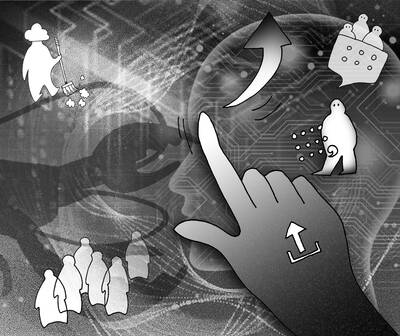
Weeks into the craze, nobody quite knows what to make of the OpenClaw mania sweeping China, marked by viral photos of retirees lining up for installation events and users gathering in red claw hats. The queues and cosplay inspired by the “raising a lobster” trend make for irresistible China clickbait. However, the West is fixating on the least important part of the story. As a consumer craze, OpenClaw — the AI agent designed to do tasks on a user’s behalf — would likely burn out. Without some developer background, it is too glitchy and technically awkward for true mainstream adoption,
A delegation of Chinese Nationalist Party (KMT) officials led by Chairwoman Cheng Li-wun (鄭麗文) is to travel to China tomorrow for a six-day visit to Jiangsu, Shanghai and Beijing, which might end with a meeting between Cheng and Chinese President Xi Jinping (習近平). The trip was announced by Xinhua news agency on Monday last week, which cited China’s Taiwan Affairs Office (TAO) Director Song Tao (宋濤) as saying that Cheng has repeatedly expressed willingness to visit China, and that the Chinese Communist Party (CCP) Central Committee and Xi have extended an invitation. Although some people have been speculating about a potential Xi-Cheng
Chinese Nationalist Party (KMT) Chairwoman Cheng Li-wun (鄭麗文) is leading a delegation to China through Sunday. She is expected to meet with Chinese President Xi Jinping (習近平) in Beijing tomorrow. That date coincides with the anniversary of the signing of the Taiwan Relations Act (TRA), which marked a cornerstone of Taiwan-US relations. Staging their meeting on this date makes it clear that the Chinese Communist Party (CCP) intends to challenge the US and demonstrate its “authority” over Taiwan. Since the US severed official diplomatic relations with Taiwan in 1979, it has relied on the TRA as a legal basis for all
The ongoing Iran conflict is putting Taiwan’s energy fragility on full display — the island of 23 million people, home to the world’s most advanced semiconductor manufacturing, is highly dependent on imported oil and gas, especially that from the Middle East. In 2025, 69.6 percent of Taiwan’s crude oil and 38.7 percent of liquified natural gas were sourced from the Middle East. In the same year, 62 percent of crude oil and 34 percent of LNG to Taiwan went through the Strait of Hormuz. Taiwan’s state-run oil company CPC Corp’s benchmark crude oil price (70 percent Dubai, 30 percent Brent)


 RSS
RSS