


The way things are going in Haiti, violent gangs might not only gain an official government role; they might actually become the government.
Following the gangs’ seizure of critical infrastructure and the resignation of Ariel Henry as prime minister, Haiti is exhibiting all the familiar features of a failed state. Its people are left with a tragic choice: continued rule by a corrupt “democratic” elite, or direct rule by gangs who present themselves as “progressive.”
With law and order having collapsed, CARICOM, the Caribbean regional intergovernmental organization, has announced an agreement to create a transitional council aimed at representing a wide swath of Haitian political and civil-society groupings. The council would wield some powers that typically belong to the (vacant) office of the president, including the power to name an interim prime minister. The resulting government would be expected eventually to hold elections, thus achieving a complete political reset.
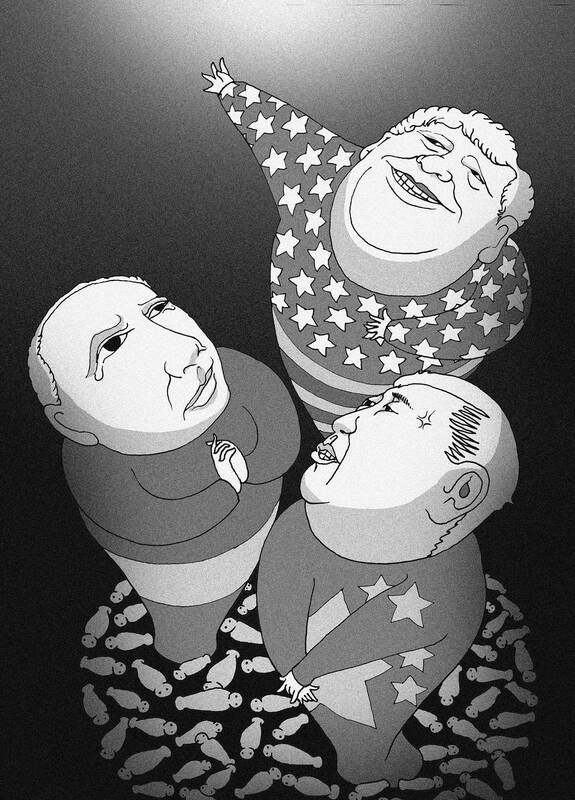
Illustration: Mountain People
But who will these new arrangements include? Haiti has been under a state of emergency since armed groups attacked the nation’s largest prison earlier this month, killing and injuring police and prison staff, and allowing nearly 4,000 inmates to escape. The gang leader, Jimmy “Barbecue” Cherizier — a former police officer — took credit for the attack and called for the government to be overthrown.
Gangs now control 80 percent of Haiti’s capital, Port-au-Prince, having seized the nation’s main airport to block Henry’s return from a diplomatic mission to Kenya, where he was hoping to secure police reinforcements.
The CARICOM agreement bars anyone with prior criminal convictions or sanctions against them, thus disqualifying Cherizier. However, Cherizier has long been known to harbor political aspirations.
He is not only a gang leader, but also a populist politician, telling an interviewer in 2019: “I would never massacre people in the same social class as me.”
Earlier this month, he said: “We won’t lie to people, saying we have a peaceful revolution. We do not have a peaceful revolution. We are starting a bloody revolution in the country.”
Cherizier has likened himself to Martin Luther King Jr, Malcolm X, Che Guevara, Fidel Castro and even Robin Hood. However, he also admires Francois “Papa Doc” Duvalier, the right-wing dictator who ruled Haiti with an iron fist from 1957 to 1971 (and who also terrorized Haitian society with armed paramilitary groups, led by the infamous Tonton Macoutes).
In a warning issued late on the night of Monday last week, Cherizier announced that the alliance of gangs known as Viv Ansanm would not recognize any government resulting from the CARICOM agreement, saying: “It is up to the Haitian people to designate the personalities who will lead the country.”
Similarly, an adviser to Guy Philippe, a Haitian rebel leader who recently returned to the country, warned that Port-au-Prince would be burned to the ground if the next government does not include Philippe.
Haiti’s story is a long-running tragedy. For more than 200 years, it has been punished for the successful slave rebellion (beginning in 1791) that allowed it to emerge as the world’s first black republic. Forced to pay reparations to France, its former colonial overlord, the only chance it ever had to prosper was when Jean-Bertrand Aristide and his Lavalas party took power a couple of decades ago. However, Aristide, a thorn in the US’ side, was toppled in a coup in February 2004.
Haiti is an extreme case of a broader phenomenon. Violent gangs have also occupied parts of cities in Ecuador and Mexico; and, of course, a gang of then-outgoing US president Donald Trump’s supporters stormed the Capitol in Washington on Jan. 6, 2021. Trump now promises that one of his first official acts, if re-elected, would be to pardon all those convicted for their participation in that assault.
The strongest of the gangs that organized the Jan. 6 insurrection are the Proud Boys, an exclusively male neo-fascist organization that openly promotes and engages in political violence. Recall that when asked about his appeal to white supremacist and paramilitary groups at a presidential debate in 2020, Trump infamously responded: “Proud Boys, stand back and stand by.” The group’s leaders have since been convicted of seditious conspiracy and other crimes against the US for their attempt to block the constitutionally prescribed transfer of presidential power.
Interestingly, the Proud Boys have an initiation process that includes physical hazing, such as being punched unless you correctly answer pop-culture trivia questions, and members must “abstain from pornography.”
Strange as these rituals sound, they are familiar mechanisms. Fraternal rituals play the role of poetry, as described by Ernst Junger, a reluctant Nazi fellow-traveler who, like the Proud Boys, celebrated the purifying effect of military struggle: “Any power struggle is preceded by a verification of images and iconoclasm. This is why we need poets — they initiate the overthrow, even that of titans.”
Failed states are no longer confined to a few corners of the Global South. If we measure a state’s failure by the cracks in the edifice of its power — that is, by the evidence of brewing ideological civil wars, deadlocked assemblies and increasingly insecure public spaces —we must recognize that France, the UK and the US are clearly on the spectrum.
The Norwegian political theorist Jon Elster was correct when he wrote in 2020: “We can reverse the common dictum that democracy is under threat, and affirm that democracy is the threat, at least in its short-termist populist form.”
Recent experience offers clear signals of what would happen if Trump wins the November presidential election.
One might appropriately paraphrase an old joke from East Germany: Russian President Vladimir Putin, Chinese President Xi Jinping (習近平) and Trump are given an audience with God and allowed one question each.
Putin begins: “Tell me what will happen to Russia in the next few decades?” God answers: “Russia will gradually become a colony of China.” Putin turns around and starts to cry.
Xi asks the same question about China. God answers: “With the Chinese economic miracle over, you will have to return to a hardline dictatorship to survive, while asking Taiwan for help.” Xi turns around and starts to cry.
Finally, Trump asks: “And what will be the fate of the US after I take over again?” God turns around and starts to cry.
Slavoj Zizek, professor of philosophy at the European Graduate School, is international director of the Birkbeck Institute for the Humanities at the University of London and the author, most recently, of Heaven in Disorder.
Copyright: Project Syndicate
KMT Chairwoman Cheng Li-wun’s (鄭麗文) recent visit to Beijing and her upcoming visit to Washington will serve as a high-level test of her diplomatic mettle. In Beijing, Cheng was received with symbolic gestures, a warm reception, and high-level access. In Washington, she will receive far less pomp and far sharper questions about the KMT’s vision for the future of Taiwan. Her challenge will be to persuade Washington that the KMT’s engagement with China can coexist with strong deterrence. Cheng’s April 7-12 visit to mainland China coincided with an intense period of conflict in Iran. Despite the strategic significance of Cheng’s trip,
The closure of the Strait of Hormuz has sent the vast Asian chemicals industry into a tailspin. Deprived of the likes of Qatari natural gas and Saudi Arabian oil, the region’s fertilizer and plastics plants are slowing production or even shutting down. Everywhere except China, that is. In petrochemicals, China is unique. As well as a traditional industry that uses oil and gas as feedstock, it has parallel output that relies on its abundant domestic coal. Unsurprisingly, India and other regional powers want to copy and paste the Chinese method. This would not be easy — or climate friendly. The
Indonesian President Prabowo Subianto says he knows how to fix the problems facing Indonesia. Yet his economic mismanagement and authoritarian tendencies are steering the nation toward a familiar mix of currency instability and political chaos. The world’s fourth-most populous nation risks reversing the hard-won democratic and business reforms that came after the Asian Financial Crisis in 1997. At that time, the rupiah collapsed and the political upheaval that followed forced former president Haji Mohamed Suharto from power. Prabowo’s administration is ignoring similar warning signs. That disconnect was apparent in a national address on Wednesday, when Prabowo projected the swagger that has
“Of course you can choose not to be Taiwanese, just do not stay here,” chairwoman of Taipei 101 operator Taipei Financial Center Corp Janet Chia (賈永婕) said in an online interview with local entertainer Tai Chih-yuan (邰智源), triggering intense discussion on social media, with politicians across party lines weighing in. In the interview, which was aired on May 14, Chia and Tai’s discussion over a meal in Taipei 101 covered Chia’s career change from entertainer to chairwoman and US climber Alex Honnold’s free solo climb up the Taipei 101 building. During the interview, Chia said, “Being on this land, we


 RSS
RSS