


Vice President William Lai (賴清德) along with his running mate, Hsiao Bi-khim (蕭美琴), won the presidential election, delivering the Democratic Progressive Party (DPP) a third term in office.
However, the green camp spearheaded by the DPP did not win a majority of legislative seats. The Legislative Yuan is to be dominated by three major parties. The DPP would have to collaborate with other political parties to advance its agenda, and this would be more promising if the green camp could collaborate with the white camp led by the Taiwan People’s Party (TPP).
The green and white camps should work out a plan to jointly nominate a legislative speaker and deputy speaker. If the blue and the white camps end up forming an alliance, former Kaohsiung mayor Han Kuo-yu (韓國瑜) might become legislative speaker — a disaster that should be avoided.
After the elections, Chinese Nationalist Party (KMT) supporters flooded the Facebook page of TPP Chairman and presidential candidate Ko Wen-je (柯文哲), blaming him for the failure of the planned “blue-white alliance” that led to Lai and Hsiao’s victory.
Many of those who voted for KMT candidates held their noses while doing so. Deep in their hearts, they did not favor New Taipei City Mayor Hou You-yi (侯友宜). It is unsurprising that Hou lost the election. To add insult to injury, he might even face a recall vote in New Taipei City for his lack of integrity toward city residents.
Many retired soldiers, civil servants and teachers voted for Hou out of personal interest. However, for many others, such as those who have to work hard to make ends meet and cannot afford to retire early, voting for Hou meant little. This is the only reason Hou and his running mate, Jaw Shaw-kong (趙少康), could get more than 4 million votes.
In this sense, the white camp should be the one that the green camp works with. Only in doing so could Taiwan move toward a better future.
Teng Hon-yuan is a university professor.
Translated by Emma Liu
In recent weeks, Taiwan has witnessed a surge of public anxiety over the possible introduction of Indian migrant workers. What began as a policy signal from the Ministry of Labor quickly escalated into a broader controversy. Petitions gathered thousands of signatures within days, political figures issued strong warnings, and social media became saturated with concerns about public safety and social stability. At first glance, this appears to be a straightforward policy question: Should Taiwan introduce Indian migrant workers or not? However, this framing is misleading. The current debate is not fundamentally about India. It is about Taiwan’s labor system, its
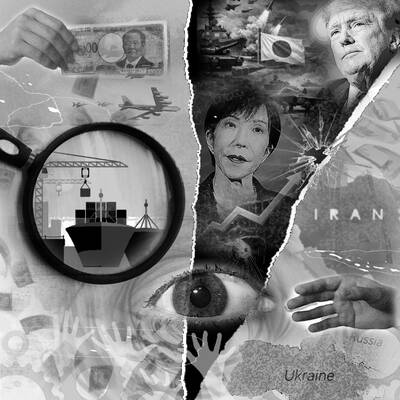
Japan’s imminent easing of arms export rules has sparked strong interest from Warsaw to Manila, Reuters reporting found, as US President Donald Trump wavers on security commitments to allies, and the wars in Iran and Ukraine strain US weapons supplies. Japanese Prime Minister Sanae Takaichi’s ruling party approved the changes this week as she tries to invigorate the pacifist country’s military industrial base. Her government would formally adopt the new rules as soon as this month, three Japanese government officials told Reuters. Despite largely isolating itself from global arms markets since World War II, Japan spends enough on its own
On March 31, the South Korean Ministry of Foreign Affairs released declassified diplomatic records from 1995 that drew wide domestic media attention. One revelation stood out: North Korea had once raised the possibility of diplomatic relations with Taiwan. In a meeting with visiting Chinese officials in May 1995, as then-Chinese president Jiang Zemin (江澤民) prepared for a visit to South Korea, North Korean officials objected to Beijing’s growing ties with Seoul and raised Taiwan directly. According to the newly released records, North Korean officials asked why Pyongyang should refrain from developing relations with Taiwan while China and South Korea were expanding high-level
Swiftly following the conclusion of Chinese Nationalist Party (KMT) Chairwoman Cheng Li-wun’s (鄭麗文) China trip, China’s Taiwan Affairs Office unveiled 10 new policy measures for Taiwan. The measures, covering youth exchanges, agricultural and fishery imports, resumption of certain flights and cultural and media cooperation, appear to offer “incentives” for cross-strait engagement. However, viewed within the political context, their significance lies not in promoting exchanges but in redefining who is qualified to represent Taiwan in dialogue with China. First, the policy statement proposes a “normalized communication mechanism” between the KMT and the Chinese Communist Party (CCP). This would shift cross-strait interaction from


 RSS
RSS