


In a year in which Walt Disney Co struggled with expensive flops and audiences finally fell out of love with superhero movies, Japan scored a best-ever series of soft power hits.
Little by little, the country is getting better at pitching its copious wares overseas, and this year proved that. From Super Mario’s domination at the theater, to Netflix Inc’s adaptation of best-selling manga One Piece, it was a year when audiences demonstrated their increasing fondness for the soft-power superpower.
With The Super Mario Bros Movie, Nintendo Co’s tie-up with Minions creator Illumination Entertainment Inc, the Kyoto-based video game maker scored the second-highest grossing movie of the year worldwide, beaten only by Warner Bros Discovery Inc’s Barbie.
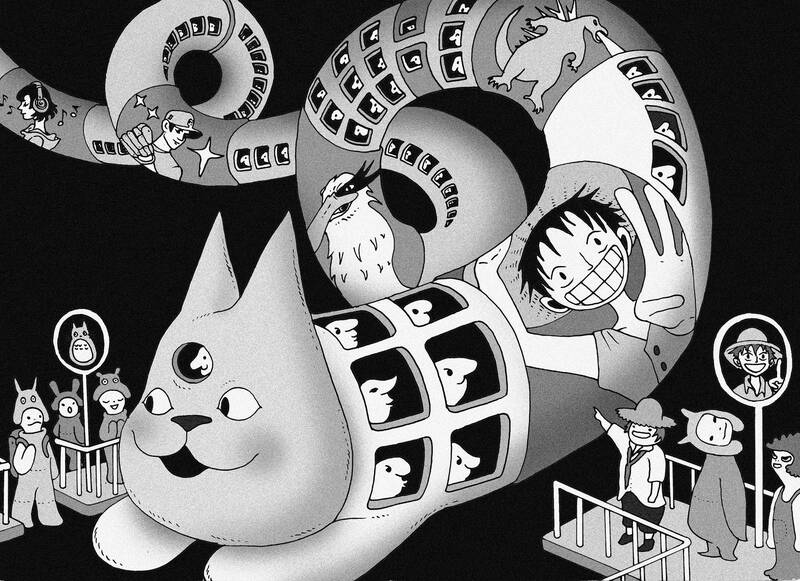
Illustration: Mountain People
Nintendo is the prime example of a Japanese company with a world-class library of intellectual properties that it has, until now, been content not to exploit. That is starting to change: The Mario film ties into Donkey Kong, the ape who will be at the center of the expanded area opening in Osaka’s Universal Studios Japan theme park early next year.
Nintendo also scored a hit with its Legend of Zelda: Tears of the Kingdom video game on Switch, which has sold 20 million copies. Zelda will also be the next of Nintendo’s properties to get the silver-screen treatment, with the company’s shares soaring after announcing a live-action adaptation. With Illumination, Nintendo’s choice of partner for Mario was inspired. It remains to be seen whether director Wes Ball, who is helming next year’s Kingdom of the Planet of the Apes, would prove as on-point a choice.
However, Nintendo is far from the only Japanese firm getting more bang for their bucks overseas. With Godzilla Minus One, Toho Co has not only had the most success ever with one of its Godzilla films overseas — it has produced the highest-grossing live-action Japanese movie at the US box office ever, as well as one of the year’s most critically acclaimed blockbusters.
Elsewhere, legendary animator Hayao Miyazaki’s magnum opus The Boy and the Heron was the first of his films to open at the top of the US box office. The movie, along with Mario and Makoto Shinkai’s Suzume, has been nominated for best animated feature at the Golden Globes — meaning the Japanese properties make up fully half of the nominations.
This time last year, I wrote about how Japan is falling out of love with Hollywood, a trend that was only accelerated this year. Much of the rest of the world often seems to be following suit. Suzume was a smash hit in South Korea, the highest-grossing foreign movie of the year. Its success in Asia was overshadowed by another property perhaps less familiar to English-language readers: The First Slam Dunk, based on the 1990s basketball manga. Much of its box office of US$280 million was earned overseas, with the movie particularly popular with Chinese audiences. Its success is perhaps the most illustrative example yet of how Japan is getting better at exploiting its massive library of intellectual property and generating revenue overseas.
On the small screen too, Netflix finally broke its streak of live-action animation duds with One Piece, the most-watched show worldwide upon its release. While I was not a fan, I am hardly the target audience: The series has been so successful that Netflix is doubling down, not only greenlighting a second season, but commissioning a brand-new animated adaptation of the comic by WIT Studios.
Adaptations of Japanese comic books are a core part of the streaming giant’s strategy, with One Piece joined by the recently released Yu Yu Hakusho. Next up, the streaming platform is planning an adaptation of the superhero manga My Hero Academia, helmed by the director of Alice in Borderland, itself an unusual Japanese-language live-action success exclusive to the platform.
Sales of Japanese comics have long since passed those of Marvel or DC in US stores, but from the success of Sony Group Corp’s dedicated streaming site Crunchyroll, to the sight of rapper Megan Thee Stallion’s viral cosplay of Jujutsu Kaisen characters, the influence of Japanese animation on Gen Z is increasingly evident — and in a world where streamers are hungry for more, the country’s content farms are stepping up. The anime market has more than doubled in size in the 10 years to 2021 to ¥2.74 trillion yen (US$19.5 billion), driven by a fourfold increase from outside Japan.
For a nation that is often said to be staid and unable to innovate, I often contrast the constant string of new franchises that manga and animation churn out against the endless recycling of US comics’ same handful of big hits. The most anticipated comic projects in Hollywood are James Gunn’s Superman: Legacy (the fourth iteration of the Man of Steel on the silver screen), and yet another adaptation of X-Men that will integrate the mutants into Marvel’s cinematic universe. Is it little wonder that audiences are tiring and turning to something new?
It was a more mixed year for Japan’s music industry, which has struggled for decades to sell itself overseas — and has been long since left in the dust by K-pop’s far more savvy management. In one bright spot, Yoasobi became the first Japanese act to score a No. 1 on the Billboard Global ex-US chart. However, the year would be blighted by the downfall of J-pop agency Johnny & Associates Inc, after revelations of sexual abuse committed by deceased founder Johnny Kitagawa came to light after an investigation by the BBC.
Finally, one other notable soft-power success for Japan this year has been in the world of sports, particularly baseball: It defeated the US in the World Baseball Classic, while Shohei Ohtani became the world’s highest-paid athlete with his deferred US$700 million contract with the Los Angeles Dodgers. And he will be joined by the hottest property playing in Japan, star pitcher Yoshinobu Yamamoto.
Millions would be watching their endeavors back home in Japan. Similarly, the Internet, smartphones and translation tools continue to make accessible all kinds of content that would have been considered incredibly niche even a decade ago. Audience tastes are changing, and this year showed they are skewing further east. Of course, the very word itself is Japanese
Gearoid Reidy is a Bloomberg Opinion columnist covering Japan and the Koreas. He previously led the breaking news team in North Asia, and was the Tokyo deputy bureau chief. This column does not necessarily reflect the opinion of the editorial board or Bloomberg LP and its owners.
From the Iran war and nuclear weapons to tariffs and artificial intelligence, the agenda for this week’s Beijing summit between US President Donald Trump and Chinese President Xi Jinping (習近平) is packed. Xi would almost certainly bring up Taiwan, if only to demonstrate his inflexibility on the matter. However, no one needs to meet with Xi face-to-face to understand his stance. A visit to the National Museum of China in Beijing — in particular, the “Road to Rejuvenation” exhibition, which chronicles the rise and rule of the Chinese Communist Party — might be even more revealing. Xi took the members
A Pale View of Hills, a movie released last year, follows the story of a Japanese woman from Nagasaki who moved to Britain in the 1950s with her British husband and daughter from a previous marriage. The daughter was born at a time when memories of the US atomic bombing of Nagasaki during World War II and anxiety over the effects of nuclear radiation still haunted the community. It is a reflection on the legacy of the local and national trauma of the bombing that ended the period of Japanese militarism. A central theme of the movie is the need, at
The Chinese Nationalist Party (KMT) and the Taiwan People’s Party (TPP) on Friday used their legislative majority to push their version of a special defense budget bill to fund the purchase of US military equipment, with the combined spending capped at NT$780 billion (US$24.78 billion). The bill, which fell short of the Executive Yuan’s NT$1.25 trillion request, was passed by a 59-0 margin with 48 abstentions in the 113-seat legislature. KMT Chairwoman Cheng Li-wun (鄭麗文), who reportedly met with TPP Chairman Huang Kuo-chang (黃國昌) for a private meeting before holding a joint post-vote news conference, was said to have mobilized her

Before the Chinese Communist Party (CCP) and its People’s Liberation Army (PLA) can blockade, invade, and destroy the democracy on Taiwan, the CCP seeks to make the world an accomplice to Taiwan’s subjugation by harassing any government that confers any degree of marginal recognition, or defies the CCP’s “One China Principle” diktat that there is no free nation of Taiwan. For United States President Donald Trump’s upcoming May 14, 2026 visit to China, the CCP’s top wish has nothing to do with Trump’s ongoing dismantling of the CCP’s Axis of Evil. The CCP’s first demand is for Trump to cease US


 RSS
RSS