


The economic meeting of the Politburo of the Chinese Communist Party (CCP) that concluded on Friday last week featured the usual rhetoric, yet lacked a clear plan for the future. It was marked by Chinese President Xi Jinping (習近平) endorsing conflicting objectives, the primary inconsistency lying in Xi’s desire to expand the economy while simultaneously avoiding liberalization of market forces and the private sector.
If China is to achieve Xi’s goal of doubling the size of its economy by 2035, the country has to maintain annual GDP growth of 5 percent. Most experts believe this type of rapid growth is no longer possible.
One of the major contributing factors is Xi’s return to Mao-like control and ideology. In Xi’s third term, a key domestic policy focus seems to be an increased emphasis on securing several aspects of governance, with a particular spotlight on economic policy. In his report to the 20th party congress in October last year, Xi emphasized the need for national security to be integrated into every facet and stage of governance. On top of his economic goals for 2035, he also charged the CCP with comprehensively enhancing the national security system by the same year.
In 1978, Deng Xiaoping (鄧小平) initiated a period of “reform and opening,” leading to economic liberalization that lifted living standards. By the 1990s, private property was recognized and eventually entrepreneurs were permitted to join the CCP. However, the government, while permitting economic reforms, always aimed to maintain control.
Friction between the government and the private sector has now materialized, disrupting the private economy. A heightened focus on security has resulted in stricter economic control. Xi has asserted dominance over the leaders of China’s major private companies, causing concern for domestic and foreign businesses. This is one of the reasons that foreign direct investment in China has been trending downward.
The model of growth controlled by the central government is proving unsustainable. Investment has accounted for as much as 40 percent of China’s GDP, while in most G7 nations, it is only about 20 percent. Continued investment in infrastructure would be wasteful as most of the necessary infrastructure has been built. Additional infrastructure investment would just provide short-term, illusory growth, coupled with overcapacity and increased debt.
Additional investment in manufacturing capacity could potentially be helpful, but the US and other nations are presently reshoring manufacturing at home or friend-shoring, shifting production to countries such as India, Vietnam and Indonesia. Recently Mexico became the No. 1 trade partner of the US. Since state-sponsored growth is proving less viable, supporting the private sector seems the best way forward.
On Nov. 27, the State Council of the People’s Republic of China unveiled its “Notice on Strengthening Financial Support Measures for the Private Economy,” which included a variety of measures to rejuvenate the private sector. It contained a particular focus on areas such as technological innovation and assistance for small and medium-sized enterprises. The plan would increase the availability of loans for private businesses, lower interest rates and utilize financial tools such as bonds, to increase the amount of credit open to private enterprises.
These support measures are a clear example of the schizophrenic nature of Xi’s policies. On the one hand, he recognizes that he needs to support the private sector. On the other hand, his focus on security has led to legislation that suppresses the private sector. China’s Counter-Espionage Law prompted raids on consulting firms. His anti-corruption campaign has purged numerous companies, with tech firms being a specific target. Under Xi, the “party-state capitalism” approach includes the “golden share” initiative. This positions the CCP within the boards of directors of leading Chinese companies, enhancing the government’s surveillance and censorship capabilities.
Another contradiction is that, at the meeting, and at numerous other times, Xi has said that he wants to shift China to a consumption-driven economy, but he has not implemented policies which would make that a reality. The lack of a social safety net, along with low wages and rising housing prices, have left households unable to increase consumption.
Any specific plans the CCP introduces to boost growth are likely to falter due to their failure to tackle the contradictions within Xi’s ideology and objectives. A tightly regulated economy might struggle to capitalize on the benefits of a free market, where creativity and opportunities lead to higher profits, rather than being perceived as threats to CCP control. Given the private sector’s potential to innovate and grow, suppressing it might impede China’s ambition to become the leading global economic power.
To maintain high growth, China needs to boost consumption. The focus should be on fostering internal demand and innovation as the main drivers of the economy, but supported by foreign investment and trade. If Xi were to just remove the stoppers, and allow market forces to work, a sustainable growth model would develop spontaneously.
However, this does not appear to be Xi’s plan for the future.
Antonio Graceffo, a China economic analyst who holds a China MBA from Shanghai Jiaotong University, studies national defense at the American Military University in West Virginia.
In recent weeks, Taiwan has witnessed a surge of public anxiety over the possible introduction of Indian migrant workers. What began as a policy signal from the Ministry of Labor quickly escalated into a broader controversy. Petitions gathered thousands of signatures within days, political figures issued strong warnings, and social media became saturated with concerns about public safety and social stability. At first glance, this appears to be a straightforward policy question: Should Taiwan introduce Indian migrant workers or not? However, this framing is misleading. The current debate is not fundamentally about India. It is about Taiwan’s labor system, its
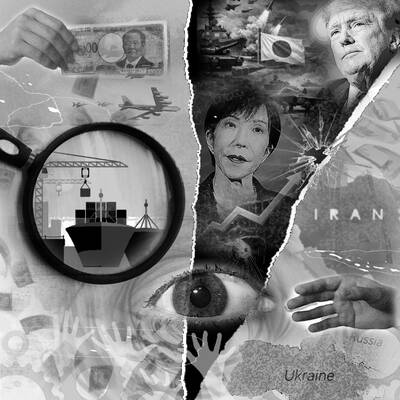
Japan’s imminent easing of arms export rules has sparked strong interest from Warsaw to Manila, Reuters reporting found, as US President Donald Trump wavers on security commitments to allies, and the wars in Iran and Ukraine strain US weapons supplies. Japanese Prime Minister Sanae Takaichi’s ruling party approved the changes this week as she tries to invigorate the pacifist country’s military industrial base. Her government would formally adopt the new rules as soon as this month, three Japanese government officials told Reuters. Despite largely isolating itself from global arms markets since World War II, Japan spends enough on its own
On March 31, the South Korean Ministry of Foreign Affairs released declassified diplomatic records from 1995 that drew wide domestic media attention. One revelation stood out: North Korea had once raised the possibility of diplomatic relations with Taiwan. In a meeting with visiting Chinese officials in May 1995, as then-Chinese president Jiang Zemin (江澤民) prepared for a visit to South Korea, North Korean officials objected to Beijing’s growing ties with Seoul and raised Taiwan directly. According to the newly released records, North Korean officials asked why Pyongyang should refrain from developing relations with Taiwan while China and South Korea were expanding high-level
Swiftly following the conclusion of Chinese Nationalist Party (KMT) Chairwoman Cheng Li-wun’s (鄭麗文) China trip, China’s Taiwan Affairs Office unveiled 10 new policy measures for Taiwan. The measures, covering youth exchanges, agricultural and fishery imports, resumption of certain flights and cultural and media cooperation, appear to offer “incentives” for cross-strait engagement. However, viewed within the political context, their significance lies not in promoting exchanges but in redefining who is qualified to represent Taiwan in dialogue with China. First, the policy statement proposes a “normalized communication mechanism” between the KMT and the Chinese Communist Party (CCP). This would shift cross-strait interaction from


 RSS
RSS