


Even by the standards of the space race, the idea seemed bold, maybe a bit crazy. In 1968, before the first human set foot on the moon, an engineer working on one of the Apollo mission’s experiments proposed a new way to power the world. Giant orbiting solar power plants could soak up the constant sunshine in space — unhindered by clouds, night or seasons — and beam it back to Earth, Peter Glaser wrote in the journal Science. Only space-based solar and perhaps nuclear fusion held the potential to one day replace fossil fuels as civilization’s main energy source, and fusion was so far off that Glaser dismissed it as “the physicist’s dream.”
This May, researchers huddled on a rooftop in Pasadena, California, received a ping of energy from an experiment passing high overhead. Designed at the California Institute of Technology and launched on a SpaceX rocket in January, the experiment had transferred power wirelessly, shifted the direction of the beam with no moving parts and then aimed it at Earth. It is one of three Caltech experiments, packed onto a single satellite, now testing key components of a space-based solar system. Glaser’s dream has inched closer to reality.
“When I first thought about this, to me, it was preposterous,” says Caltech professor Harry Atwater, a leader of the school’s Space Solar Power Project. “But then I started thinking, and it sort of gnawed at me, and I couldn’t let go of it.”
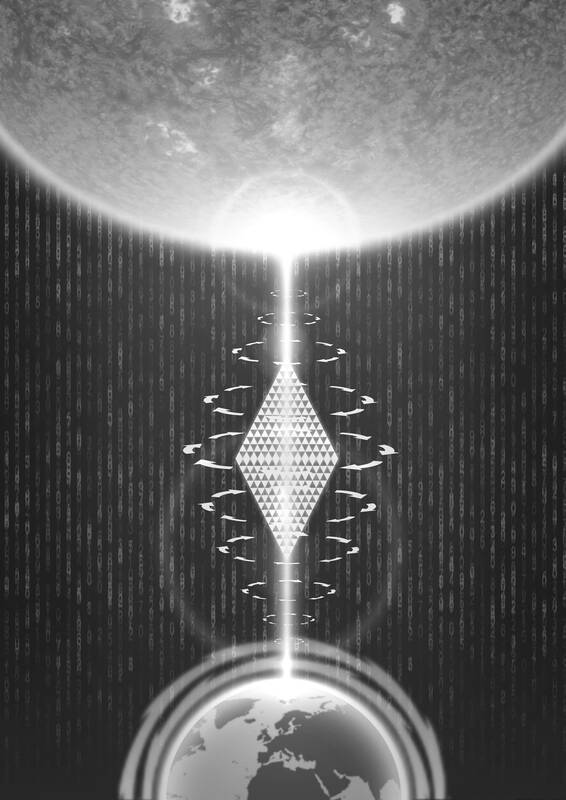
Illustration: Yusha
Atwater is part of a new generation of engineers — driven by climate change and armed with technologies unavailable to Glaser, who died in 2014 — betting that space solar’s time has finally arrived. Thin-film solar cells and carbon-fiber building materials have slashed the potential weight of orbiting plants, and private launch companies such as SpaceX have cut the cost of lofting them into space. Construction would not require highly trained astronauts laboring in suits; plant components stowed for launch could unfold themselves in space.
In 2020 the US Naval Research Laboratory used the military’s X-37B space plane to launch a device that converts solar energy directly into microwaves, a building block for future orbiting power plants. The European Space Agency has its own space solar program, though it remains years away from conducting orbital experiments, as do China, Japan and the UK. Nikolai Joseph, an analyst at NASA, said last year that the agency would take another look at the idea’s feasibility, but so far the storied organization does not seem to be actively engaged in the race.
Creating a network of orbiting solar plants, however, remains a daunting task, not only to design the plants but also to prove that they can make economic sense. The hurdles that have grounded space-based solar in the past are not merely technical, they are also financial.
“Nobody’s shown that any of the challenges cannot be solved,” says Sanjay Vijendran, leader of the Solaris initiative at the European Space Agency (ESA). “There are no showstoppers. There are, of course, huge challenges. But we have to make a start at some point. We don’t have a decade to lose.”
A report by the Frazer-Nash Consultancy for the UK government in 2021 found that space-based solar power could one day have a levelized cost of energy (which includes capital costs as well as operations) of £35 to £79 (US$43 to US$96) per megawatt-hour, following an 18-year development program. This seems optimistic, considering that BloombergNEF says a new US wind farm with back-up batteries — proven, frequently deployed technologies — would have a levelized cost from US$63 to US$103 per MWh.
The people pursuing space-based solar understand its status as one of those long-sought breakthroughs that always seem a decade away. To generate a meaningful amount of energy, the plants would have to be far larger than any objects humans have placed in orbit to date. They could be damaged by micrometeorites or space junk, and the would have to overcome the inherent loss of energy that transmitting power by microwave — the most likely method, because microwaves pierce clouds — entails.
The basic idea stretches back even further than Glaser. Author Isaac Asimov set his 1941 short story “Reason” aboard a space station that absorbs the energy of the sun and beams it to a distant Earth, though the technology the station uses is never spelled out. Atwater’s colleague Ali Hajimiri found a translation of the story while growing up in Iran. “I was exposed to that from an early age,” he says. “It was more of the science-fiction realm for me.”
Billionaire real-estate developer Donald Bren, a Caltech trustee, read about space-based solar power in the magazine Popular Science, and in 2011 he discussed setting up a research program with the school’s president. He and his wife, Brigitte, a fellow trustee, have since donated more than US$100 million to the effort. The school roped in Atwater, a veteran of several solar-power startups, and Hajimiri, who specializes in integrated circuits and the wireless transfer of power. Sergio Pellegrino, whose interests include lightweight structures, rounded out the team.
They decided the approach that space-based solar advocates had taken in the past would not work. Their alternative is radically different, something Hajimiri describes as going from an elephant to an army of ants. Instead of a massive solid structure in space, each of Caltech’s power plants would be a fleet of detached, kitelike solar arrays orbiting in formation. Each array would be launched folded up, then unfurl in orbit. Tiny thrusters would keep it in position relative to the rest. Together, they would make up a single plant that could be 1km wide but without any physical structure linking the arrays.
Previous space solar concepts envisioned plants beaming energy through a big microwave dish. In Caltech’s version, transmitters located on all of the arrays would beam their energy together, making use of constructive and destructive interference to target the energy precisely where it is wanted. That energy would be collected on the ground by a kilometer-wide receiver made of wire-mesh that Atwood likens to chicken wire. And the orbiting plant could easily change where it beams its energy. It could supply a disaster area or war zone where the power grid had been knocked out. “You can actually have a carpetlike structure that you can roll open and make your receiving station,” Hajimiri says.
It is hard to talk about this final step of space-based solar — that is, transmitting the energy — without conjuring images of a death ray. What would happen to birds or planes that flew through the beams? The Caltech team says the power density of the beam would be comparable to the power density of sunlight.
“You could walk under the beam and have more danger from sunburn from the sunlight than from the microwave beam itself,” Atwood says. “So that tends to defray what people call the ‘smoking bird’ problem.” Convincing the public of the system’s safety, though, could prove challenging.
For now the team is taking data from its orbiting experiments. In addition to the power transmission experiment, another will test how a small-scale version of an array unfolds, and a third will see how different photovoltaic materials perform unprotected in the harsh environment of space. A full-scale system, Hajimiri says, remains a decade away — still.
But space solar advocates insist the idea can work, if society has the will to pursue it. “There’s a big opportunity, and people just have to change the mindset that energy is something that has to be terrestrial,” the ESA’s Vijendran says. “There’s a resource up there that we haven’t tapped.”

KMT Chairwoman Cheng Li-wun’s (鄭麗文) recent visit to Beijing and her upcoming visit to Washington will serve as a high-level test of her diplomatic mettle. In Beijing, Cheng was received with symbolic gestures, a warm reception, and high-level access. In Washington, she will receive far less pomp and far sharper questions about the KMT’s vision for the future of Taiwan. Her challenge will be to persuade Washington that the KMT’s engagement with China can coexist with strong deterrence. Cheng’s April 7-12 visit to mainland China coincided with an intense period of conflict in Iran. Despite the strategic significance of Cheng’s trip,

The closure of the Strait of Hormuz has sent the vast Asian chemicals industry into a tailspin. Deprived of the likes of Qatari natural gas and Saudi Arabian oil, the region’s fertilizer and plastics plants are slowing production or even shutting down. Everywhere except China, that is. In petrochemicals, China is unique. As well as a traditional industry that uses oil and gas as feedstock, it has parallel output that relies on its abundant domestic coal. Unsurprisingly, India and other regional powers want to copy and paste the Chinese method. This would not be easy — or climate friendly. The
US President Donald Trump recently repeated his claim that “Taiwan stole America’s chip industry,” reigniting public debate on the issue. As a former Taiwanese minister of economic affairs and an entrepreneur deeply involved in semiconductor supply chain development, I feel a responsibility to clarify this misunderstanding. From the perspective of global industrial evolution and the economic principle of comparative advantage, such a statement appears overly simplistic and risks obscuring the essence of the issue. The rise of Taiwan’s semiconductor industry was not built on “replacing America,” but rather emerged as a result of countries pursuing different development paths within the
The Presidential Office on Saturday reiterated that Taiwan is a sovereign, independent nation after US President Donald Trump said that Taiwan should not “go independent.” “We’re not looking to have somebody say: ‘Let’s go independence because the United States is backing us,’” Trump said in an interview with Fox News aired on Friday. President William Lai (賴清德) on Monday said that the Republic of China (ROC) — Taiwan’s official name — and the People’s Republic of China (PRC) are not subordinate to each other. Speaking at an event marking the 40th anniversary of the establishment of the Democratic Progressive Party (DPP), Lai said


 RSS
RSS