


In our competitive society, some consider it a badge of honor to get only four or five hours of sleep a night, or pull all-nighters in the service of work. Forget about naps.
However, sleep might have more benefits than just making you sharper and more alert during your waking hours. Sleep also brings dreams, which new research has shown shapes creative ideas that come to us like gifts from a muse.
While sleeping, the brain is not idle. It is still working — and scientists have found ways to direct dreams and squeeze more creative juice from them.
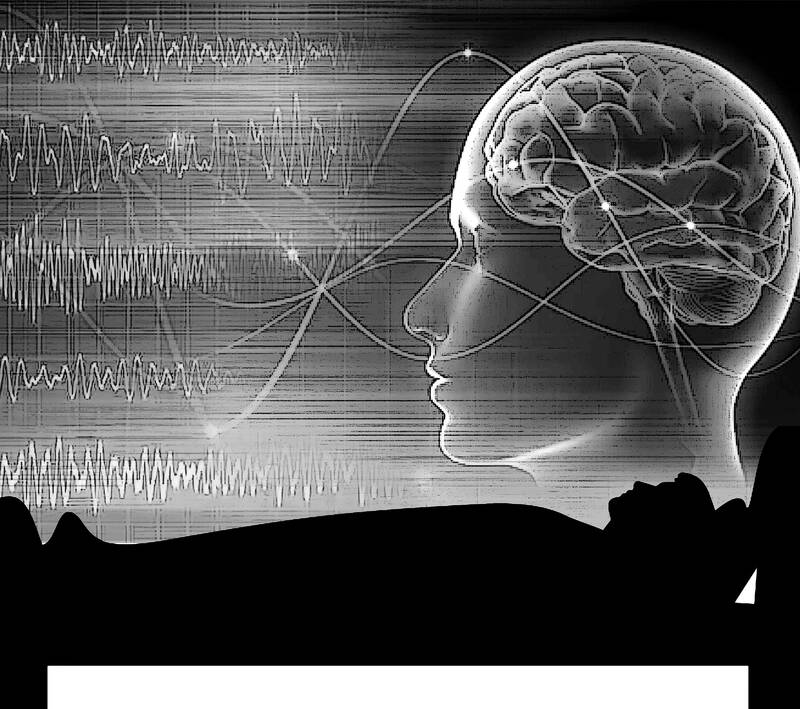
Illustration: Constance Chou
Even if you do not remember what happened in a dream, synaptic pathways are changing in the brain, said Harvard Medical School psychiatrist Robert Stickgold, who has been studying dreams for decades.
Associations are made and strengthened while asleep, he said, adding that this leads to those ideas we get and wonder where they came from.
US inventor Thomas Edison, British author Mary Shelley and British musician Paul McCartney reported creative ideas coming from dreams. Spanish artist Salvador Dali wrote of his own dream hacking technique — napping as he held a key over a plate so it would fall and wake him in time to remember his dreams and make artistic use of them.
Dali was on to something. There is a phase called N1, right as you are first falling asleep, when your dreams are most likely to follow from the thoughts you are having as you drift off. A well timed suggestion can steer the course of those dreams.
Building on Dali’s experiment, but using a device that detects the onset of N1, Stickgold and a group of researchers from the Massachusetts Institute of Technology (MIT) showed they could induce people to dream about a particular subject, and that doing so helped them become more creative, at least temporarily.
They published their findings last month in Scientific Reports.
Until the past few years, dream research was not respectable science, Stickgold said.
It was nearly impossible to get funding. The primary form of data were people’s reports of their own dreams, which were considered too subjective and idiosyncratic to study in a rigorous way.
However, about 20 years ago, Stickgold had a breakthrough idea following a dream. He had been on a hiking trip that involved climbing on some rocky terrain.
“As I was going to bed, I could literally feel myself back on the rocks,” he said.
He thought this might have something to do with his brain storing what he had learned on the mountain. He asked his students how they might go about studying this phenomenon in the lab, and someone suggested Tetris, a video game that involves rotating falling shapes.
In a study published in 2000, he and colleagues showed that some volunteers who played the game would have visual dreams about the falling shapes — even several subjects who suffered from amnesia.
In his new study, conducted with Adam Haar, Kathleen Esfahany and Thomas Vega from the MIT Media Lab, the team wanted to see how dreams influence what is called divergent creativity — the generation of new ideas, or thinking out of the box.
In the other form, convergent creativity, the mind pieces together diverse clues to solve a problem.
The MIT researchers had developed a device, dubbed a Dormio, which fits over a person’s hand and monitors skin conductivity, muscle tension, temperature and pulse, which can indicate the stages of sleep to show whether the N1 phase had started.
At just the right moment, the device would ask the subjects to think about trees, and then it would wake them up every few minutes and ask them to recount their dreams, which it recorded.
About 70 percent of subjects getting the tree prompt dreamed about trees; some had up to five dreams about trees.
One dreamed of being much bigger than trees and “eating them like finger food.”
Another dreamed of being an “oak king” with wooden arms and legs and leaves for a crown.
Those who experienced more dreams about trees scored higher on creativity tests — a vindication of Dali and his fellow creative dreamers.
The findings are a reminder that the line between productivity and resting is blurry — especially in creative endeavors.
It is possible that in a productivity-obsessed society, people keep skimping on sleep and try to use dream-hacking to stay productive 24/7.
However, ideally these new revelations about dreams and creativity can move people toward more balance, giving sleep and even naps some much needed respect.
F.D. Flam is a Bloomberg Opinion columnist covering science. She is host of the Follow the Science podcast. This column does not necessarily reflect the opinion of the editorial board or Bloomberg LP and its owners.
China badly misread Japan. It sought to intimidate Tokyo into silence on Taiwan. Instead, it has achieved the opposite by hardening Japanese resolve. By trying to bludgeon a major power like Japan into accepting its “red lines” — above all on Taiwan — China laid bare the raw coercive logic of compellence now driving its foreign policy toward Asian states. From the Taiwan Strait and the East and South China Seas to the Himalayan frontier, Beijing has increasingly relied on economic warfare, diplomatic intimidation and military pressure to bend neighbors to its will. Confident in its growing power, China appeared to believe
After more than three weeks since the Honduran elections took place, its National Electoral Council finally certified the new president of Honduras. During the campaign, the two leading contenders, Nasry Asfura and Salvador Nasralla, who according to the council were separated by 27,026 votes in the final tally, promised to restore diplomatic ties with Taiwan if elected. Nasralla refused to accept the result and said that he would challenge all the irregularities in court. However, with formal recognition from the US and rapid acknowledgment from key regional governments, including Argentina and Panama, a reversal of the results appears institutionally and politically
In 2009, Taiwan Semiconductor Manufacturing Co (TSMC) made a welcome move to offer in-house contracts to all outsourced employees. It was a step forward for labor relations and the enterprise facing long-standing issues around outsourcing. TSMC founder Morris Chang (張忠謀) once said: “Anything that goes against basic values and principles must be reformed regardless of the cost — on this, there can be no compromise.” The quote is a testament to a core belief of the company’s culture: Injustices must be faced head-on and set right. If TSMC can be clear on its convictions, then should the Ministry of Education
The Chinese People’s Liberation Army (PLA) provided several reasons for military drills it conducted in five zones around Taiwan on Monday and yesterday. The first was as a warning to “Taiwanese independence forces” to cease and desist. This is a consistent line from the Chinese authorities. The second was that the drills were aimed at “deterrence” of outside military intervention. Monday’s announcement of the drills was the first time that Beijing has publicly used the second reason for conducting such drills. The Chinese Communist Party (CCP) leadership is clearly rattled by “external forces” apparently consolidating around an intention to intervene. The targets of


 RSS
RSS