


The strengthening of ASEAN-India strategic cooperation is becoming more evident. From May 2 to Monday last week, the first-ever ASEAN-India maritime exercise — the ASEAN India Maritime Exercise (AIME) 2023 — was conducted.
A statement by the Indian Government Press Information Bureau said that the exercise was aimed at enhancing interoperability and exchange of best practices among participating navies.
The AIME was held in Singapore and included a dual-phase exercise. The harbor phase was on May 2 and May 3, and the sea phase in the South China Sea was from May 6 to Monday last week.
The Indian naval ships INS Satpura and INS Delhi participated in AIME using Singapore as a base.
The INS Satpura is an indigenously produced guided stealth frigate. The INS Delhi is India’s first indigenously built guided missile destroyer.
The ships are part of India’s eastern naval fleet based in Visakhapatnam, Andhra Pradesh. These ships are fitted with state-of-the art weapons and sensors. The ships would also participate in this year’s International Maritime Defense Exhibition and Conference, hosted by Singapore.
Besides exercising with the ASEAN navies, the ships exhibit India’s indigenous naval capacities and would manifest the country’s capabilities for shipbuilding. ASEAN is increasing its defense acquisitions from middle powers to avoid big-power rivalries.
The sea phase included wide-ranging maritime collaboration, including tactical maneuvers, helicopter cross-deck landings, navigation and other maritime activities.
The exercise improved interoperability and highlighted the potential of the Indian and ASEAN fleets to work together to promote peace, stability and security in the region.
During the sea phase, intimation that a Chinese flotilla changing course and coming within 80km of the exercise zone emerged. No contact with the Chinese ships was made, but they kept a close watch.
ASEAN works in graduated responses to its partners. Its dealings with India on the strategic dimension are slow, but have hastened.
ASEAN remains apprehensive about its relationship with China, particularly in the South China Sea. There is little progress on the code of conduct, under negotiation since 2002. China consolidated its hold over islands and waters of ASEAN members.
In the face of this, India-ASEAN maritime cooperation was a function of how much anxiety ASEAN would bear from China. By 2018, their apprehension to deal with India, based on what China would think, was overcome.
At the 25th anniversary Commemorative Summit in 2018, when all ASEAN leaders were “chief” guests at India’s Republic Day celebrations, India and ASEAN for the first time jointly focused on maritime security.
Later in 2018, Indian Prime Minister Narendra Modi announced India’s Indo-Pacific policy at the International Institute for Strategic Studies Shangri-La Dialogue.
In 2019, ASEAN announced its outlook on the Indo-Pacific region, and in the same year announced its Indo-Pacific Oceans Initiative.
ASEAN signed an ASEAN Outlook on the Indo-Pacific and India’s Indo-Pacific Oceans Initiative, and issued a joint statement on cooperation with India in 2021.
Paragraph 4.21 of the joint statement refers to “maritime security” efforts to counter piracy and armed robbery against ships, maritime safety and search and rescue operations.
For the 30th anniversary, a special foreign ministers’ meeting was held in June last year. It announced the first informal India-ASEAN Defense Ministers’ Meeting, held in Cambodia on the sidelines of the meeting in November last year.
India is the fourth dialogue partner of ASEAN, and it participated in the India-ASEAN maritime exercise after previous ones with China in October 2018, the US in September 2019 and Russia in December 2021.
On those occasions, the exercises were held in Singapore, Thailand and Indonesia respectively. The exercises cannot be compared, as the world is a different place now.
At the India-ASEAN Defense Ministers’ meeting, Indian Minister of Defense Rajnath Singh emphasized India’s consistent advocacy for a free, open, inclusive and rules-based Indo-Pacific region, while proposing the benefits if India and ASEAN worked together for regional maritime security.
The forum recognized the importance of the India-ASEAN partnership to ensure peace and stability in the region.
What does AIME manifest? It was the highest-attended among four ASEAN-held exercises. All ASEAN members participated, eight with naval assets and Cambodia and Laos with delegations.
Indonesia was represented by the KRI I Gusti Ngurah Rai; Singapore by the RSS Supreme and its Information Fusion Center; Brunei by the KDB Darulehsan; Malaysia by the KD Lekiu and a Super Lynx combat helicopter; Philippines by the BRP Jose Rizal and an AW-109 helicopter; Thailand by the HTMS Pattani and Vietnam by a frigate.
A P81 Poseidon and a Chetak helicopter attended from India. No other exercises have seen such great participation by ASEAN.
India has coordinated patrols and exercises with several ASEAN members, and it conducts a trilateral exercise with Thailand and Singapore.
However, AIME shows that India is an important partner of ASEAN. This comes soon after India and ASEAN agreed to upgrade the relationship to a comprehensive strategic partnership at the India-ASEAN summit in November last year.
The bilateral engagements that several ASEAN members have with India show more confident steps to work with India on an ASEAN-wide basis.
India’s regional role is recognized, particularly in dealing with high availability disaster recovery operations after tsunamis, volcanic eruptions and other disasters.
It is almost routine for the Indian Navy, which is always on call in the region, to be among the first responders.
India’s cooperation with ASEAN in dealing with nontraditional threats — such as drug running, illegal migration, terrorism and illegal fishing — is valued.
ASEAN and India worry about big-power rivalry threatening development and autonomy in the region. The logic of collaborating more is evident, as India and ASEAN initiated the AIME.
The broader implications of AIME is more than a simple exercise among ships. The familiarity that India and several ASEAN members already have has translated to the regional level.
This bodes well, as unstable conditions in the South China Sea and growing contention in the Indo-Pacific region can be jointly resolved by India and ASEAN through cooperation.
Gurjit Singh is a former Indian ambassador to Germany, Indonesia and ASEAN, Ethiopia and the African Union.
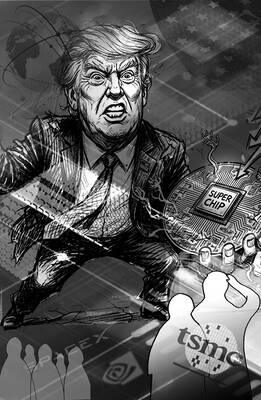
The White House’s decision to take a 9.9 percent stake in Intel Corp is looking like very shrewd business indeed. Since the government bought in at US$20.47 a share last August, the US chipmaker’s surging stock price has delivered the US a US$43 billion return. One of the reasons the investment has so far proved so sound is that the White House has made sure of it. According to The Wall Street Journal, Howard personally pushed deals on Intel’s behalf with some of the most lucrative clients imaginable. They include Nvidia Corp, the company at the heart of the AI
A single photograph can cut through a lot of noise, but it can also be used to misrepresent the truth. At the very least, it can concentrate the mind on something that requires further investigation. On Monday last week, Ma Ying-jeou Foundation CEO Tai Hsia-ling (戴遐齡) and former National Security Council secretary-general King Pu-tsung (金溥聰) held a news conference in which they showed a photograph of former foundation CEO Hsiao Hsu-tsen (蕭旭岑), now Chinese Nationalist Party (KMT) deputy chairman. In the image Hsiao is seated next to Xiamen Taiwan Businessmen Association chairman Han Ying-huan (韓螢煥). The two men were holding
I first met Professor Ray Jiing (井迎瑞) as a film and documentary student at Shih Hsin University’s (SHU) Department of Radio Television and Film in 1988. The following year, he went on to become the director of the Chinese Taipei Film Archive — forerunner of the Taiwan Film and Audiovisual Institute (TFAI). Over his eight-year tenure, Jiing rescued and restored over 200 classic Taiwanese films. In 1997, he established the Graduate Institute of Studies in Documentary and Film Archiving at Tainan National University of the Arts (TNNUA), and I joined the program in his third cohort of students. Beyond a
A recent report concerning a student who is suing his teacher posed the question in its headline: Does failing a student in two subjects constitute bullying? The college student in Chiayi County apparently sought NT$2 million (US$63,603) in state compensation, but a court dismissed the case. The first reaction of many might have been to ask: What has happened to students nowadays? Some say that teachers have lost their authority, while others say students are overindulged. Some even start reminiscing over the days when “whatever the teacher says goes.” However, the real issue might be overlooked if emotional reactions like that are the


 RSS
RSS