


Russian President Vladimir Putin’s swift and severe response to an attack on his Black Sea Fleet reflects a war that is increasingly marked by a duel between long-range Russian missiles and Ukraine’s innovative array of drones and truck bombs.
Putin on Monday made clear why he was suspending Russia’s involvement in a deal that for three months had allowed much needed Ukrainian grain to be shipped to global markets: He wants to secure the Russian Navy’s ships after an attack by air and sea drones.
On Wednesday, Russia’s ministry of defense said Moscow was rejoining the grain agreement, after receiving assurances from Ukraine that the safe passage corridor it established would not be used for attacks. The episode speaks volumes about the dual nature of a war that is being fought as intensely behind the front lines as on them.
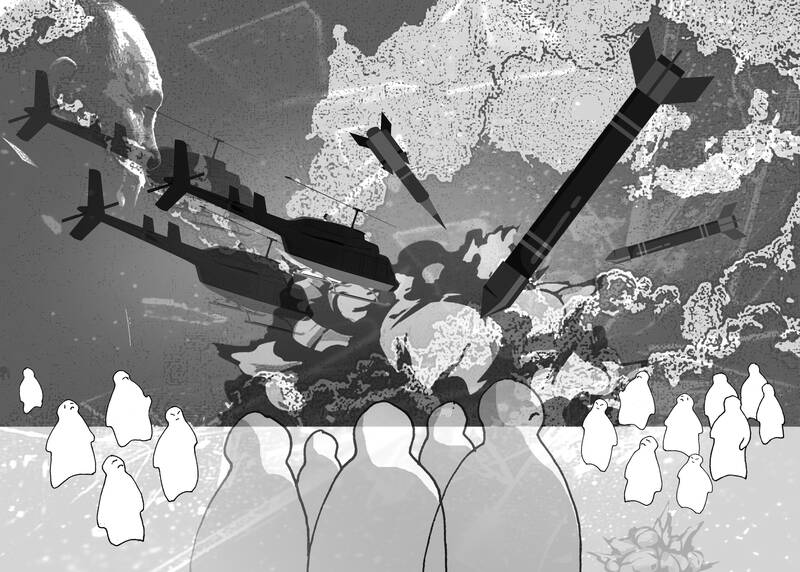
Illustration: Tania Chou
The Crimea-based Black Sea Fleet might no longer pose the threat of imminent amphibious assault it did at the outset of Putin’s invasion, but according to the US and Ukraine, it has been launching Kalibr cruise missiles that form part of the missile barrages Russia has been unleashing on Ukrainian cities for weeks.
While Ukrainian President Volodymyr Zelenskiy’s forces have no direct equivalents in their arsenal to fire back with, they are finding other ways to respond.
The long-range war that the Black Sea Fleet forms part of is likely to become more important in the coming months, as fighting on the ground is slowed by autumn rain and falling winter temperatures, adding to exhaustion of both armies in a high intensity conflict that has been underway since February.
It is a “war of drones,” Ukrainian Vice Prime Minister and Minister of Digital Transformation Mykhailo Fedorov told Forbes Ukraine in an interview published on Monday, adding that his country was on the cusp of a boom in their manufacture, including a model specifically designed to shoot down the Shahed-136 loitering drones the US says Russia bought from Iran.
“Those who can now scale the management and production of strike drones on an industrial level will win,” Fedorov said.
Russia denies its Geran-2 drones are relabeled Shaheds bought from Iran. On Tuesday, US National Security Council spokesman John Kirby said the US was concerned “Iran might be considering the provision of surface-to-surface missiles to Russia in addition to the drones.”
Putin’s production lines are hampered by sanctions on key components such as silicon chips.
In the meantime, Ukraine appears to be using whatever means it can find to strike behind Russian lines. On Tuesday, the intelligence arm of Ukraine’s defense ministry celebrated the destruction of two night-attack helicopters, and damage to two others, by hand-set explosives at Russia’s Pskov air base. Pskov is more than 700km from the Ukrainian border.
Ukraine has not claimed responsibility for Saturday’s use of unmanned boats against the Russian fleet.
However, it described as “the beginning” an Oct. 8 truck bomb attack that disabled a key bridge linking the Russian mainland to Crimea, which Putin annexed in 2014.
The bridge is about 400km from the nearest Ukrainian controlled territory. Ukraine has also struck numerous behind-the-lines targets within the 80km reach of US High Mobility Artillery Rocket Systems.
Answering questions after a meeting with the leaders of Armenia and Azerbaijan at Russia’s Black Sea resort of Sochi, Putin first reiterated his claim that as little as 3 percent to 5 percent of grain released through the July 22 grain deal’s secure corridor was going to the poor countries that were supposed to get it.
The correct figure is 20 percent, according to the UN, which also says the goal with the agreement was to reduce soaring global grain prices, rather than to send specifically Ukrainian grain to poor countries.
“But that isn’t the point,” Putin said, adding that the point was that Ukraine had attacked the Black Sea Fleet with six-meter-long boat drones that were packed with explosives.
“This is not a joke,” he said.
The attack failed, Putin said, but it put at risk both Russian and international shipping. To lift the suspension on the grain deal, he said he wanted the UN — which brokered the agreement — to get Ukraine to guarantee the security of the agreement’s corridor. That assurance now appears to have been given and could give the fleet at Sevastopol a measure of protection to continue launching Kalibr missiles across Ukraine.
The war’s different theaters — front line, long-range and economic — are tightly interwoven. Taken together, they suggest Putin still has an ambitious strategy to control Ukraine, rather than one based around any sudden nuclear escalation to stop or settle the war, according to the Institute for the Study of War, a US think tank that closely follows the conflict.
The same hold-territory-and-wait strategy is consistent with withdrawals to new defensive lines in Ukraine’s southern Kherson province. It is also in line with the recent campaign of missile strikes on energy infrastructure aimed at eroding public morale, creating a renewed refugee crisis in Europe and hindering Ukraine’s war effort.
It is not clear that any of those goals are being achieved, but temperatures will fall further. The nation’s electricity utility said on Wednesday it would order more power outages to maintain the grid in northern and central Ukraine.
In an overnight statement, Zelenskiy said he asked the EU for help in restoring the country’s energy infrastructure, 40 percent of which has been damaged.
The General Staff of the Armed Forces of Ukraine said on Facebook that Russia launched another seven missiles and 47 air attacks on Tuesday.
Despite optimism in Ukraine that Russian forces can be pushed back to the east bank of the Dnipro river at Kherson by the end of the year, “it looks very much like a hard fight,” Michael Kofman, a specialist in Russia’s military at the CNA security think tank in Washington, said in a podcast.
Kofman, who just returned to the US from a field trip to Ukraine, said Russian forces were digging multiple lines of defense around Kherson in a way they had failed to do in the north east, the scene of September’s rapid Ukrainian counteroffensive.
“Putin still thinks he can win time while support for Ukraine withers, and he’s getting some positive signals” from the US, where progressive US Democratic Party members and former US president Donald Trump’s Republican Party followers expressed reservations about the scale of military and financial aid to the country, said Mykola Bielieskov, a research fellow at the Kyiv-based think tank National Institute for Strategic Studies.
There probably would be a few weeks for Ukraine to claw back territory and inflict Russian losses before winter sets in. The slowdown that follows is likely to be less the result of inclement weather than of the need for both sides to rest and rebuild after more than eight months in the field, he said.
In the meantime, the long-range battle is likely to accelerate as both sides ramp up production and purchases of attack drones and missiles. Putin’s threats of nuclear Armageddon have been overplayed, and should be seen as part of a successful strategy to deter the US from supplying Ukraine with the 300km Army Tactical Missile Systems it needs to level the long-range playing field, Bielieskov said.
“We are trying to innovate,” and to “compensate for our lack of long-range fire,” Bielieskov added.

What began on Feb. 28 as a military campaign against Iran quickly became the largest energy-supply disruption in modern times. Unlike the oil crises of the 1970s, which stemmed from producer-led embargoes, US President Donald Trump is the first leader in modern history to trigger a cascading global energy crisis through direct military action. In the process, Trump has also laid bare Taiwan’s strategic and economic fragilities, offering Beijing a real-time tutorial in how to exploit them. Repairing the damage to Persian Gulf oil and gas infrastructure could take years, suggesting that elevated energy prices are likely to persist. But the most
Taiwan should reject two flawed answers to the Eswatini controversy: that diplomatic allies no longer matter, or that they must be preserved at any cost. The sustainable answer is to maintain formal diplomatic relations while redesigning development relationships around transparency, local ownership and democratic accountability. President William Lai’s (賴清德) canceled trip to Eswatini has elicited two predictable reactions in Taiwan. One camp has argued that the episode proves Taiwan must double down on support for every remaining diplomatic ally, because Beijing is tightening the screws, and formal recognition is too scarce to risk. The other says the opposite: If maintaining
Chinese Nationalist Party (KMT) Chairwoman Cheng Li-wun (鄭麗文), during an interview for the podcast Lanshuan Time (蘭萱時間) released on Monday, said that a US professor had said that she deserved to be nominated for the Nobel Peace Prize following her meeting earlier this month with Chinese President Xi Jinping (習近平). Cheng’s “journey of peace” has garnered attention from overseas and from within Taiwan. The latest My Formosa poll, conducted last week after the Cheng-Xi meeting, shows that Cheng’s approval rating is 31.5 percent, up 7.6 percentage points compared with the month before. The same poll showed that 44.5 percent of respondents
India’s semiconductor strategy is undergoing a quiet, but significant, recalibration. With the rollout of India Semiconductor Mission (ISM) 2.0, New Delhi is signaling a shift away from ambition-driven leaps toward a more grounded, capability-led approach rooted in industrial realities and institutional learning. Rather than attempting to enter the most advanced nodes immediately, India has chosen to prioritize mature technologies in the 28-nanometer to 65-nanometer range. That would not be a retreat, but a strategic alignment with domestic capabilities, market demand and global supply chain gaps. The shift carries the imprimatur of Indian Prime Minister Narendra Modi, indicating that the recalibration is


 RSS
RSS