


Predictions are always tricky, especially when they involve the actions of individuals.
Last week, National Security Bureau Director-General Chen Ming-tong (陳明通) said, regarding the formation of the Chinese Communist Party’s new Politburo Standing Committee lineup, that if two or three members were replaced, the policy of “common prosperity, reform and opening up” would endure.
However, if there were a reshuffle of up to four members, Chinese President Xi Jinping (習近平) would have a tighter grip on power than before, Chen said.
The reshuffle showed that Xi has created a new ruling elite stacked with loyalists, suggesting that the political struggle in China was more ferocious than Chen expected.
Dictators are known to be arbitrary and volatile, and should not be expected to behave any other way.
Xi, 69, will be 74 if he finishes his third term. As he has scrapped the presidential two-term limit, it seems he seeks indefinite rule.
By the end of a fourth term, Xi would be an advanced age, but not older than many other dictators through history. As he has already broken the age rule of 68, and considers himself above the new one, Xi seems to be on track to become leader for life, with power rivaling that of former Chinese leader Mao Zedong (毛澤東).
Dictatorships can be efficient through their use of force, giving a false impression of competence.
However, without an opposing force to keep this power in balance, a regime’s policies might only reflect the interests of an elite group and could therefore be biased.
Such a state needs to deploy propaganda or clamp down on freedom of expression to cover up “mishaps” caused by such policies. When mistakes begin to pile up, the nation can fall into decline, and face collapse when a grave policy mistake occurs. The rise and fall of Imperial Japan and Nazi Germany are good illustrations.
In The Origins of Totalitarianism, political philosopher Hannah Arendt describes the features and mechanics of totalitarian movements, including the one-party state, monitoring the behavior of its people and subordinates, and implementing large-scale social mobilization through recurring mass movements.
With the establishment of an urban management corps and “big white” health officials wearing hazmat suits to stamp out corruption and impose harsh lockdowns, Xi has concentrated power in the hands of a single man through mass mobilization campaigns.
A dictator’s indefinite rule is not protected by the system. If the original rule is overturned by force, the rule-breaker has to watch out for potential threats. Even if a dictator is universally feared, they can experience anxiety, paranoia and defensiveness.
Since the founding of the People’s Republic of China, its ill-fated campaigns like the Great Leap Forward, the Cultural Revolution, and the gruesome deaths of former Chinese president Liu Shaoqi (劉少奇) and former Chinese vice premier Lin Biao (林彪) were all associated with dictator-style rule.
For those outside the regime, it is not possible to know what a dictator embracing lifelong rule would choose as their goal. Would it be to cement a legacy in the history of the party, or to have an iron grip on power?
The former could mean starting a cross-strait war, reclaiming the “lost” territories of the Siberian Stanovoy Range or the island of Sakhalin, while the latter could lead to turbulence and turmoil on the scale of the Cultural Revolution.
Only time will tell what a Chinese dictatorship portends.
HoonTing is a political commentator.
Translated by Rita Wang

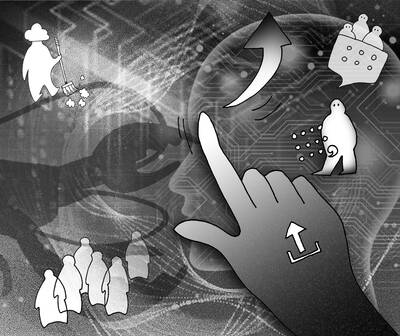
Weeks into the craze, nobody quite knows what to make of the OpenClaw mania sweeping China, marked by viral photos of retirees lining up for installation events and users gathering in red claw hats. The queues and cosplay inspired by the “raising a lobster” trend make for irresistible China clickbait. However, the West is fixating on the least important part of the story. As a consumer craze, OpenClaw — the AI agent designed to do tasks on a user’s behalf — would likely burn out. Without some developer background, it is too glitchy and technically awkward for true mainstream adoption,
A delegation of Chinese Nationalist Party (KMT) officials led by Chairwoman Cheng Li-wun (鄭麗文) is to travel to China tomorrow for a six-day visit to Jiangsu, Shanghai and Beijing, which might end with a meeting between Cheng and Chinese President Xi Jinping (習近平). The trip was announced by Xinhua news agency on Monday last week, which cited China’s Taiwan Affairs Office (TAO) Director Song Tao (宋濤) as saying that Cheng has repeatedly expressed willingness to visit China, and that the Chinese Communist Party (CCP) Central Committee and Xi have extended an invitation. Although some people have been speculating about a potential Xi-Cheng
Chinese Nationalist Party (KMT) Chairwoman Cheng Li-wun (鄭麗文) is leading a delegation to China through Sunday. She is expected to meet with Chinese President Xi Jinping (習近平) in Beijing tomorrow. That date coincides with the anniversary of the signing of the Taiwan Relations Act (TRA), which marked a cornerstone of Taiwan-US relations. Staging their meeting on this date makes it clear that the Chinese Communist Party (CCP) intends to challenge the US and demonstrate its “authority” over Taiwan. Since the US severed official diplomatic relations with Taiwan in 1979, it has relied on the TRA as a legal basis for all
The ongoing Iran conflict is putting Taiwan’s energy fragility on full display — the island of 23 million people, home to the world’s most advanced semiconductor manufacturing, is highly dependent on imported oil and gas, especially that from the Middle East. In 2025, 69.6 percent of Taiwan’s crude oil and 38.7 percent of liquified natural gas were sourced from the Middle East. In the same year, 62 percent of crude oil and 34 percent of LNG to Taiwan went through the Strait of Hormuz. Taiwan’s state-run oil company CPC Corp’s benchmark crude oil price (70 percent Dubai, 30 percent Brent)


 RSS
RSS