


National Taiwan University (NTU) has revoked the master’s degree of former Hsinchu mayor Lin Chih-chien (林智堅) of the Democratic Progressive Party (DPP), who withdrew his candidacy in the Taoyuan mayoral election over a plagiarism scandal that led to the revocation. NTU president Kuan Chung-ming (管中閔) and NTU College of Social Sciences dean Su Hung-dah (蘇宏達) announced the annulment of Lin’s degree at a news conference, saying that the scandal had damaged the university’s reputation.
However, have Kuan and Su contributed to the school’s reputation? Before he was elected NTU president, Kuan caused controversy by simultaneously serving as an “independent director” at a private company and teaching at the university. He has also been accused of plagiarism. Su has also caused controversy, as he had criticized Representative to Japan Frank Hsieh (謝長廷) after the suicide of a Taiwanese diplomat.
Did these controversies affect the school’s reputation? The final verdict of Lin’s case will be made by voters in Taoyuan on Nov. 26.
In terms of the school’s reputation, late NTU professor Peng Ming-min (彭明敏) should not be forgotten. Peng died this year at age 98, without seeing his goal of turning Taiwan into a normal country fulfilled. After Peng and two of his students in 1964 attempted to release a manifesto titled A Declaration of Formosan Self-Salvation, he became a political prisoner of conscience and was forced to live in exile for more than 20 years. NTU failed to protect him at the time, although the manifesto, which called on Taiwan to democratize, pointed in the right direction.
In Taiwan, politicians like to promote their status by obtaining academic degrees, and universities have started offering tailor-made “in-service” master’s programs for them, although the trend is slowly cooling after a series of plagiarism scandals in the past few years.
However, looking at political leaders around the world, few value education credentials more than those in Taiwan, where the share of holders of master’s degrees and doctorates is especially high.
What other country has a president, a premier and ministers all holding master’s or doctoral degrees? Policymakers and their top aides in most other countries have professional experience that enables them to make sophisticated decisions.
For example, John Major, British prime minister from 1990 to 1997, rose through the ranks even though he never attended university and started his career as an insurance agent.
As several “thesis gate” scandals exposed the wrongdoings of one Taiwanese politician after another, the public should remember that there is a difference between learning ability and academic background. In the 1960s, Sony cofounder Akio Morita in a book titled Never Mind School Records emphasized the importance of practical abilities over academic achievements. His criticism of credentialism served as a warning to the world. Unfortunately, Taiwanese society has been kidnapped by credentialism, and most people have forgotten about the difference between learning ability and academic background.
In the past few years, many vocational schools in Taiwan have upgraded their status to become vocational senior high schools, five-year junior colleges, colleges or universities of science and technology. Although such schools can award students academic degrees, what practical knowledge do their graduates have after studying at them?
Despite the large number of Taiwanese universities offering master’s and doctoral programs, many students find it difficult to contribute to society after entering the workforce because they are not able to apply what they spent all those years studying.
Lee Min-yung is a poet.
Translated by Eddy Chang
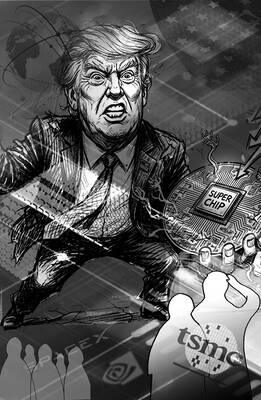
The White House’s decision to take a 9.9 percent stake in Intel Corp is looking like very shrewd business indeed. Since the government bought in at US$20.47 a share last August, the US chipmaker’s surging stock price has delivered the US a US$43 billion return. One of the reasons the investment has so far proved so sound is that the White House has made sure of it. According to The Wall Street Journal, Howard personally pushed deals on Intel’s behalf with some of the most lucrative clients imaginable. They include Nvidia Corp, the company at the heart of the AI
A single photograph can cut through a lot of noise, but it can also be used to misrepresent the truth. At the very least, it can concentrate the mind on something that requires further investigation. On Monday last week, Ma Ying-jeou Foundation CEO Tai Hsia-ling (戴遐齡) and former National Security Council secretary-general King Pu-tsung (金溥聰) held a news conference in which they showed a photograph of former foundation CEO Hsiao Hsu-tsen (蕭旭岑), now Chinese Nationalist Party (KMT) deputy chairman. In the image Hsiao is seated next to Xiamen Taiwan Businessmen Association chairman Han Ying-huan (韓螢煥). The two men were holding
I first met Professor Ray Jiing (井迎瑞) as a film and documentary student at Shih Hsin University’s (SHU) Department of Radio Television and Film in 1988. The following year, he went on to become the director of the Chinese Taipei Film Archive — forerunner of the Taiwan Film and Audiovisual Institute (TFAI). Over his eight-year tenure, Jiing rescued and restored over 200 classic Taiwanese films. In 1997, he established the Graduate Institute of Studies in Documentary and Film Archiving at Tainan National University of the Arts (TNNUA), and I joined the program in his third cohort of students. Beyond a
A recent report concerning a student who is suing his teacher posed the question in its headline: Does failing a student in two subjects constitute bullying? The college student in Chiayi County apparently sought NT$2 million (US$63,603) in state compensation, but a court dismissed the case. The first reaction of many might have been to ask: What has happened to students nowadays? Some say that teachers have lost their authority, while others say students are overindulged. Some even start reminiscing over the days when “whatever the teacher says goes.” However, the real issue might be overlooked if emotional reactions like that are the


 RSS
RSS