


With scientific and technological research efforts multiplied in quantity and quality, the conquest of critical technology has intensified in the 21st century.
Microchips and related technological might are enabling today’s tech titans to prosper.
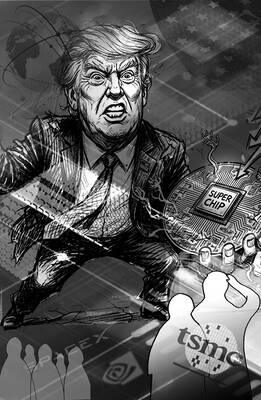
The drivers of economic activity have been a basic denominator of growth and power contests. To a large extent, modern microchips, which enable sophisticated computing, are powering technology-driven contentions between states that control resources, technologies and supplies, and determine the world’s semiconductor security architecture.
Unlike oil and gas, there are no alternatives to microchips. While many industrialized economies, such as Taiwan, the US, South Korea and China, are aggressively developing sophisticated semiconductor industries, their emerging counterparts continue to rely on cheaper and aged technologies, which do not offer them any advantage over their competitors, but only time to survive and room to catch up.
The semiconductor industry reckons on China for technological domination and is a testament to its power.
Many states perceive dangers in China’s technological rise.
However, it is not the first country to climb the value chain utilizing cutting-edge technologies and state-backed industrial espionage. Annals of globalization reveals how Taiwan, Japan and South Korea used their innovation ability to generate a tech revolution beyond East Asia.
This was possible because of these countries’ classically heterogeneous perspectives on technologies, which at the same time kept up the pace with the global proliferation of newer technologies. Not only does technological innovation play a vital role in these states’s economies and development, it also plays a central role in crucial next-generation networks and digital technologies whose standards are adopted worldwide.
The characteristics of heterogeneous perspectives of science and technology are encouraging the rise of spillover technologies and the proliferation of technologies that uphold human development. These factors are also pivotal in the semiconductor industry, which involves complicated products that have fostered an enormously complex supply chain involving thousands of specialized companies around the world, as well as asymmetrical market requirements and their disproportionate scales of needs across the world.
Retrospectively, economic power combined with technological superiority powered nation-states to rise. These metrics and historical antecedents based on empiricism underline that China’s rise is a significant disruption because of its linear approach to science and technology advancement. This disruption is rooted in the context of China’s persuasive rise and its hedge to redesign global supplies of sophisticated products. This directly manifests China’s revisionist intention to alter the international community’s norms consistent to its national interests.
China understands technology as a power resource. Technological leadership in crucial industrial processes fuels national economic power, which, in turn, leads to global political power.
The colossal transformation in tech diplomacy is not new, but the potential of China’s military-civilian industrial complex to serve as a source of advanced technology for China’s military is an undeniable fact. Given that most of the critical technologies China uses are imported, the Chinese leadership is in haste to overcome these dependencies by deepening the country’s electronic capabilities.
The semiconductor industry has become the turf on which the battle lines are redrawn and fought over fiercely. The ubiquity of chips has led to the growth of a vast global industry. In contrast to such technological shifts, the Japanese government in the middle of the 20th century was prepared to forgo technological power to placate protectionist sentiments by the US, the UK and the European Economic Community, the predecessor to the EU.
Japan’s technological innovation and its penetration of US microchip markets increased US dependency on Japan. This behavior contrasts the contemporary situation where the economic dependency and technological superiority gives an upper hand to a state, which can also be viewed through the lens of shifting political power dynamics.
Newer players such as China have accelerated this rivalry.
The West’s chip technology is rooted in 19th-century experimental science. The early development of semiconductor devices resulted from the thermionic valve industry. These states’ partnerships were cohesive and did not deter the global supply chain and turn disruptive.
China’s “geostrategic rise” reflected its intentions of curating high technologies on a mass scale by providing subsidies, cheap loans, encouragement of rationalization and incentives for research and development, and changing its educational system to increase the numbers of technologically qualified people available to the Chinese industry.
Going by the standards of the breadth of serviceable markets, a supporting semiconductor infrastructure, healthy downstream industries, and a sizeable and steady supply of capital to cover escalating development costs, Chinese firms look behind the curve. With the rapid diffusion of high-tech know-how through its alliances with multinational corporations and tier 1 foundries, China strives to close the gap. China is an example of how domestic technology has become a political resource for national governments.
Consequently, China’s technological rise is seen as a threat given the fact that it derives its “security” from asymmetries of power. China’s military tenets are conventional in character and reiterate the power imbalances of every sort — economic, technological and political.
Today’s discussions about technology and its control are not just about intellectual property or commercial contours, but also about its geopolitical character. China’s use of technology can be classified as something more than “strictly scientific.”
Many political strategists have asserted that government-led scientific activities can provide a generative field from which they might derive much-needed control over power and its manifestation. This seems true. The nature of contestations have changed from mere guns and steel to smart inventions.
The wheels of invention have intermittently driven the modernizations of nation-states, their power in military terms, their warfare capabilities and their intent to acquire more power.
Whereas, China’s industrial and technological prowess to dominate the world of semiconductors emphasizes the other perspective, that whether the conduct of warfare has been a fundamental preoccupation of nation-states for centuries.
The technological and material demands of warfare influenced China’s strategies and foreign affairs. An anxiety to wield its control over the microchip supply chain has given birth to a new kind of tech-nationalism in China, which fuels its superpower ambitions. The US’ Creating Helpful Incentives to Produce Semiconductors (CHIPS) and Science Act might delay China’s ability to take the lead, but it is be hard to predict whether it can entirely stop China.
Aravind Yelery is an adjunct fellow at the Institute of Chinese Studies in New Delhi. Sadia Rahman is a non-resident fellow at the Centre for Advanced Policy Research Initiative, Mumbai, India.
The White House’s decision to take a 9.9 percent stake in Intel Corp is looking like very shrewd business indeed. Since the government bought in at US$20.47 a share last August, the US chipmaker’s surging stock price has delivered the US a US$43 billion return. One of the reasons the investment has so far proved so sound is that the White House has made sure of it. According to The Wall Street Journal, Howard personally pushed deals on Intel’s behalf with some of the most lucrative clients imaginable. They include Nvidia Corp, the company at the heart of the AI
A single photograph can cut through a lot of noise, but it can also be used to misrepresent the truth. At the very least, it can concentrate the mind on something that requires further investigation. On Monday last week, Ma Ying-jeou Foundation CEO Tai Hsia-ling (戴遐齡) and former National Security Council secretary-general King Pu-tsung (金溥聰) held a news conference in which they showed a photograph of former foundation CEO Hsiao Hsu-tsen (蕭旭岑), now Chinese Nationalist Party (KMT) deputy chairman. In the image Hsiao is seated next to Xiamen Taiwan Businessmen Association chairman Han Ying-huan (韓螢煥). The two men were holding
I first met Professor Ray Jiing (井迎瑞) as a film and documentary student at Shih Hsin University’s (SHU) Department of Radio Television and Film in 1988. The following year, he went on to become the director of the Chinese Taipei Film Archive — forerunner of the Taiwan Film and Audiovisual Institute (TFAI). Over his eight-year tenure, Jiing rescued and restored over 200 classic Taiwanese films. In 1997, he established the Graduate Institute of Studies in Documentary and Film Archiving at Tainan National University of the Arts (TNNUA), and I joined the program in his third cohort of students. Beyond a
A recent report concerning a student who is suing his teacher posed the question in its headline: Does failing a student in two subjects constitute bullying? The college student in Chiayi County apparently sought NT$2 million (US$63,603) in state compensation, but a court dismissed the case. The first reaction of many might have been to ask: What has happened to students nowadays? Some say that teachers have lost their authority, while others say students are overindulged. Some even start reminiscing over the days when “whatever the teacher says goes.” However, the real issue might be overlooked if emotional reactions like that are the


 RSS
RSS