


Europe’s era of “Germany knows best” is coming to an end.
Berlin for the past decade commanded moral and financial authority in the EU, guiding policy and playing bad cop to the weaker southern economies. The energy crisis has upended that balance.
Germany’s reliance on Russia has exposed the flaws of its economic model — high-intensity industry running on cheap gas — and the blindness of its political class to its dependence on the Kremlin.
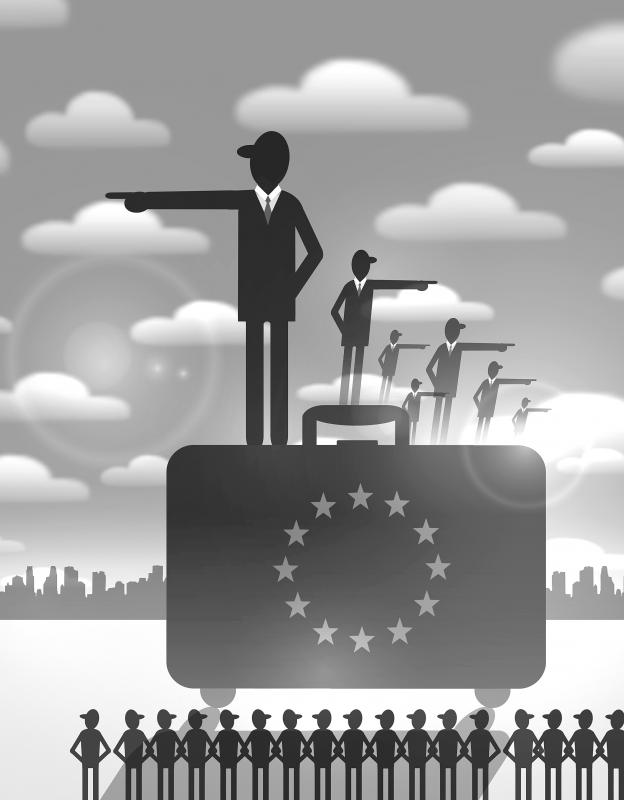
Illustration: Yusha
While Berlin is still coming to grips with the shock, Europe’s south is growing assertive. It is not revenge for years of German-led austerity, but a recalibration of forces that could ultimately result in a healthier EU.
Spain is an example. Spanish Minister for Ecological Transition Teresa Ribera bared teeth when she hit back at a European Commission proposal demanding that all 27 member states cut energy consumption by 15 percent this winter. In pushing back, Ribera said that Madrid had done its homework. It had little exposure to Russia and invested heavily in renewables — most importantly, she said, Spain had “lived within its means.”
The jab echoed the language from German rebukes at the height of the European financial crisis, when Berlin wrote the biggest checks in exchange for structural reforms that deepened the south’s economic slump.
The language was an unusual show of bravado for a country such as Spain, which is usually a net beneficiary of European funding. Reactions to her statements were split between those who said it was about time to call out the inconsistencies from Berlin and those fearful that such language risked inflaming old tensions.
In my view, Ribera’s comment was a mix of both, reflecting exasperation with the German reluctance to accept the monumental failure of its Russia policy. While everyone else seems to have realized “Made in Germany” was built on a shaky foundation, Berlin had yet to eat real humble pie, which is usually the first step before asking for help.
Spain was among the first to sound the alarm on the energy crisis, just as Putin began to squeeze supply and the market started to show signs of stress at the end of last year. Spanish Prime Minister Pedro Sanchez, who also faces enormous pressure to bring down inflation and energy bills at home, suggested in autumn last year that rocketing energy prices would require a joint European response.
Madrid argued — as it has for a while — that it needs better energy interconnectivity with the rest of Europe. Reducing consumption at home cannot help countries such as Germany if Madrid cannot export its surplus. Spain’s pitch fell on deaf ears, brushed aside as another example of the south seeking a handout.
Energy only became a European problem when the risks for Germany began to look insurmountable.
That reflects Europe’s policymaking problem — and points the way to a solution. It is time that proposals from southern Europe are taken more seriously. A rebalancing, if it leads to improved decisionmaking, should be welcomed in Brussels, where each leader speaks simultaneously to their domestic audience and their counterparts.
To their credit, the leaders of the southern nations agreed to a deal designed for Germany at record speed this week, moving beyond rhetorical resistance and avoiding critics’ schadenfreude.
It would have been silly and shortsighted, and, above all, a victory to Russia if the EU had failed. The Kremlin was caught off guard by the unity in Europe, and pitting Europeans against each other would undo that.
Ribera summarized it well after the deal was approved: In Europe, “when a neighbor calls for help, you have to help.”
That is the same spirit that got Europe through the COVID-19 pandemic and saw Germany cross its red line to agree to joint debt, a watershed moment for the EU. Plus, given their co-dependency, European crises are essentially circular. A recession in Germany, the euro area’s largest economy, would be detrimental for all.
A clash between northern and southern Europe would drag the continent back after a decade of joint problem-solving. Perhaps, considering the size of the German fiasco and the challenges it poses for the whole of Europe, Berlin should not be surprised to see the south asking for a bigger say.
Maria Tadeo is the European correspondent for Bloomberg Television and based in Brussels, where she covers European politics, economics and NATO. This column does not necessarily reflect the opinion of the editorial board or Bloomberg LP and its owners.
What began on Feb. 28 as a military campaign against Iran quickly became the largest energy-supply disruption in modern times. Unlike the oil crises of the 1970s, which stemmed from producer-led embargoes, US President Donald Trump is the first leader in modern history to trigger a cascading global energy crisis through direct military action. In the process, Trump has also laid bare Taiwan’s strategic and economic fragilities, offering Beijing a real-time tutorial in how to exploit them. Repairing the damage to Persian Gulf oil and gas infrastructure could take years, suggesting that elevated energy prices are likely to persist. But the most
Taiwan should reject two flawed answers to the Eswatini controversy: that diplomatic allies no longer matter, or that they must be preserved at any cost. The sustainable answer is to maintain formal diplomatic relations while redesigning development relationships around transparency, local ownership and democratic accountability. President William Lai’s (賴清德) canceled trip to Eswatini has elicited two predictable reactions in Taiwan. One camp has argued that the episode proves Taiwan must double down on support for every remaining diplomatic ally, because Beijing is tightening the screws, and formal recognition is too scarce to risk. The other says the opposite: If maintaining
Chinese Nationalist Party (KMT) Chairwoman Cheng Li-wun (鄭麗文), during an interview for the podcast Lanshuan Time (蘭萱時間) released on Monday, said that a US professor had said that she deserved to be nominated for the Nobel Peace Prize following her meeting earlier this month with Chinese President Xi Jinping (習近平). Cheng’s “journey of peace” has garnered attention from overseas and from within Taiwan. The latest My Formosa poll, conducted last week after the Cheng-Xi meeting, shows that Cheng’s approval rating is 31.5 percent, up 7.6 percentage points compared with the month before. The same poll showed that 44.5 percent of respondents
India’s semiconductor strategy is undergoing a quiet, but significant, recalibration. With the rollout of India Semiconductor Mission (ISM) 2.0, New Delhi is signaling a shift away from ambition-driven leaps toward a more grounded, capability-led approach rooted in industrial realities and institutional learning. Rather than attempting to enter the most advanced nodes immediately, India has chosen to prioritize mature technologies in the 28-nanometer to 65-nanometer range. That would not be a retreat, but a strategic alignment with domestic capabilities, market demand and global supply chain gaps. The shift carries the imprimatur of Indian Prime Minister Narendra Modi, indicating that the recalibration is


 RSS
RSS