


As Ukraine regained control of the entire Kyiv region for the first time since the start of Russia’s invasion in February, its forces are finding a bleak landscape in recently liberated areas. In Bucha, a town northwest of Kyiv, hundreds of bodies lay strewn in the streets, while others wrapped in black plastic bags were heedlessly dumped in a sandpit.
Bucha Mayor Anatoliy Fedoruk said that many civilians had been shot at close range.
Surviving Bucha residents accused retreating Russians of mining homes, fences and even bodies.
Taking into account these sickening atrocities, what happened in Bucha is nothing short of a massacre. It is hard to believe that a national army like the Russian military would devolve into such brutality. Its indiscriminate butchering of civilians has put it in the same box as the Islamic State for its persecution of Yazidis, a Kurdish religious minority in the north of Iraq.
If the massacre of more than 400 civilians cannot be considered a war crime, then what could?
As a military instructor at National Defense University, I have used an example from US war film Lone Survivor when giving a lecture on military ethics. Adapted from the true story of the US military’s ill-fated Operation Red Wings mission in Afghanistan in 2005, the movie provides an excellent example of moral dilemmas on the battlefield.
As four members of Seal Team 10 were conducting recon to take out a Taliban leader, three goatherds stumbled upon them by chance. The four men faced a moral challenge: kill the herders and continue their mission, or release them and risk them tipping off the Taliban.
The leader, Luttrell, abided by the rules of war — which prohibit attacks on unarmed civilians — and let the herders go, resulting in the death his three comrades. Luttrell was the “lone survivor.”
Professional soldiers have a duty to understand and observe the rules of war.
While the global community waits to see whether the International Criminal Court can bring Russian President Vladimir Putin to justice for his war crimes, the barbarity of the Russian forces is already in apparent violation of the Geneva Convention, which established international standards for humanitarian treatment in war. Having already attracted condemnation for its invasion, the Russian troops’ atrocities in Bucha have triggered a further global outcry and fresh pledges of additional sanctions against Moscow.
In the Russia-Ukraine war, there has been a wide range of modern weaponry and equipment deployed, and the political and military strategies and tactics in textbooks have been applied in a real situation.
Moreover, people have witnessed the brutality and cruelty of war.
With blood, sweat and tears, Ukrainians have already paid far too high a price for the defense of their country.
Chang Ling-ling is a military instructor at National Defense University.
Translated by Rita Wang
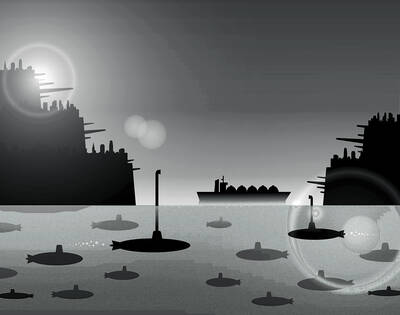
In the event of a war with China, Taiwan has some surprisingly tough defenses that could make it as difficult to tackle as a porcupine: A shoreline dotted with swamps, rocks and concrete barriers; conscription for all adult men; highways and airports that are built to double as hardened combat facilities. This porcupine has a soft underbelly, though, and the war in Iran is exposing it: energy. About 39,000 ships dock at Taiwan’s ports each year, more than the 30,000 that transit the Strait of Hormuz. About one-fifth of their inbound tonnage is coal, oil, refined fuels and liquefied natural gas (LNG),
To counter the CCP’s escalating threats, Taiwan must build a national consensus and demonstrate the capability and the will to fight. The Chinese Communist Party (CCP) often leans on a seductive mantra to soften its threats, such as “Chinese do not kill Chinese.” The slogan is designed to frame territorial conquest (annexation) as a domestic family matter. A look at the historical ledger reveals a different truth. For the CCP, being labeled “family” has never been a guarantee of safety; it has been the primary prerequisite for state-sanctioned slaughter. From the forced starvation of 150,000 civilians at the Siege of Changchun
The two major opposition parties, the Chinese Nationalist Party (KMT) and the Taiwan People’s Party (TPP), jointly announced on Tuesday last week that former TPP lawmaker Chang Chi-kai (張啟楷) would be their joint candidate for Chiayi mayor, following polling conducted earlier this month. It is the first case of blue-white (KMT-TPP) cooperation in selecting a joint candidate under an agreement signed by their chairpersons last month. KMT and TPP supporters have blamed their 2024 presidential election loss on failing to decide on a joint candidate, which ended in a dramatic breakdown with participants pointing fingers, calling polls unfair, sobbing and walking
In recent weeks, Taiwan has witnessed a surge of public anxiety over the possible introduction of Indian migrant workers. What began as a policy signal from the Ministry of Labor quickly escalated into a broader controversy. Petitions gathered thousands of signatures within days, political figures issued strong warnings, and social media became saturated with concerns about public safety and social stability. At first glance, this appears to be a straightforward policy question: Should Taiwan introduce Indian migrant workers or not? However, this framing is misleading. The current debate is not fundamentally about India. It is about Taiwan’s labor system, its


 RSS
RSS