


Following the failure of last year’s referendum item on reinstating the ban on imports of US pork containing traces of the additive ractopamine, the battle lines have shifted to whether to lift the ban on food imports from areas near Japan’s crippled Fukushima Dai-ichi nuclear power plant.
In a speech delivered to the Democratic Progressive Party’s (DPP) Central Executive Committee on Jan. 12, President Tsai Ing-wen (蔡英文) said that bilateral negotiations with Tokyo would adhere to the principle of ensuring public health and safety, and involve stringent checks in line with international standards and scientific evidence.
Tsai said that her administration would engage with the public to communicate policy and participate in reasonable debate, and would push for Taiwan’s participation in high-level international economic and trade blocs, such as the Comprehensive and Progressive Agreement for Trans-Pacific Partnership.
The initial response from the Chinese Nationalist Party (KMT) was that it would not oppose the government, provided that the Japanese side could provide assurances on the safety of its food exports to Taiwan. However, the KMT now says that it rejects the unrestricted opening of the Taiwanese market to “radioactive” food imports from Japan.
Easing restrictions on beef or pork imports containing trace amounts of ractopamine, lifting the ban on Japanese food imports, national energy policy, national spatial planning and the consolidation of local government jurisdictions can be resolved through the application of modern science.
In other countries such problems are easily handled, yet for the Indo-Pacific’s “bellwether” democracy, they are intractable problems. The reason is simple: Taiwan’s political parties place politics above specialist opinion, politicize science and mobilize public opinion.
In government, the KMT had opened up Taiwan to US beef imports containing ractopamine, but once in opposition, it opposed pork imports containing the same additive.
In opposition, the DPP opposed US beef imports, but now that it is in office, it wants to remove restrictions on pork imports. Meanwhile, Taiwan’s smaller political parties, which have little prospect of holding office, vie with one another to adopt holier-than-thou positions. Each party believes it is their duty to be a drag on the government to prevent it from implementing its agenda.
With China regularly attempting to sabotage Taiwan’s agricultural sector, many Taiwanese feel perturbed by the naked politicking. Yet as a nation, we employ all sorts of excuses to block foreign imports. Many Taiwanese seem to believe there is nothing wrong with keeping the nation closed off from global markets. With this kind of double standard, could it be that Taiwanese are not serious about joining global trade blocs?
The biggest stumbling block is not foreign products, it is the selfish motives of Taiwanese politicians. Many politicians are not concerned with bettering the lives of ordinary people or expanding international trade opportunities; they are focused solely on their electoral prospects.
For such politicians, being in opposition is ideal, since there is none of the responsibility associated with being in government. All they have to do is stimulate voters’ populist instincts, hurl insults at election time and put their feet up for another four years.
Their positions on issues often defy logic. A KMT politician opposed to relaxing restrictions on Japanese food imports could ask: “Why are you opposed to nuclear energy, yet you are quite happy to allow food imports from the Fukushima disaster area?” A DPP politician could shoot back: “You support restarting construction of the Fourth Nuclear Power Plant, so why do you oppose food imports from Fukushima?”
Clearly, logical propositions such as these, which are purely political in nature, do not stand up to a moment’s scrutiny. These sorts of games are played all the time by Taiwan’s entrenched political parties. This is why our democracy has stagnated.
In the past two years, Taiwan has won accolades from abroad for its management of the COVID-19 pandemic, thanks to the government’s policies and the character of the Taiwanese people. Yet at the beginning of the pandemic, the government’s firm and decisive actions, including a blanket ban on the export of masks, initially attracted ridicule from civil servants.
In May last year, when there was a spike in COVID-19 infections in Taiwan — with confirmed cases here dwarfed by numbers in other countries — the KMT and other opposition parties sought to sow chaos, and even tried to force the government to procure vaccines from China.
With a recent uptick in cases, some city mayors and county commissioners have sought to unilaterally introduce “vaccine passports” within their jurisdictions, using the outbreak as a platform on which to grandstand. That our politicians cannot even put their differences to one side and work together during a national crisis is concerning. If an even bigger crisis were to afflict the nation, how would they react?
Local elections are scheduled for this year, and Taiwan’s distorted politics will once again rise to the fore. International competition is ferocious and unforgiving. The infighting between Taiwan’s political parties is like a massive heat sink, sucking energy out of the nation.
If this destructive behavior could be brought under control, the nation’s accumulated industrial strength would soar. This would require the DPP and KMT to reach across the political divide and engage in rational dialogue. As Taiwan’s civic society continues to mature, it will become increasingly difficult for political parties to oppose for the sake of opposing.
Since 2020, Taiwan has gone through a series of recall votes, referendums and by-elections that have subverted established quadrennial presidential and legislative elections. A democratic “civil war” has been waged by political parties during a national health crisis in which local elections erupt into green-on-blue conflagrations regarded as “warm-ups” ahead of the next legislative election.
Meanwhile, China’s campaign of coercion against Taiwan continues, but receives nothing like the same attention.
Taiwan is faced with a formidable enemy whose military aircraft harass the nation’s sovereign airspace on a near-daily basis. What the nation needs above all else is to cement a shared sense of community. There should at least be agreement on this point, regardless of party or politics.
However, there is a force within Taiwanese politics that indiscriminately assigns fault to the government of the day for Taiwan being bullied by an external enemy. The nation desperately needs leaders on either side of the political divide to step up to the plate and resolve this problem, but party leaders are unlikely to sit down and talk when the focus is on the next election.
The present situation, with the nation beset with difficulties at home and abroad, is reminiscent of the consensus-seeking cross-party conventions, such as the 1990 National Affairs Conference and the 1996 National Development Conference during former president Lee Teng-hui’s (李登輝) tenure.
In that era, the DPP and KMT came together and reached a consensus on fundamental issues such as constitutional reform. It was this spirit that led to the transformation of Taiwan’s democracy.
Whether a similar spirit of cooperation for the greater national good could inspire Taiwan’s leaders seems remote, but we must not lose hope.
Our political leaders must prioritize the fate of the nation and the well-being of Taiwanese, rather than simply focusing on elections. They must seek common ground and respect each other’s differences.
If they fail and govern the nation poorly, this could create opportunities for authoritarians and demagogues who would destroy Taiwan’s democracy and steer the ship of state onto the rocks.
Translated by Edward Jones
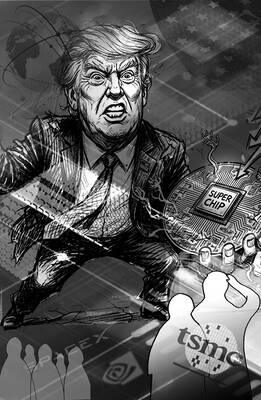
The White House’s decision to take a 9.9 percent stake in Intel Corp is looking like very shrewd business indeed. Since the government bought in at US$20.47 a share last August, the US chipmaker’s surging stock price has delivered the US a US$43 billion return. One of the reasons the investment has so far proved so sound is that the White House has made sure of it. According to The Wall Street Journal, Howard personally pushed deals on Intel’s behalf with some of the most lucrative clients imaginable. They include Nvidia Corp, the company at the heart of the AI
In a Taiwanese university classroom, a lecturer asks in English: “Can anyone give me an example from Taiwan?” Students look down. No one answers. After class, one student writes on the course platform in Mandarin: “I understood the concept, but I didn’t know how to answer in English.” That moment highlights a key issue in Taiwan’s English-medium instruction (EMI) reform: It is not just about more English-taught courses, but whether students can learn, participate and belong. EMI expansion is part of the Bilingual 2030 policy and the Ministry of Education’s BEST Program, aiming to improve English ability, support EMI teaching
The Ministry of the Interior, working with the navy and coast guard, is organizing Taiwan’s first joint exercise simulating escort tankers carrying liquefied natural gas (LNG) and oil through a Chinese blockade. The drills simulate fuel transport along three maritime corridors leading toward Japan, the Philippines and the US. Deputy Minister of the Interior Sawyer Mars (馬士元) said that a blockade of the Taiwan Strait would amount to “almost a 100 percent blockade of the regional energy supply.” Minister of National Defense Wellington Koo said planning to counter a blockade is standard practice in Taipei. While the exercise is limited in
A single photograph can cut through a lot of noise, but it can also be used to misrepresent the truth. At the very least, it can concentrate the mind on something that requires further investigation. On Monday last week, Ma Ying-jeou Foundation CEO Tai Hsia-ling (戴遐齡) and former National Security Council secretary-general King Pu-tsung (金溥聰) held a news conference in which they showed a photograph of former foundation CEO Hsiao Hsu-tsen (蕭旭岑), now Chinese Nationalist Party (KMT) deputy chairman. In the image Hsiao is seated next to Xiamen Taiwan Businessmen Association chairman Han Ying-huan (韓螢煥). The two men were holding


 RSS
RSS