


In the short, medium and long term, Taiwanese businesses operating in China are likely to face three major problems.
The first problem is the normalization of electricity rationing.
Australia is the largest exporter of coal to China. In 2018, China imported more than 80 million tonnes of coal from Australia, or more than 20 percent of total coal imports that year.
However, following a steep deterioration in relations between the two countries, Beijing in December last year announced a ban on the importation of Australian coal.
The sudden trade embargo resulted in a shortfall of 80 million tonnes, and coal suppliers in other countries were unable to fill the gap on such short notice.
Moreover, Australian coal is of a particularly high quality. Its energy generation efficiency is 1.5 times higher than coal from China or other countries.
Not long after the imposition of the embargo, local governments across China, including in the provinces of Zhejiang and Hunan, introduced electricity restrictions, and Beijing last month issued new guidelines to control energy consumption and intensity, known as “dual control.”
To date, the policy has resulted in the closure of at least 50 power stations. How long can the electricity rationing continue? There are no quick and easy solutions available to Beijing.
As a result, Taiwanese businesses operating in China will in the foreseeable future likely experience frequent power outages and must prepare for them to increase in duration.
The second problem is the normalization of conflict.
The ascent to power of Chinese President Xi Jinping (習近平) has brought about root-and-branch change to the global order. This has increased the likelihood of conflict at a scale, quantity, direction and depth rarely seen in the past few decades.
The US-China trade war cannot be resolved anytime soon, and contradictions between China and other countries could also become more severe.
The Taiwan-China relationship will continue to fluctuate, and it would be nothing short of a miracle if a further deterioration in the relationship is averted. As Xi continues to solidify his position, factional infighting within the Chinese Communist Party (CCP) is likely to increase. Taiwanese businesses operating in China might therefore come under significantly increased pressure from local governments, including with regard to taxation, environmental regulations and labor disputes.
Finally, there is the normalization of hostage taking. It goes without saying that Taiwanese business, and people living and working in China, have become potential targets of hostage diplomacy. Their lives can be terminated and their personal assets can be confiscated at the whim of the CCP.
To understand the severity of the threat to Taiwanese in China, one only needs to observe the case of two Canadians, former diplomat Michael Kovrig and businessman Michael Spavor, who were imprisoned by Beijing in December 2018. This was in retaliation for the arrest of Huawei Technologies Co chief financial officer Meng Wanzhou (孟晚舟) by Canadian authorities.
Nobody knows how many innocent Taiwanese are languishing within China’s “black prison” system.
Additionally, Taiwanese with business interests in China, including artists, often must declare their political affiliation and constantly respond to Chinese policies, such as Xi’s “common prosperity” drive.
Some Taiwanese companies believe that because they are not listed companies or that they do not operate on the scale of mega-corporations, such as Hon Hai Precision Industry Co — better known as Foxconn outside of China and Taiwan — or Want Want China Holdings, they do not have to worry about the charity required by that policy.
This line of thought might make sense in respect of corporate responsibility in Taiwan, but it does not pass muster in Xi’s China.
Moreover, China’s Taiwan Affairs Office has publicly stated that China welcomes “Taiwanese companies investing in [China’s] charitable and public welfare foundations.” The subtext of this statement should be obvious.
Finally, if Taiwanese businesses operating in China believe that the CCP would not know how much money they have made, then they are naive in the extreme. A simple investigation by the authorities is all that it would take.
The situation in China is becoming more severe by the day.
In the words of Confucius: “Do not enter dangerous lands or put down your roots in unstable regimes.”
Taiwanese businesses of any size should stop procrastinating: It is time to get out of China while they still can.
Liu Ming-te holds a doctorate in political science from the Free University of Berlin.
Translated by Edward Jones
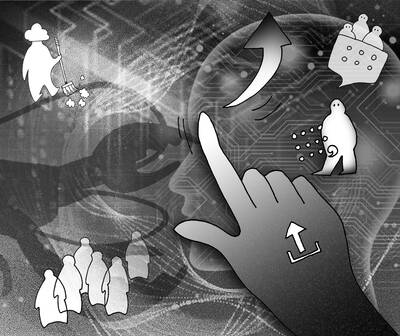
Weeks into the craze, nobody quite knows what to make of the OpenClaw mania sweeping China, marked by viral photos of retirees lining up for installation events and users gathering in red claw hats. The queues and cosplay inspired by the “raising a lobster” trend make for irresistible China clickbait. However, the West is fixating on the least important part of the story. As a consumer craze, OpenClaw — the AI agent designed to do tasks on a user’s behalf — would likely burn out. Without some developer background, it is too glitchy and technically awkward for true mainstream adoption,
Out of 64 participating universities in this year’s Stars Program — through which schools directly recommend their top students to universities for admission — only 19 filled their admissions quotas. There were 922 vacancies, down more than 200 from last year; top universities had 37 unfilled places, 40 fewer than last year. The original purpose of the Stars Program was to expand admissions to a wider range of students. However, certain departments at elite universities that failed to meet their admissions quotas are not improving. Vacancies at top universities are linked to students’ program preferences on their applications, but inappropriate admission
On Monday, a group of bipartisan US senators arrived in Taiwan to support the nation’s special defense bill to counter Chinese threats. At the same time, Beijing announced that Chinese President Xi Jinping (習近平) had invited Chinese Nationalist Party (KMT) Chairwoman Cheng Li-wun (鄭麗文) to visit China, a move to make the KMT a pawn in its proxy warfare against Taiwan and the US. Since her inauguration as KMT chair last year, Cheng, widely seen as a pro-China figure, has made no secret of her desire to interact with the Chinese Communist Party (CCP) and meet with Xi, naming it a
Taiwan People’s Party (TPP) Chairman Huang Kuo-chang (黃國昌) took the stage at a protest rally on Sunday in front of the Presidential Office Building in Taipei in support of former TPP chairman Ko Wen-je (柯文哲), who has been sentenced to 17 years in jail for corruption and embezzlement. Huang told the crowd that Chinese Nationalist Party (KMT) Chairwoman Cheng Li-wun (鄭麗文) had sent a message of support the previous day, saying she would be traveling from the south to Taipei: If the protest continued into the evening, she had said, she would show up. The rally was due to end


 RSS
RSS