


In the early days of the 2016 US presidential election campaign, Fang Kecheng (方可成), a former journalist at the liberal-leaning Chinese newspaper Southern Weekly and then-doctoral student at the University of Pennsylvania, began fact-checking then-US presidential candidate Donald Trump’s statements on refugees and Muslims on Chinese social media, hoping to provide additional context to the reporting back home.
However, his effort was quickly met with fierce criticism on the Chinese Internet. Some accused him of being a “white left” — a popular insult for idealistic, left-wing and Western-oriented liberals; others labeled him a “virgin,” a “bleeding heart” or a “white lotus” — demeaning phrases that describe do-gooders who care about the underprivileged, as he tried to defend women’s rights.
“It was absurd,” Fang, now a journalism professor at the Chinese University of Hong Kong, told the Observer. “When did caring for disadvantaged groups become the reason for being scolded? When did social Darwinism become so justified?”
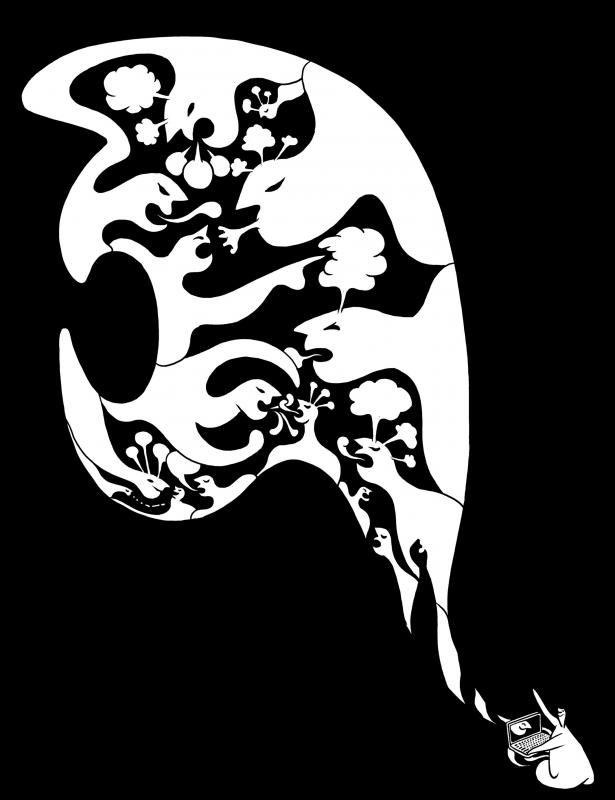
Illustration: Mountain People
At the time of Trump’s election victory, he began to notice striking similarities between the “alt-right” community in the US and a group of social media users posting on the Chinese Internet.
“Like their counterparts in the English-speaking sphere, this small, but growing community also rejects the liberal paradigm and identity-based rights — similar to what is called ‘alt-right’ in the US context,” Fang said, adding that in the Chinese context, the discourse often comprises what he considers anti-feminist ideas, xenophobia, Islamophobia, racism and Han-ethnicity chauvinism.
Throughout the Trump presidency and immediately after the Brexit vote in 2016, researchers on both sides of the Atlantic began carefully studying the rise of the alt-right in English-speaking cyberspace.
On the Chinese Internet, a similar trend was taking place at the same time, with some observing that users would additionally often strike a nationalistic tone and call for state intervention.
In a recent paper that he coauthored with Tian Yang, a University of Pennsylvania colleague, Fang analyzed nearly 30,000 alt-right posts on the Chinese Internet. He discovered that the users share not only domestic alt-right posts, but also global ones. Many of the issues were brought in by US-based Chinese immigrants feeling disillusioned by the progressive agenda set by the US left, he found.
However, not all academics are comfortable with the description “alt-right.”
“I’m skeptical about applying categories lifted from US politics to the Chinese Internet,” said Sebastian Veg, a researcher at the School of Advanced Studies in Social Sciences in Paris. “Many former ‘liberal’ intellectuals in China or from China are extremely critical of Black Lives Matter, the refugee crisis, political correctness, etc. They are hardly populists, but on the contrary, a regime-critical elite. Are they alt-right?”
Dylan Levi King, a Tokyo-based writer on the Chinese Internet, first noticed this loosely defined group during the 2015 European refugee crisis.
“Whether you call it populist nationalism or alt-right, if you paid close attention to what they talked about back then, you find them borrowing similar talking points from the European alt-right community, such as the phrase ‘the great replacement,’ or the alleged no-go zones for non-Muslims in European cities, which was also used by Fox News,” he said.
Shortly after the refugee crisis broke out, Liu Zhongjing (劉仲敬), a Chinese translator and commentator who built a name through his staunch anti-leftist and anti-progressive stance, was asked about his view on the way Germany handled it.
“A new kind of political correctness has taken shape in Germany, and many things can no longer be mentioned,” he said.
Liu also quoted Thilo Sarrazin, a former Berlin senator of finance who some say is the “flag-bearer for Germany’s far-right” in supporting his argument.
On June 20, 2017, when the UN High Commissioner for Refugees (UNHCR) posted about the plight of the displaced people on a Chinese microblogging site on World Refugee Day, with the hashtag #StandWithRefugees, thousands of users overwhelmed the account with negative comments.
Chinese actress Yao Chen (姚晨), a UNHCR goodwill ambassador, had to clarify that she had no intention of suggesting that China should take part in accepting refugees.
In the same year, another post appeared on popular social media site Zhihu, with the headline: “Sweden: The capital of sexual assault in Europe.”
The post’s author, Wu Yuting (吳雨停), wrote: “But the cruel reality is that, with the large number of Muslims flocking into Sweden, they also brought in Islam’s repression and damage against women, and destroyed gender equality in Swedish society.”
Islamophobia is the main topic among China’s alt-right, Fang and Yang’s research found.
“By framing the policies as biased, they interpreted them as a source of inequality and intended to trigger resentment by presenting Han as victims in their narrative,” Fang said. “They portrayed a confrontational relationship between Han — the dominant ethnic group in China — and other ethnic minorities, especially the two Muslim minorities — the Hui and the Uighurs.”
“It’s exactly the same logic and mainstream narrative deployed in the alt-right in the US: poor working-class white men being taken advantage of by immigrants and by minorities,” he added.
Other researchers went a step further.
In a 2019 paper, Zhang Chenchen (張晨晨), a researcher at Queen’s University Belfast, analyzed 1,038 Chinese social media posts and concluded that by criticizing Western “liberal elites,” the right-wing discourse on the Chinese Internet constructed an ethno-racial identity against the “inferior” of non-Western other.
This is “exemplified by non-white immigrants and Muslims, with racial nationalism on the one hand; and formulates China’s political identity against the declining Western other with realist authoritarianism on the other,” she wrote.
Anti-feminism is another issue frequently discussed by the Chinese online alt-right.
In December last year, 29-year-old Chinese comedian Yang Li (楊笠) faced a backlash after a question she posed in her show.
“Do men have the bottom line?” she quipped.
The line brought laughter from her live audience, but anger among many on the Internet. Although Yang does not publicly identify herself as a feminist, many accused her of adopting a feminist agenda, with some calling her “feminist militant” and “female boxer ... in an attempt to gain more privilege over men,” one critic said.
“Feminist bitch,” another scolded.
In April, Xiao Meili (蕭美麗), a well-known Chinese feminist, received a slew of abuse after she posted online a video of a man throwing hot liquid at her after she asked him to stop smoking.
Some of the messages called her and others — without credible evidence — “anti-China” and “foreign forces.”
Others said: “I hope you die, bitch,” or: “Little bitch, screw the feminists.”
“When the Xiao Meili incident happened, a lot of feminists were being trolled, including myself,” said one of the artists who later collected more than 1,000 of the abusive messages posted to feminists and feminist groups, and turned them into a piece of art.
“We wanted to make the trolling words into something that could be seen, touched, to materialize the trolling comments and amplify the abuse of what happens to people online,” she said.
Some artists and rights advocates established a temporary physical “Internet Violence Museum” to show how users on the Chinese Internet brutally attacked feminists. The project responded to a recent persecution of feminists by nationalist trolls and major online platforms.
Xiao blamed social media companies for not doing enough to stop such vitriol, even though China has the world’s most sophisticated Internet filtering system.
“[Sina] Weibo is the biggest enabler,” she told a US-based Web site in April. “It treats the incels as if they are the royal family.”
However, Michel Hockx, director of the Liu Institute for Asia and Asian Studies at the University of Notre Dame, said that it is because such comments do not threaten the government.
“They don’t necessarily challenge the ruling party and spill over to collective action, so there’s less of an incentive for social media companies to remove them,” he said. “They are not told to do so by the authorities.”
King said that Chinese state censors also walk a fine line in monitoring such content.
“The alt-right tend to be broadly supportive of the Communist party line on most things,” he said. “They do see China as a bulwark against the corrosive power of Western liberalism.”
However, their online rhetoric has offline consequences, he added.
“Things like ethnic resentment are something just below the surface, which can’t be allowed to fester,” he said. “When it explodes, it’s very ugly.”
A gap appears to be emerging between Washington’s foreign policy elites and the broader American public on how the United States should respond to China’s rise. From my vantage working at a think tank in Washington, DC, and through regular travel around the United States, I increasingly experience two distinct discussions. This divergence — between America’s elite hawkishness and public caution — may become one of the least appreciated and most consequential external factors influencing Taiwan’s security environment in the years ahead. Within the American policy community, the dominant view of China has grown unmistakably tough. Many members of Congress, as
The Hong Kong government on Monday gazetted sweeping amendments to the implementation rules of Article 43 of its National Security Law. There was no legislative debate, no public consultation and no transition period. By the time the ink dried on the gazette, the new powers were already in force. This move effectively bypassed Hong Kong’s Legislative Council. The rules were enacted by the Hong Kong chief executive, in conjunction with the Committee for Safeguarding National Security — a body shielded from judicial review and accountable only to Beijing. What is presented as “procedural refinement” is, in substance, a shift away from
The shifting geopolitical tectonic plates of this year have placed Beijing in a profound strategic dilemma. As Chinese President Xi Jinping (習近平) prepares for a high-stakes summit with US President Donald Trump, the traditional power dynamics of the China-Japan-US triangle have been destabilized by the diplomatic success of Japanese Prime Minister Sanae Takaichi in Washington. For the Chinese leadership, the anxiety is two-fold: There is a visceral fear of being encircled by a hardened security alliance, and a secondary risk of being left in a vulnerable position by a transactional deal between Washington and Tokyo that might inadvertently empower Japan
After declaring Iran’s military “gone,” US President Donald Trump appealed to the UK, France, Japan and South Korea — as well as China, Iran’s strategic partner — to send minesweepers and naval forces to reopen the Strait of Hormuz. When allies balked, the request turned into a warning: NATO would face “a very bad” future if it refused. The prevailing wisdom is that Trump faces a credibility problem: having spent years insulting allies, he finds they would not rally when he needs them. That is true, but superficial, as though a structural collapse could be caused by wounded feelings. Something


 RSS
RSS