


BioNTech SE’s potent COVID-19 vaccine is widely used in the US and Europe, but China has yet to approve the shot, leaving questions swirling about Beijing’s plans for an inoculation that is heavily coveted in the rest of the world.
Regulators in China have not signed off on the shot nearly nine months after it received its first regulatory clearance in the UK. Shares of Shanghai Fosun Pharmaceutical Group Co — which has an agreement with BioNTech to sell it in Taiwan and China, including Hong Kong and Macau — have fallen about 23 percent below an all-time high early last month.
The Chinese drugmaker was among the first globally to spot the potential of the mRNA vaccine, which was originally developed by BioNTech.
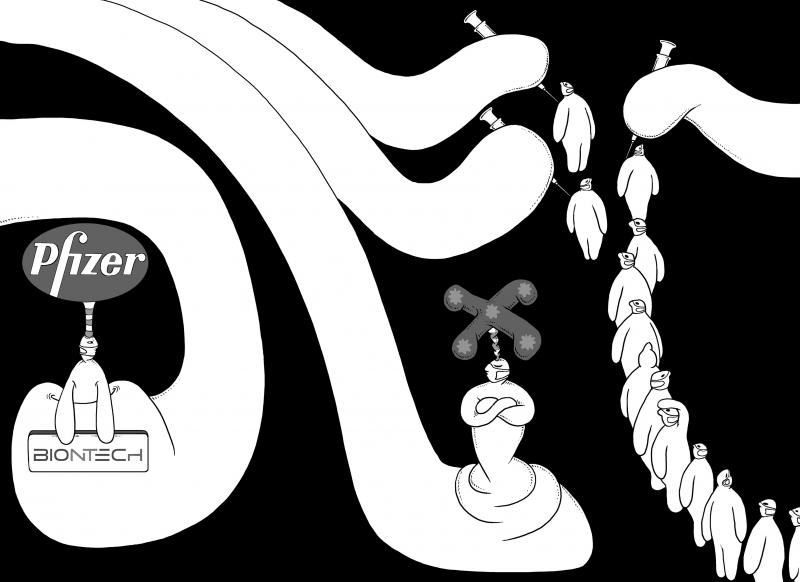
Illustration: Mountain People
In a July meeting with investors, Fosun Pharma chief executive officer Wu Yifang (吳以芳) said that the shot had cleared China’s expert reviews and was undergoing final administrative vetting, local business news firm Caixin reported.
Yet more than a month has passed and the much anticipated approval has not been announced. It is also nearly two months behind an end-of-June timeline suggested in articles by the Wall Street Journal and China’s Global Times.
China does not urgently need a new shot, because it has quelled all outbreaks so far.
Some analysts say that the seeming delay could be due to the Chinese government’s reluctance to greenlight a foreign vaccine, with Beijing concerned that approval of the BioNTech shot could be interpreted as an acknowledgment that local shots are less effective than Western ones.
Tensions have run high between China and the West over issues from the virus’ origins to trade in the past few months.
Chinese health authorities now worry that if the BioNTech vaccine is approved, a lack of confidence in homegrown shots will make it harder to reach its goals on inoculation rates, the Wall Street Journal reported, citing an 80 percent vaccination goal it said was set by Chinese President Xi Jinping (習近平).
Delaying approval also leaves more time for local drugmakers to work on their own mRNA shots, the newspaper said.
On Wednesday last week, the chairman of the Chinese drugmaker’s parent, Fosun International Ltd, said that the regulatory review was proceeding normally, but did not provide a timeline.
Distributed by BioNTech and Pfizer Inc in the rest of the world, the shot uses cutting-edge mRNA technology and is among the most effective ones against COVID-19.
China’s decision would affect Fosun Pharma and BioNTech’s earnings, and could also play a role in determining how the world’s most populous nation eventually loosens COVID-19 restrictions.
“This whole thing about BioNTech not reaching the hospital is a huge mystery,” said Joerg Wuttke, the Beijing-based president of the EU Chamber of Commerce in China.
As far back as last year, Fosun Pharma was asking such groups if their members would be interested in getting the vaccine, but the timing on when it will actually be available in China is now unclear and appears to keep shifting, Wuttke said.
BioNTech has agreed to supply at least 100 million doses to China this year. Fosun and BioNTech have agreements on dividing profits on the shot in the region, where Pfizer does not have the rights to sell it.
Fosun Pharma and the Chinese National Medical Products Administration did not respond to requests for comment.
BioNTech declined to comment.
“We hope the vaccine can arrive in mainland China’s market as soon as possible,” Fosun International chairman Guo Guangchang (郭廣昌) said on an earnings conference call on Wednesday last week, adding that the company had received support from all levels of the country.
“I haven’t seen any deliberate stalling of the process,” Guo said.
Meanwhile, vaccines initially intended for China could end up elsewhere.
In Taipei, the Centers for Disease Control on Wednesday last week said that the nation could receive the BioNTech shot earlier than scheduled, as a batch licensed by Fosun Pharma and previously meant to be sold elsewhere would be ready by the end of last month.
If permitted in China, the BioNTech shot would be the only foreign inoculation to join seven locally made ones in the nation, which studies have found less effective than mRNA shots.
Approving the BioNTech vaccine would introduce competition against Chinese vaccines and could even be seen as denting confidence in Chinese inoculations, said Huang Yanzhong (黃嚴忠), director of the Center for Global Health Studies at Seton Hall University in New Jersey.
“There is no reason to not approve the vaccine if they are judging by its safety and efficacy,” Huang said.
Wuttke said that there is speculation that China might want to withhold approval for a foreign vaccine until Chinese shots are accredited in the EU.
“So if China makes the approval of BioNTech contingent of the approval Sinovac and Sinopharm in Europe, then I think we’re in for a long march,” Wuttke said.
Earlier this year, Chinese Center for Disease Control and Prevention director-general Gao Fu (高福) discussed changing things such as dosage or mixing vaccines to enhance the protection offered by Chinese shots.
The remarks were interpreted as an admission of the lower efficacy of Chinese vaccines, but in a later interview with state media, Gao said he was misunderstood.
China in the past few weeks has also weathered its worst domestic outbreak since the virus emerged in Wuhan in late 2019. It did so by largely relying on techniques such as mass testing and quarantines.
“Maybe the reason you haven’t seen them worked out in China means that the situation on the ground there isn’t currently viewed as an emergency,” Loncar Investments chief executive officer Brad Loncar said of the BioNTech shot.
About 55 percent of China’s population is fully vaccinated, still far from the more than 80 percent some experts see as crucial. The Delta variant of SARS-CoV-2 is making it harder for nations to achieve herd immunity.
The efficacy of inactivated vaccines from China’s Sinovac Biotech Ltd and Sinopharm, and the one-shot viral vector vaccine from CanSino Biologics Inc have been below 80 percent in clinical trials. Some Chinese vaccine makers also have experimental mRNA vaccines in Phase III testing.
In the past few months, people familiar with the matter have said that Beijing was considering using the BioNTech shot as a booster in China.
Still, the global debate around the use of boosters has been getting more complicated.
The WHO has in the past few weeks urged wealthier nations to hold off on boosters for now to ensure more equitable distribution of vaccines globally.
On Friday last week, China said that those at higher risk of getting COVID-19 can seek a booster shot six months after they are fully vaccinated, although officials did not specify which vaccines would be used as booster shots.
If the BioNTech vaccine has been under administrative review as Wu suggested, that means the drug regulator would usually make a decision within 20 days.
If they did approve the shot, the certificate of approval would be given in 10 days, China’s drug registration rules say.
That could still leave the door open for an approval soon.
“I’ve seen people saying there’s 90 percent chance the vaccine will be approved on the mainland in August, but there’s also no indication it will ever be approved,” Huang said.
The White House’s decision to take a 9.9 percent stake in Intel Corp is looking like very shrewd business indeed. Since the government bought in at US$20.47 a share last August, the US chipmaker’s surging stock price has delivered the US a US$43 billion return. One of the reasons the investment has so far proved so sound is that the White House has made sure of it. According to The Wall Street Journal, Howard personally pushed deals on Intel’s behalf with some of the most lucrative clients imaginable. They include Nvidia Corp, the company at the heart of the AI
A single photograph can cut through a lot of noise, but it can also be used to misrepresent the truth. At the very least, it can concentrate the mind on something that requires further investigation. On Monday last week, Ma Ying-jeou Foundation CEO Tai Hsia-ling (戴遐齡) and former National Security Council secretary-general King Pu-tsung (金溥聰) held a news conference in which they showed a photograph of former foundation CEO Hsiao Hsu-tsen (蕭旭岑), now Chinese Nationalist Party (KMT) deputy chairman. In the image Hsiao is seated next to Xiamen Taiwan Businessmen Association chairman Han Ying-huan (韓螢煥). The two men were holding
I first met Professor Ray Jiing (井迎瑞) as a film and documentary student at Shih Hsin University’s (SHU) Department of Radio Television and Film in 1988. The following year, he went on to become the director of the Chinese Taipei Film Archive — forerunner of the Taiwan Film and Audiovisual Institute (TFAI). Over his eight-year tenure, Jiing rescued and restored over 200 classic Taiwanese films. In 1997, he established the Graduate Institute of Studies in Documentary and Film Archiving at Tainan National University of the Arts (TNNUA), and I joined the program in his third cohort of students. Beyond a
A recent report concerning a student who is suing his teacher posed the question in its headline: Does failing a student in two subjects constitute bullying? The college student in Chiayi County apparently sought NT$2 million (US$63,603) in state compensation, but a court dismissed the case. The first reaction of many might have been to ask: What has happened to students nowadays? Some say that teachers have lost their authority, while others say students are overindulged. Some even start reminiscing over the days when “whatever the teacher says goes.” However, the real issue might be overlooked if emotional reactions like that are the


 RSS
RSS