


Forty years ago, then-Chinese leader Deng Xiaoping (鄧小平) first began talking about “socialism with Chinese characteristics.” After launching reforms, turning to capitalism and opening up, the Chinese Communist Party (CCP) has frequently used the phrase “Chinese characteristics.”
In addition to promoting state enterprises at the cost of the private sector and depriving private businesses of their wealth as part of “socialism with Chinese characteristics,” Chinese President Xi Jinping (習近平) wrote an article published on Monday in the Chinese Communist Party (CCP) Central Committee’s bimonthly journal Qiushi with the headline: “Build archeology with Chinese characteristics, Chinese style with Chinese grandeur to better understand the ancient and profound Chinese civilization.”
In the rambling article, Xi wrote: “Archeological work is important for displaying and constructing the history of the Chinese nation and the treasures of Chinese civilization. To understand history is inseparable from archeology... Our practice and innovation must be based on the law of historical development and must move in the correct direction of history... We must attach great importance to archeology to provide strong support for the promotion of China’s excellent traditional culture and the enhancement of cultural self-confidence.”
In short, Xi wants Chinese archeologists to use their field to “discover” the “might” of Chinese culture in the service of the CCP’s political interests.
On the issue of globalization, the Chinese financial magazine Caixin two years ago used the phrase “globalization with Chinese characteristics” in an article published while Chinese Vice Premier Liu He (劉鶴) — who is also a member of the CCP politburo and director of the office for the Central Financial and Economic Affairs Commission — attended the World Economic Forum in Davos, Switzerland.
Tom Rafferty, a Beijing-based analyst at the Economist Intelligence Unit, has said that although China claims to be an advocate for free trade, its vision of globalization is much narrower than the scope of globalization that the world is used to. This implies that the CCP still wants to strictly control both domestic and international affairs.
Furthermore, Scott Kennedy, senior adviser and trustee chair in Chinese business and economics at the Center for Strategic and International Studies, also said that “globalization with Chinese characteristics” represents a non-free system that encourages trade and investment, and deep government intervention to serve industrial policy goals and guarantee domestic stability and increased international influence.
ASEAN, Australia, China, Japan and South Korea last month signed the Regional Comprehensive Economic Partnership. After loudly promoting free trade for so long, China has turned around and put curbs on imports of Australian coal, wine, barley and cotton. Without clear explanation, China also delayed the clearance of Australian rock lobster shipments in Shanghai due to increased import restrictions, resulting in the lobsters dying.
China is clearly retaliating against Australia for having early this year called for an investigation into the source of COVID-19.
China has also been criticized by the New York Times for publicly contravening the principles of free trade. It accused the Chinese government for, on the one hand, promoting opening up internationally, while on the other adopting increasingly aggressive, sometimes even punitive, policies to force other countries do play according to Beijing’s rules.
All Taiwanese must gain a clear understanding of China’s true nature and stop believing in the Chinese illusion before once again falling into the Chinese trap.
John Yu is a civil servant.
Translated by Perry Svensson

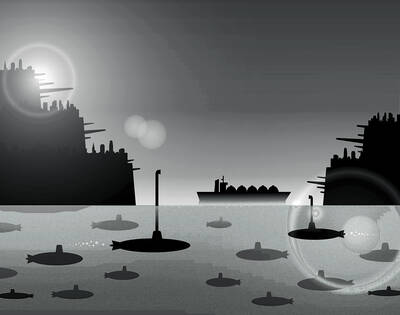
In the event of a war with China, Taiwan has some surprisingly tough defenses that could make it as difficult to tackle as a porcupine: A shoreline dotted with swamps, rocks and concrete barriers; conscription for all adult men; highways and airports that are built to double as hardened combat facilities. This porcupine has a soft underbelly, though, and the war in Iran is exposing it: energy. About 39,000 ships dock at Taiwan’s ports each year, more than the 30,000 that transit the Strait of Hormuz. About one-fifth of their inbound tonnage is coal, oil, refined fuels and liquefied natural gas (LNG),
On Monday, the day before Chinese Nationalist Party (KMT) Chairwoman Cheng Li-wun (鄭麗文) departed on her visit to China, the party released a promotional video titled “Only with peace can we ‘lie flat’” to highlight its desire to have peace across the Taiwan Strait. However, its use of the expression “lie flat” (tang ping, 躺平) drew sarcastic comments, with critics saying it sounded as if the party was “bowing down” to the Chinese Communist Party (CCP). Amid the controversy over the opposition parties blocking proposed defense budgets, Cheng departed for China after receiving an invitation from the CCP, with a meeting with
Chinese Nationalist Party (KMT) Chairwoman Cheng Li-wun (鄭麗文) is leading a delegation to China through Sunday. She is expected to meet with Chinese President Xi Jinping (習近平) in Beijing tomorrow. That date coincides with the anniversary of the signing of the Taiwan Relations Act (TRA), which marked a cornerstone of Taiwan-US relations. Staging their meeting on this date makes it clear that the Chinese Communist Party (CCP) intends to challenge the US and demonstrate its “authority” over Taiwan. Since the US severed official diplomatic relations with Taiwan in 1979, it has relied on the TRA as a legal basis for all
To counter the CCP’s escalating threats, Taiwan must build a national consensus and demonstrate the capability and the will to fight. The Chinese Communist Party (CCP) often leans on a seductive mantra to soften its threats, such as “Chinese do not kill Chinese.” The slogan is designed to frame territorial conquest (annexation) as a domestic family matter. A look at the historical ledger reveals a different truth. For the CCP, being labeled “family” has never been a guarantee of safety; it has been the primary prerequisite for state-sanctioned slaughter. From the forced starvation of 150,000 civilians at the Siege of Changchun


 RSS
RSS