


Believe it or not, the world did not stop turning on its axis because of the US election and ensuing self-indulgent disputes in the land of the free-for-all. In the age of US President Donald Trump, narcissism spreads like the plague.
However, the longer the wrangling in Washington continues, the greater the collateral damage to the US’ global reputation — and to less fortunate states and peoples who rely on the US and the Western allies to fly the flag for democracy and freedom.
Consider, for example, the implications of the Israeli army’s operation, on US election day, to raze the homes of 74 Palestinians, mostly women and children, in the occupied West Bank village of Khirbet Humsa.
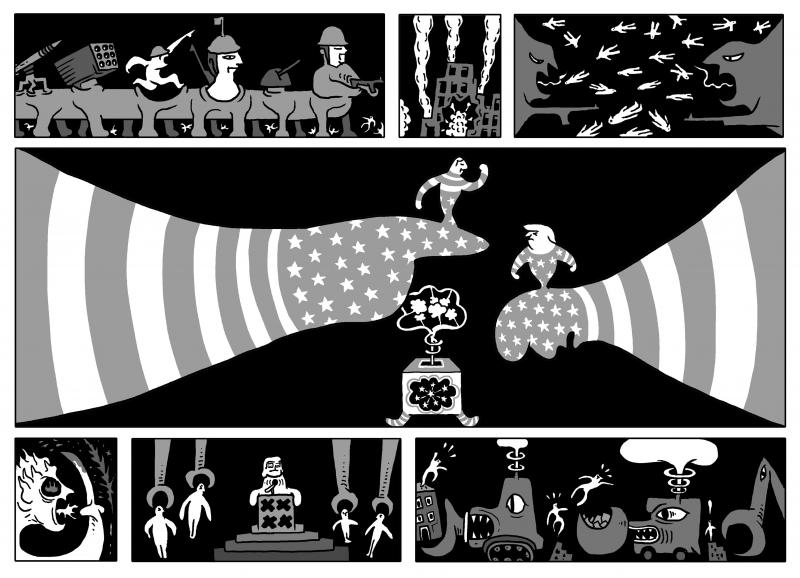
Illustration: Mountain People
The pace of West Bank demolitions has increased this year, possibly in preparation for Israeli annexation of the Jordan Valley — a plan backed in principle by Trump.
Appealing for international intervention, Palestinian Prime Minister Mohammed Shtayyeh claimed that Israel had acted while “attention is focused on the US election.”
Yet worse might be to come. Trump’s absurdly lopsided Middle East “peace plan” gave Israeli Prime Minister Benjamin Netanyahu virtual carte blanche to expand settlements and seize Palestinian land. US president-elect Joe Biden has promised to revive the two-state solution. However, while the power struggle rages in Washington, Netanyahu might continue to arbitrarily create new “facts on the ground” — with Trump’s blessing — analysts have warned.
“Over the next 11 weeks, we are likely to see a major uptick in Israeli demolitions, evictions, settlement announcements, and perhaps even formal annexation of parts of the occupied territories, as Netanyahu and his allies in the settler movement seek to make the most of Trump’s remaining time in office,” Khaled Elgindy of Washington’s Middle East Institute said.
The Khirbet Humsa incident gained widespread media attention. The same cannot be said of a soccer pitch massacre in northern Mozambique that also coincided with US polling.
While Americans were counting votes, villagers in Cabo Delgado Province were counting bodies after Islamic State (IS)-affiliated extremists decapitated more than 50 victims.
Nearly 450,000 people have been displaced, and up to 2,000 killed, in an escalating insurgency in the mainly Muslim province where extreme poverty exists alongside valuable, Western-controlled gas and mineral riches. Chinese, US and British energy companies are all involved there.
Mozambique’s government has appealed for help, saying that its forces cannot cope.
Biden vows to maintain the fight against the IS.
However, it is unclear if he is willing to look beyond Syria-Iraq and expand US involvement in the new extremist killing grounds of the Sahel, West Africa and the Mozambique-Tanzania border.
As for Trump, he claimed credit last year for “defeating 100% of the Isis caliphate.” The fool thinks it is all over. In any case, he has shown zero interest in what he calls “shithole” African countries.
Afghanistan is another conflict zone where the cost of US paralysis is counted in civilian lives. It is a war Trump claims to be ending, but which is escalating fast.
While all eyes were supposedly on Pennsylvania, Kabul university was devastated when gunmen stormed classrooms, killing 22 students. Another four people were killed last week by a suicide bomber in Kandahar.
Overall, violence has soared in the past few months as the US and the Taliban — which denied responsibility for the Kabul atrocity — argue in Qatar.
Trump plainly wants US troops out at any price. Biden is more circumspect about abandoning Afghanistan, but there is little he can do right now.
The Biden-Trump stand-off encourages uncertainty and instability, inhibiting the progress of international cooperation on a multitude of issues such as the climate crisis and the COVID-19 pandemic. It also facilitates regression by malign actors.
China’s opportunistic move to debilitate the Hong Kong Legislative Council last week by expelling opposition politicians was a stark warning to Democrats and Republicans alike.
Beijing just gave notice that it would not tolerate democratic ideas, open societies and free speech, there or anywhere.
China’s leaders apparently calculated, correctly, that the US was so distracted by its presidential melodrama that it would be incapable of reacting in any meaningful way.
Taiwan’s people have cause to worry. The “renegade” island is next on Chinese President Xi Jinping’s (習近平) “reunification” wish-list. Who would bet money on the US riding to Taipei’s rescue if Beijing takes aim?
Much has been said about the negative domestic ramifications of Trump’s spiteful disruption of the presidential transition — his lawsuits, his refusal to share daily intelligence briefings with Biden and his appointment of loyalists to key Pentagon posts.
He hopes to turn January’s two US Senate election re-runs in Georgia into a referendum — on him.
However, not enough attention is being paid to how this constitutional chaos affects the US’ influence and leadership position in the world — or to the risk Trump might take last-minute, punitive unilateral action against, say, Iran or Venezuela.
Like Xi, Russian President Vladimir Putin undoubtedly relishes US confusion. He might find ways to take advantage, as with last week’s Moscow-imposed Armenia-Azerbaijan “peace deal.”
Authoritarian, ultra-nationalist and right-wing populist leaders everywhere take comfort from the US’ perceived democratic nervous breakdown.
This is the worst of it. By casting doubt on the election’s legitimacy, Trump nurtures and instructs anti-democratic rogues the world over. The Belarus-style myth he peddles, and will perpetuate, of a strong “man of the people” resisting a conspiracy plotted by corrupt liberal elites, is the final, toxic element of his profoundly poisonous legacy.
Farmers in Palestine, fishermen in Mozambique and students in Kabul all pay a heavy price for his unprincipled lies and puerile irresponsibility. So, too, does the cause of global democracy.
Minister of Labor Hung Sun-han (洪申翰) on April 9 said that the first group of Indian workers could arrive as early as this year as part of a memorandum of understanding (MOU) between the Taipei Economic and Cultural Center in India and the India Taipei Association. Signed in February 2024, the MOU stipulates that Taipei would decide the number of migrant workers and which industries would employ them, while New Delhi would manage recruitment and training. Employment would be governed by the laws of both countries. Months after its signing, the two sides agreed that 1,000 migrant workers from India would
In recent weeks, Taiwan has witnessed a surge of public anxiety over the possible introduction of Indian migrant workers. What began as a policy signal from the Ministry of Labor quickly escalated into a broader controversy. Petitions gathered thousands of signatures within days, political figures issued strong warnings, and social media became saturated with concerns about public safety and social stability. At first glance, this appears to be a straightforward policy question: Should Taiwan introduce Indian migrant workers or not? However, this framing is misleading. The current debate is not fundamentally about India. It is about Taiwan’s labor system, its
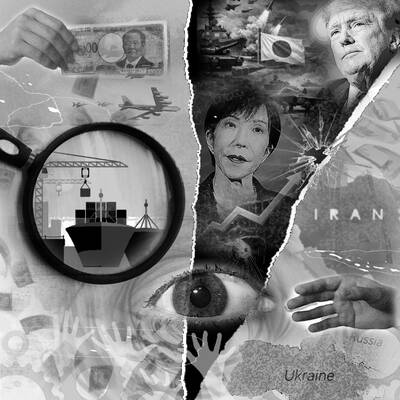
Japan’s imminent easing of arms export rules has sparked strong interest from Warsaw to Manila, Reuters reporting found, as US President Donald Trump wavers on security commitments to allies, and the wars in Iran and Ukraine strain US weapons supplies. Japanese Prime Minister Sanae Takaichi’s ruling party approved the changes this week as she tries to invigorate the pacifist country’s military industrial base. Her government would formally adopt the new rules as soon as this month, three Japanese government officials told Reuters. Despite largely isolating itself from global arms markets since World War II, Japan spends enough on its own
On March 31, the South Korean Ministry of Foreign Affairs released declassified diplomatic records from 1995 that drew wide domestic media attention. One revelation stood out: North Korea had once raised the possibility of diplomatic relations with Taiwan. In a meeting with visiting Chinese officials in May 1995, as then-Chinese president Jiang Zemin (江澤民) prepared for a visit to South Korea, North Korean officials objected to Beijing’s growing ties with Seoul and raised Taiwan directly. According to the newly released records, North Korean officials asked why Pyongyang should refrain from developing relations with Taiwan while China and South Korea were expanding high-level


 RSS
RSS