


This year would be remembered as the year that COVID-19 brought most of the world to a virtual standstill, and the year of a momentous US presidential election.
In Taiwan, while many are watching international events, people are also casting a glance over the history of their own island. Tainan is preparing to commemorate 400 years of its founding, Taipei has marked its own centenary with the “Journey of a Century” exhibition and Kaohsiung is putting on a series of events to celebrate 100 years since it adopted its new name.
It is wholly commendable that Taiwanese are exploring their history, taking the time to remember the hard work of their forebears and reflecting on what these all mean for how they are to march on into the future.
Tainan started its life in 1624, when the Dutch built a fort at Tayuan (大員), the present day Anping District (安平), initially calling it Orange City before changing the name to Zeelandia. This was Taiwan’s first-ever fortified stronghold, from where the Dutch governed the island, which would also become a hub for overseas trade.
Later, the Ming Dynasty warlord Cheng Cheng-kung (鄭成功, also known as Koxinga) would use this fort as his own base. Now called Anping Fort, it has also been called Wangcheng (王城, “royal city”), Anping City and Taiwan City.
To commemorate its 400-year history, Tainan is holding a series of archeological, installation, cultural and folk events, in cooperation with exhibitions across Taiwan and overseas, to show the city’s image and Taiwan’s national brand on the international stage, all in anticipation of the next four centuries.
Taipei’s centenary celebrations marked the initial implementation of Taiwan’s city system in 1920 as the location of the Japanese colonial era Sootokufu, the Office of the Governor-General of Taihoku Prefecture, when the city was named Taihoku.
The city was established at the same time as Taichuu (present day Taichung) and Tainan: Takao (present day Kaohsiung) and Kiryuu (now named Keelung) were not to be built for another four years.
As the provincial capital was Taipei, it had a similar status for Taiwan as the imperial capital in Tokyo had in Japan, and was also known as the “island capital.” After World War II, the Japanese-era city system was retained, and is still used today.
Kaohsiung was originally named Takau by the Makatao people, meaning “bamboo grove.” Later, Han Chinese immigrants would transliterate this name to the Chinese characters dagou (打狗, meaning “to hit a dog”). In 1920, during the Japanese colonial period, those characters were changed to the Chinese characters still used today, after Takao, an area in the environs of Kyoto, which sounded similar to dagou in Japanese and had an auspicious meaning of “flying high, overlooking the south seas.”
This year, the city is putting on a series of events based on the three themes of its history, its port and Kaohsiung’s prospects, allowing its residents to tell their own story and write their own history, with a view to a glorious 100 more years.
After the war, Taiwan came under the control of an external regime, which suppressed its history and local culture, preventing many people from coming to know the rich cultural heritage of this land. Now that Taiwan is a democracy, events such as those described above make it once more possible for Taiwanese to appreciate the contributions of those who came before, and understand how modern-day Taiwan evolved and what this means for the future.
There is much to learn from how Tainan, Kaohsiung and Taipei developed.
For a start, Taiwan’s history and culture is made up of elements from Aborigines, the Dutch, Chinese and Japanese. These constituent parts might have had a larger or a smaller impact, for a longer or shorter period, but they — together with Fort San Domingo bequeathed by the Spanish, missionary work undertaken by European countries and post-war popular US culture thrown in for good measure — have made Taiwan the diverse culture it is today, and have fed into its rich and unique history and culture.
Next, there is the way the nation has developed, from south to the north. Taiwan was the origin of the Austronesian-language cultural diaspora, developing advanced maritime technologies that allowed its people to trade overseas and emigrate to other parts of the region.
During the 17th century Age of Discovery, the Dutch established their regional base in Taiwan, introducing aspects of Western civilization, such as literacy and Christianity.
When Koxinga arrived, and with the Qing Dynasty in China, Tainan would become a cultural city, the seat of learning on the island, the place where culture and education first developed, and where the arts were assembled.
In the late 19th century, Taipei gradually took on more importance.
Taiwanese politicians are often criticized for always taking the short-term view. Taking a step back and looking at the way these cities have developed over the centuries, and what taking the long-term view can produce, is exactly what is required.
Kaohsiung’s radiating and grid street layout plan and Taipei’s Daan Forest Park — the “lungs of the city” — date back to the Japanese colonial period, when in the 1930s a 30-year urban planning project was initiated in Kaohsiung, and 17 large city parks were planned for Taipei.
Taipei Mayor Ko Wen-je (柯文哲) initially announced plans for a 50-year infrastructure and reinvigoration plan for Taipei, but thus far there has been more talk than action.
A perspective on urban planning is not the only thing to be gained from an overview of Taiwan’s history. Next year is the centenary of the establishment of the Taiwanese Cultural Association by democracy pioneers such as Chiang Wei-shui (蔣渭水) and the Petition Movement for the Establishment of a Taiwanese Parliament started by Lin Hsien-tang (林獻堂), as well as the 360th anniversary of Koxinga’s landing on Taiwan at Luermen (鹿耳門) in Tainan. Commemorating these events sheds a light on the contribution of individuals in the past to Taiwan’s development, and can serve as inspiration for Taiwanese today.
At the same time, many schools in the past few years have held centennial celebrations marking the establishment of public schools, heralding the era of universal state education for Taiwanese, a milestone in the enlightenment of ordinary people and the modernization of the country.
The arts also have much to offer in this regard, the most recent example of which is the planned Taiwan Trilogy by director Wei Te-sheng (魏德聖). The trilogy is to relate the interaction of three different peoples and cultures during the Age of Discovery, told from the perspective of a Siraya hunter, a Chinese pirate and a Dutch missionary.
For the movies, sets are to be made of Chikan (赤崁) and Dawan (大灣) in Tainan, the Wankan (魍港) Pirate Village in Chiayi County and Madou Village of the Siraya. Wei has said that the sets would be faithful to the Taiwan experience and will not resemble Disneyland sets.
As the English Renaissance statesman and philosopher Francis Bacon wrote: “Histories make men wise.” Armed with knowledge about their nation’s past, Taiwanese would be better prepared to face the challenges presented to them.
Translated by Paul Cooper
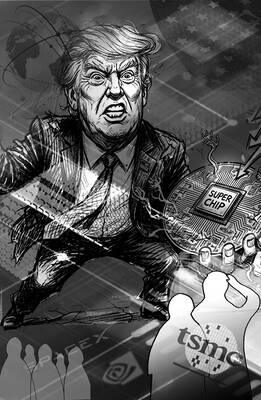
The White House’s decision to take a 9.9 percent stake in Intel Corp is looking like very shrewd business indeed. Since the government bought in at US$20.47 a share last August, the US chipmaker’s surging stock price has delivered the US a US$43 billion return. One of the reasons the investment has so far proved so sound is that the White House has made sure of it. According to The Wall Street Journal, Howard personally pushed deals on Intel’s behalf with some of the most lucrative clients imaginable. They include Nvidia Corp, the company at the heart of the AI
The Ministry of the Interior, working with the navy and coast guard, is organizing Taiwan’s first joint exercise simulating escort tankers carrying liquefied natural gas (LNG) and oil through a Chinese blockade. The drills simulate fuel transport along three maritime corridors leading toward Japan, the Philippines and the US. Deputy Minister of the Interior Sawyer Mars (馬士元) said that a blockade of the Taiwan Strait would amount to “almost a 100 percent blockade of the regional energy supply.” Minister of National Defense Wellington Koo said planning to counter a blockade is standard practice in Taipei. While the exercise is limited in
A single photograph can cut through a lot of noise, but it can also be used to misrepresent the truth. At the very least, it can concentrate the mind on something that requires further investigation. On Monday last week, Ma Ying-jeou Foundation CEO Tai Hsia-ling (戴遐齡) and former National Security Council secretary-general King Pu-tsung (金溥聰) held a news conference in which they showed a photograph of former foundation CEO Hsiao Hsu-tsen (蕭旭岑), now Chinese Nationalist Party (KMT) deputy chairman. In the image Hsiao is seated next to Xiamen Taiwan Businessmen Association chairman Han Ying-huan (韓螢煥). The two men were holding
I first met Professor Ray Jiing (井迎瑞) as a film and documentary student at Shih Hsin University’s (SHU) Department of Radio Television and Film in 1988. The following year, he went on to become the director of the Chinese Taipei Film Archive — forerunner of the Taiwan Film and Audiovisual Institute (TFAI). Over his eight-year tenure, Jiing rescued and restored over 200 classic Taiwanese films. In 1997, he established the Graduate Institute of Studies in Documentary and Film Archiving at Tainan National University of the Arts (TNNUA), and I joined the program in his third cohort of students. Beyond a


 RSS
RSS