


Kaohsiung City Councilor Jane Lee (李眉蓁) — the Chinese Nationalist Party’s (KMT) candidate in the Kaohsiung mayoral by-election — has been accused of plagiarism and violating academic ethics after it was discovered that her master’s thesis was almost identical to Minister of Overseas Community Affairs Tung Chen-yuan’s (童振源) paper titled Political and Economic Exchanges Across the Taiwan Strait.
When the case was first reported, Lee argued that as National Sun Yat-sen University (NSYSU), which approved her work, has “very high standards,” she did not think there was any problem with her thesis, as it had passed a university review.
However, the university late last year revoked a graduate degree issued in 2018 due to plagiarism and the paper of one of the university’s researchers published in an international academic journal early this year was retracted in May for violating academic ethics.
Simply saying that the university has “very high standards” is clearly not sufficient to prove that there is no problem with her thesis.
Higher education in Taiwan has been haunted by plagiarism for years. Several papers published by Taiwanese professors have been retracted in just the past few months.
The Ministry of Education and the Ministry of Science and Technology have proposed preventive measures over the past decade to fight academic plagiarism, but their efforts seem to have been in vain.
A look into the cause of the problem shows that many Taiwanese universities would rather settle a plagiarism dispute quietly.
Some colleges and universities even have so-called “plagiarism clans.” For example, even if a graduate student copies their adviser’s doctoral dissertation in their own thesis, the student might still be able to pass the oral defense and obtain the degree if their adviser is on the oral defense committee.
Reports of such cases are often presented on the Internet, but the authorities have failed to investigate them thoroughly.
The argument that NSYSU has “very high standards” is challenged by the fact that theses violate academic ethics, but its reputation has not been shattered, as it has not covered up the truth in the Lee situation in an attempt to save face.
Amid the responses of other local universities to plagiarism, NSYSU taking responsibility for passing a thesis that violated academic ethics by revoking the degree is a rare example of good standards. In doing so, the institute displayed its academic conscience and moral courage, and it is doing a better job than education authorities.
Lee on Thursday last week finally issued a public apology, saying that she would fully respect the results of an investigation by her alma mater.
Hopefully, the university will maintain its standards as it investigates the issue, which would help address problems caused by negligence that led it to lose control of the quality of a student’s knowledge and thesis.
By doing so, it would show that it indeed has “very high standards.”
Niu Ming is a university researcher.
Translated by Eddy Chang
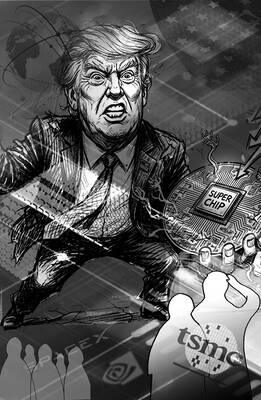
The White House’s decision to take a 9.9 percent stake in Intel Corp is looking like very shrewd business indeed. Since the government bought in at US$20.47 a share last August, the US chipmaker’s surging stock price has delivered the US a US$43 billion return. One of the reasons the investment has so far proved so sound is that the White House has made sure of it. According to The Wall Street Journal, Howard personally pushed deals on Intel’s behalf with some of the most lucrative clients imaginable. They include Nvidia Corp, the company at the heart of the AI
In a Taiwanese university classroom, a lecturer asks in English: “Can anyone give me an example from Taiwan?” Students look down. No one answers. After class, one student writes on the course platform in Mandarin: “I understood the concept, but I didn’t know how to answer in English.” That moment highlights a key issue in Taiwan’s English-medium instruction (EMI) reform: It is not just about more English-taught courses, but whether students can learn, participate and belong. EMI expansion is part of the Bilingual 2030 policy and the Ministry of Education’s BEST Program, aiming to improve English ability, support EMI teaching
A single photograph can cut through a lot of noise, but it can also be used to misrepresent the truth. At the very least, it can concentrate the mind on something that requires further investigation. On Monday last week, Ma Ying-jeou Foundation CEO Tai Hsia-ling (戴遐齡) and former National Security Council secretary-general King Pu-tsung (金溥聰) held a news conference in which they showed a photograph of former foundation CEO Hsiao Hsu-tsen (蕭旭岑), now Chinese Nationalist Party (KMT) deputy chairman. In the image Hsiao is seated next to Xiamen Taiwan Businessmen Association chairman Han Ying-huan (韓螢煥). The two men were holding
The Ministry of the Interior, working with the navy and coast guard, is organizing Taiwan’s first joint exercise simulating escort tankers carrying liquefied natural gas (LNG) and oil through a Chinese blockade. The drills simulate fuel transport along three maritime corridors leading toward Japan, the Philippines and the US. Deputy Minister of the Interior Sawyer Mars (馬士元) said that a blockade of the Taiwan Strait would amount to “almost a 100 percent blockade of the regional energy supply.” Minister of National Defense Wellington Koo said planning to counter a blockade is standard practice in Taipei. While the exercise is limited in


 RSS
RSS