


Minutes after reports broke that China on Tuesday passed sweeping national security legislation for the territory, Hong Kong Chief Executive Carrie Lam (林鄭月娥) stood in front of a backdrop of the territory’s iconic skyline for a weekly press briefing.
With legions of reporters clamoring to hear details of the legislation that could reshape the financial hub’s future, it quickly became clear that Hong Kong’s leader had none.
Lam, who previously acknowledged that she had not seen the legislation, could not even confirm that China had approved it before quickly ending the press conference and walking away from the podium.
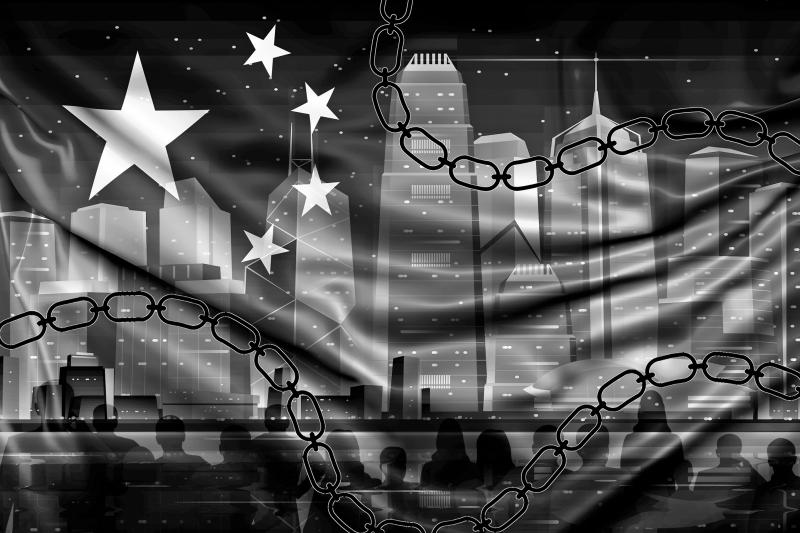
Illustration: Louise ting
The awkward scene underscored the extent to which Chinese President Xi Jinping (習近平) sidelined Hong Kong’s leaders in shaping the territory’s most important legislation since Beijing took control of the former British colony in 1997. When the details were finally unveiled to the world at around 11pm on Tuesday, it became clear why they kept it under wraps.
The legislation carries life sentences for secession, subversion, terrorism and collusion with foreign forces, which cover everything from serious disruption of transportation networks and attacks on government offices — tactics used by protesters last year — to advocating foreign sanctions against China, which many in the pro-democracy camp called for just weeks ago to deter Beijing from passing the legislation.
It also gives Chinese agents operating in Hong Kong immunity, allows for secret trials and calls for greater oversight of news agencies. The legislation is applicable to everyone, anywhere in the world — whether or not they are Hong Kong residents.
While those provisions look familiar to anyone in mainland China, they are foreign to Hong Kong. The treaty between China and the UK that resulted in Hong Kong’s Basic Law guaranteed an independent judiciary, freedom of speech, the right to protest and other civil liberties — protections credited with attracting foreign talent and investment, and preserving Hong Kong’s status as one of the world’s top financial centers.
The legislation shows that Xi sees the territory foremost as the one place under his control where citizens could openly undermine the Chinese Communist Party’s (CCP) grip on power, and that could not stand, no matter the consequences.
Consulting with Hong Kong on legislation designed to intimidate its residents into silence, might make it less effective both as a tool of coercion, and as a message to China’s neighbors and the world, according to Brookings Institution China Strategy Initiative director Rush Doshi.
“Beijing is determined to signal strength and resolve even when doing so might harm China’s economic and reputational interests in the US, Europe and now India. This approach, however, clearly reduces the space for bargaining with others,” said Doshi, who is also providing informal counsel to the campaign of US presidential candidate Joe Biden.
The legislation raises concerns about China’s commitment to international agreements like its 1984 Joint Declaration with the UK. That treaty, which is registered with the UN, guarantees that Hong Kong “will enjoy a high degree of autonomy, except in foreign and defense affairs,” and that the “laws currently in force in Hong Kong will remain basically unchanged.”
The G7 foreign ministers before the legislation’s passage said that the decision was “not in conformity” with the treaty.
However, China has rejected such criticism as foreign meddling, saying “the core” of its treaty obligations were fulfilled after resuming sovereignty over Hong Kong.
“The bill reflects Xi’s steely determination to draw a bright red line on the inviolability of Chinese sovereignty, and that he views Western governments at best as easily divided and at worst as paper tigers,” said Chris Johnson, a former CIA China analyst who now heads China Strategies Group, a consulting firm.
“If Xi is proven right in that judgement, it will increase his dialectical, almost millenarian certainty that the West’s decline is both permanent and accelerating, perhaps emboldening him to take greater risks on other points of tension with the US,” Johnson said.
China has no shortage of international spats at the moment. In the past few months, it has stepped up fighter jet exercises near Taiwan, clashed over islands in the South China Sea, charged two Canadians it detained under murky circumstances, sparred with Australia over an investigation into the origins of COVID-19, quarreled with the EU over a range of issues and undertook its worst military skirmish with India in nearly half a century.
That does not even take into account its wider strategic battle with the US, which is preparing to sanction Chinese officials, and possibly take stronger actions regarding its moves in Hong Kong after imposing visa bans and restricting exports of sensitive technologies.
US Secretary of State Mike Pompeo on Thursday said that the US “will not stand by idly while China swallows Hong Kong into its authoritarian maw.”
Still, the harshest moves US President Donald Trump can take — particularly anything that hits at Hong Kong’s financial stability — could end up backfiring on the US economy.
While Trump has threatened even a complete decoupling of the world’s biggest economies, he also insisted last month that a “phase-one” trade deal that the two sides reached in January was “fully intact.”
“China is just slowly tightening the noose under the 1997 handover law, and there’s not much frankly the US can do about it,” said Max Baucus, a former US ambassador to China who also served for more than three decades in the US Senate.
Xi’s move to reign in dissent in Hong Kong gained steam three years ago during a visit to the territory. While praising the “one country, two systems” framework, he also hinted at the possibility of the tough measures that came into force this week.
“Any attempt to endanger China’s sovereignty and security, challenge the power of the central government and the authority of the Basic Law of the Hong Kong Special Administrative Region, or use Hong Kong to carry out infiltration and sabotage activities against the mainland is an act that crosses the red line, and is absolutely impermissible,” Xi said.
That message came just a few years after the 2014 Umbrella movement had for months occupied a large swathe of the territory’s financial district.
The demonstrations last year, marked by the frequent use of Molotov cocktails, disruption of key transport routes and a brief seizure of the international airport, proved to be the final straw for the CCP.
The tough Hong Kong security legislation reflects Xi’s “own near-obsession with maintaining stability in all the geographies he considers as belonging to the CCP,” Center for Strategic and International Studies Freeman Chair in China Studies Jude Blanchette said.
“From Taiwan to Hong Kong to India, the Xi administration’s playbook relies on a clenched fist and a checkbook,” Blanchette added.
Beijing’s assertiveness in the wake of the pandemic, which has tanked the global economy and increased unemployment at home, has prompted countries to seek ways to reduce their economic dependence on China.
The US has called for rewiring supply chains, and both Japan and Taiwan are offering incentives for companies to leave China. The UK reversed course on relying on Huawei for its 5G networks, and India just banned 59 of China’s largest technology apps including TikTok.
Democratic governments are also offering Hong Kongers the chance to get out. Japan and Taiwan are both seeking ways to attract financial professionals from the territory, while the UK has offered a path to citizenship for about 3 million Hong Kong residents, and the US is mulling ways to welcome refugees from Hong Kong.
Michael Tien (田北辰), a pro-Beijing lawmaker in the Hong Kong Legislative Council, said that international companies would be fine if they just focused on business and avoided the four areas specified in the legislation, including speaking about the CCP’s legitimacy in China.
“When it comes to these four areas, you guys had better think more about ‘one country,’ forget about your ‘two systems.’ You can still go on dancing, you can still go on horse racing, you can innovate, you can trade, you can do all those things, but just stay away from these four areas,” Tien said to media on Wednesday.
While Hong Kong’s concerns about an erosion of freedoms are valid, China’s leaders imposed the legislation because they felt “cornered” by protesters, Nanjing University Institute of International Studies director Zhu Feng (朱鋒) said.
“After all, a national security law is much better than mobilizing the army to quash the protests as in 1989,” Zhu said, referring to the deadly crackdown at Tiananmen Square in Beijing.
“But that does not necessarily mean that China wants to challenge the global order pinned by the universal values,” Zhu added.
The Chinese Hong Kong and Macau Affairs Office called the legislation the “sword of Damocles” for the “extremely few” people endangering national security, and a “guardian angel” to the “vast majority” of residents.
Lam, who finally saw the legislation’s contents, on Wednesday also praised it as restoring stability to the territory.
Still, the fact that Hong Kong’s leader did not comment on the legislation ahead of time shows how the territory’s autonomy has been “completely thrown out of the window,” pro-democracy Hong Kong Legislator Fernando Cheung (張超雄) said.
Thousands protested against the legislation on Wednesday, and police said they arrested seven people under the new legislation.
“The US and the rest of the free world have given ample warnings to the CCP not to destroy the international city, and Xi is doing the exact opposite. By passing the draconian law in a secretive way, Xi is sending a hostile message to the free world that it has no interests in conforming to the universal values of a free and open society,” Cheung said.
When Chinese President Xi Jinping (習近平) sits down with US President Donald Trump in Beijing on Thursday next week, Xi is unlikely to demand a dramatic public betrayal of Taiwan. He does not need to. Beijing’s preferred victory is smaller, quieter and in some ways far more dangerous: a subtle shift in American wording that appears technical, but carries major strategic meaning. The ask is simple: replace the longstanding US formulation that Washington “does not support Taiwan independence” with a harder one — that Washington “opposes” Taiwan independence. One word changes; a deterrence structure built over decades begins to shift.
The cancelation this week of President William Lai’s (賴清德) state visit to Eswatini, after the Seychelles, Madagascar and Mauritius revoked overflight permits under Chinese pressure, is one more measure of Taiwan’s shrinking executive diplomatic space. Another channel that deserves attention keeps growing while the first contracts. For several years now, Taipei has been one of Europe’s busiest legislative destinations. Where presidents and foreign ministers cannot land, parliamentarians do — and they do it in rising numbers. The Italian parliament opened the year with its largest bipartisan delegation to Taiwan to date: six Italian deputies and one senator, drawn from six
Recently, Taipei’s streets have been plagued by the bizarre sight of rats running rampant and the city government’s countermeasures have devolved into an anti-intellectual farce. The Taipei Parks and Street Lights Office has attempted to eradicate rats by filling their burrows with polyurethane foam, seeming to believe that rats could not simply dig another path out. Meanwhile, as the nation’s capital slowly deteriorates into a rat hive, the Taipei Department of Environmental Protection has proudly pointed to the increase in the number of poisoned rats reported in February and March as a sign of success. When confronted with public concerns over young
Taipei is facing a severe rat infestation, and the city government is reportedly considering large-scale use of rodenticides as its primary control measure. However, this move could trigger an ecological disaster, including mass deaths of birds of prey. In the past, black kites, relatives of eagles, took more than three decades to return to the skies above the Taipei Basin. Taiwan’s black kite population was nearly wiped out by the combined effects of habitat destruction, pesticides and rodenticides. By 1992, fewer than 200 black kites remained on the island. Fortunately, thanks to more than 30 years of collective effort to preserve their remaining


 RSS
RSS