


It started with headaches, then came nausea and diarrhea. Within two weeks, gay Ugandan barber Eric, 26, had become so weak without his HIV medication that he could not walk and had to be hospitalized.
“I was in the hospital for a week and four days. I nearly lost my life,” Eric said by telephone from his village in Ntungamo District in western Uganda.
“The doctor told me that I shouldn’t have stopped taking my HIV medicines, but it wasn’t my choice,” Eric said.
“There is no transport available because of the lockdown and I couldn’t walk the 20km to the clinic to get my refills,” he added.
Lockdowns globally are preventing some LGBT+ people with HIV from getting the life-saving treatment they need — and potentially putting their compromised immune systems at risk if they contract COVID-19, HIV/AIDS organizations said.
From Uganda, Kenya and Mozambique to Lebanon, Kyrgyzstan, and Trinidad and Tobago, rights groups have reported hearing of sexual minorities forced off treatment due to stay-at-home orders, despite some government and non-governmental organization efforts to try to help them.
HIV technical lead at the charity Frontline AIDS Matteo Cassolato said that they are receiving a rising number of grant applications from grassroots LGBT+ groups whose members are struggling to get their medications because of COVID-19.
“People living with HIV across the world are having problems to get their regular treatment due to lockdowns, but for groups like the LGBT+ community it is more challenging due to their vulnerability and the discrimination they face,” Cassolato said.
“They are being persecuted and arrested in some countries, or stopped by police as they go to collect their medicine and forced to return home. Due to the stigma and homophobia, it is often difficult to explain themselves,” he said.
Cassolato said that his organization had just approved a grant to support transgender people in Trinidad and Tobago who are facing difficulties getting medicine due to the shutdowns.
Limited opening hours and high demand at health facilities and pharmacies have deterred trans people — who are more visible and can face harassment — from fetching medication, he said.
Nearly 38 million people worldwide are infected with HIV, with the AIDS pandemic having killed about 35 million people worldwide since it began in the 1980s.
Gay men account for nearly 20 percent of new HIV infections and are 27 times more likely to become infected with HIV than other men, the Joint United Nations Programme on HIV and AIDS (UNAIDS) said.
Meanwhile, 16.5 percent of transgender women are living with HIV, UNAIDS said, adding that trans women shoulder a risk of acquiring HIV that is 12 times higher than the general population.
HIV cannot be cured, but the infection can be kept in check with antiretroviral drugs (ARVs) that help lower viral levels so that the virus is not transmissible, preventing full-blown AIDS.
Campaigners said that while about 60 percent of those living with HIV/AIDS have access to medication, the lockdowns have made it hard for sexual minorities already living on the margins of society.
Many are living in countries where same-sex relations are criminalized and homophobia is widespread, suffering discrimination at the workplace, as well as with regards to housing, education and healthcare.
As COVID-19 continues to take its toll across the world, LGBT+ people are not only being blamed and targeted, shutdowns are preventing them from getting medication and earning an income, and are pushing many to the brink, LGBT+ rights groups said.
In Uganda, for example, where gay sex carries a life sentence, 19 LGBT+ people — some of whom were HIV-positive — have been jailed, accused of risking the spread of COVID-19.
In countries such as Kenya, Zimbabwe, Mozambique, Ukraine, Kyrgyzstan and Lebanon, the shutdowns have meant people cannot get their ARVs due to a lack of transport, or they cannot afford transport costs due to a loss of income.
LGBT+ friendly drop-in health centers in many of these countries have been forced to close or restrict their hours and, in some countries, HIV/AIDS services have been diverted to fight the COVID-19 pandemic.
In Egypt, for example, clinics where patients collect their medication are being used as COVID-19 testing centers, leaving LGBT+ people hesitant to visit.
“People living with HIV should never have to fear picking up their medication,” Human Rights Watch deputy director for the Middle East and North Africa Joe Stork said in a statement.
“The government should ensure that people already facing health concerns can get their medication safely,” Stork added.
In Mexico, more than 1,000 government workers — some of them from the LGBT+ community — have been left without medication since March due to drug shortages caused by changes in the way the government buys drugs, human rights groups said.
Mexican Secretariat of Public Education employee Victor said that he struggled to get a three-month supply of ARVs from the government in March, and is now worried that his medication could run out again.
“I don’t know what’s going to happen,” the gay 28-year-old said by telephone from his home in Mexico City. “I don’t know if I’ll have to live the same fear again, the same worry, the same uncertainty.”
Some LGBT+ people have also been forced to stop taking their medication, as they have no money to buy food and cannot withstand the powerful drugs on an empty stomach.
Mbarara Rise Foundation executive director Real Raymond said that finding a daily meal had become a problem for some people under the lockdown.
The charity organization delivers ARVs to almost 70 LGBT+ people in rural parts of western Uganda by bicycle.
Many LGBT+ people are daily income earners working in bars, casinos or in other gathering places that have been shut under the lockdown so they have no money for food.
“Some have stopped taking their daily HIV treatment due to lack of food to eat. The medications they have been prescribed are strong and cannot be taken on an empty stomach, which has led many to stop taking their medication entirely,” Raymond said.
“They tell me that whenever they take them on an empty stomach, their body becomes too weak, feverish and headachy,” he added.
The WHO has said that there is no evidence that the risk of COVID-19 is different among people living with HIV who are on ARV treatment compared with the general population.
However, those with advanced HIV who are not taking ARVs could have an increased risk of infection and health complications related to COVID-19, the WHO said.
UNAIDS has called on governments to safeguard resources for HIV and sexual health programs sensitive to the needs of LGBT+ people, and ensure continued access to ARVs, such as by multi-month dispensing, home deliveries and virtual consultations.
“Very rightfully there has been a very forceful and strong response to COVID-19 in many countries and that shows great leadership, but in all that effort to put those measures in place, we must not forget marginalized groups like the LGBTIQ community,” UNAIDS senior adviser for community support in east and southern Africa Christoforos Mallouris said.
“More than before, we need to make sure that the population is as healthy as ever if they are faced with COVID-19,” he added.
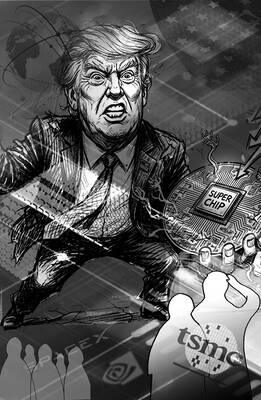
The White House’s decision to take a 9.9 percent stake in Intel Corp is looking like very shrewd business indeed. Since the government bought in at US$20.47 a share last August, the US chipmaker’s surging stock price has delivered the US a US$43 billion return. One of the reasons the investment has so far proved so sound is that the White House has made sure of it. According to The Wall Street Journal, Howard personally pushed deals on Intel’s behalf with some of the most lucrative clients imaginable. They include Nvidia Corp, the company at the heart of the AI
A single photograph can cut through a lot of noise, but it can also be used to misrepresent the truth. At the very least, it can concentrate the mind on something that requires further investigation. On Monday last week, Ma Ying-jeou Foundation CEO Tai Hsia-ling (戴遐齡) and former National Security Council secretary-general King Pu-tsung (金溥聰) held a news conference in which they showed a photograph of former foundation CEO Hsiao Hsu-tsen (蕭旭岑), now Chinese Nationalist Party (KMT) deputy chairman. In the image Hsiao is seated next to Xiamen Taiwan Businessmen Association chairman Han Ying-huan (韓螢煥). The two men were holding
I first met Professor Ray Jiing (井迎瑞) as a film and documentary student at Shih Hsin University’s (SHU) Department of Radio Television and Film in 1988. The following year, he went on to become the director of the Chinese Taipei Film Archive — forerunner of the Taiwan Film and Audiovisual Institute (TFAI). Over his eight-year tenure, Jiing rescued and restored over 200 classic Taiwanese films. In 1997, he established the Graduate Institute of Studies in Documentary and Film Archiving at Tainan National University of the Arts (TNNUA), and I joined the program in his third cohort of students. Beyond a
A recent report concerning a student who is suing his teacher posed the question in its headline: Does failing a student in two subjects constitute bullying? The college student in Chiayi County apparently sought NT$2 million (US$63,603) in state compensation, but a court dismissed the case. The first reaction of many might have been to ask: What has happened to students nowadays? Some say that teachers have lost their authority, while others say students are overindulged. Some even start reminiscing over the days when “whatever the teacher says goes.” However, the real issue might be overlooked if emotional reactions like that are the


 RSS
RSS