


It was refreshing. Not twenty days into his tenure, on Sept. 26, 2017, at a Legislative Yuan interpellation, Taiwan’s new Premier of the Executive Yuan, Dr. William Lai Ching-te (賴清德), explained in plain language to the elected representatives of Taiwan’s people who he was and what he believed.
The former physician and Harvard-trained master of public health, now one of Taiwan’s most admired political figures, stated flatly, “I am a political worker who advocates Taiwan’s independence.” For anyone interested in what he meant by “Taiwan’s independence,” he continued: “We already are a sovereign, independent country by the name of ‘The Republic of China’ and are mutually non-subordinate with China.” In the six months since, Dr. Lai has shared his position with anyone who has asked.
The new Premier’s words transported me back a quarter of a century to Nov. 22, 1993, when I supervised all China intelligence at the State Department’s Bureau of Intelligence and Research from the eighth floor of the decrepit “Main State” building on 21st Street. Late that afternoon, the fax machine outside my office hummed with a flimsy from my old friend, James Wang (王景弘) in Seattle during the first “leaders summit” of the Asia-Pacific Economic Cooperation (APEC). “Sovereign, independent” and “mutually non-subordinate” were prominent among the lines scribbled in an unfamiliar shorthand cursive grass-script. James was covering the APEC meeting for the United Daily News group, and had faxed me the hand-written press release, prepared by a now-forgotten Taiwan economic ministry member of the APEC delegation, of exactly what Taiwan economic minister Chiang Pin-kung (江丙坤) had recited, word-for-word, from a prepared text. (The unknown transcriber omitted, perhaps purposefully, lines about a “transitional Two China Policy.” James added the words in his own handwriting at the end of the fax.) Minister Chiang cleared his throat and, if I recall from James later, proceeded nervously to denounce Chinese President Jiang Zemin’s (江澤民) declaration — just an hour earlier — that “Taiwan is a province of the People’s Republic of China.”
Minister Chiang’s voice firmed noticeably: “China” he said, “is an historical, geographical and cultural term, and in this sense Taiwan is a part of China as is Mainland China; but ‘China’ does not equal ‘The People’s Republic of China,’ nor is Taiwan a part or a province of the ‘People’s Republic of China.’” He continued: “Within a geographical ‘China,’ the Republic of China and the People’s Republic of China are two mutually non-subordinate countries.”
The terminology “two sovereign, independent and mutually non-subordinate countries” was new to me in 1993. I knew that President Lee Teng-hui (李登輝) was extremely upset with US president Bill Clinton who had invited President Lee to Seattle earlier in the year, and then withdrew the invitation when Chinese President Jiang threatened to boycott the summit. APEC was founded on “a commitment to open dialogue and consensus, with equal respect for the views of all participants,” and under these principles both China and Taiwan were admitted in 1991. Yet, President Clinton hosting the very first APEC leadership summit, repudiated that “commitment” by disinviting President Lee.
I admit to profound private sympathy in 1993 for Taiwan’s new declaration of “sovereignty, independence, and mutual non-subordination” to China. And that description of Taiwan’s international status has resonated with me ever since.
Just a few months earlier, on Aug. 31, I had analyzed Beijing’s so-called “White Paper” on “The Taiwan Question and the Reunification of China” which was issued in Beijing just as President Lee’s emissaries arrived there to discuss opening “practical” cross-Strait cooperation. In violation of a tacit consensus between the two Strait elders Koo Chen-fu (辜振甫) and Wang Daohan (汪道涵) struck in Singapore in April 1993, China declared that “Taiwan is a province of the People’s Republic of China.” President Lee was certain that his Chinese counterpart Jiang would use the Seattle APEC as an international soapbox from which to proclaim Taiwan’s “provincial” status under the PRC, and President Lee was determined that Mr. Jiang would not have the last word. For weeks ahead of the APEC summit, President Lee worked with Taiwan’s erudite vice foreign minister Fan King-yen (房金炎), himself a native of Nantou, to craft a position. In the end, Vice Minister Fan and President Lee had unfolded a complex formula for an “interim two Chinas policy” that would do the trick. They instructed that Minister Chiang deliver it at APEC if the Chinese declared Taiwan to be their “province.”
Over these past twenty-five years, Taiwan’s leaders have struggled to devise a formula for Taiwan’s international status that fulfills President Chen Shui-bian’s (陳水扁) threefold mandate that it: 1) be supported by Taiwan’s citizens, 2) “satisfies the Americans,” and 3) is something “the other side can put up with” (國人會支持,美國會滿意,對方會接受). Of course, none ever fit the bill. In 1999, President Lee suggested “special state-to-state relations” across the Strait; in 2002 President Chen blurted out “each side is its own nation.” President Ma Ying-jeou (馬英九) said “only one China, the Republic of China.” Each missed the mark in its own way. Premier Lai’s “sovereign, independent, and mutually non-subordinate” is my favorite.
Premier Lai’s open admission that he is a “political worker in the advocacy of Taiwan Independence” is supported by Taiwan’s citizens. But it already has Beijing hopping mad. But unlike before, the American side has accepted it with equanimity. Washington takes the Premier’s words at face value because they do not change the status quo at all. Besides, these days, Washington is less inclined to fret over the legal fictions in the Taiwan Strait or worry about Beijing’s rants because China has done precious little to moderate its hostility to America otherwise. North Korean “denuclearization” remains a ploy to break the US-South Korea alliance, weaken ties with Japan and ultimately insist that the US itself “denuclearize” in East Asia; China’s trade, dumping, theft of economic secrets, environmental despoliation, and financial crimes alienate the Congress; and China’s ever-aggressive territorial claims and military occupation in the South China Sea, its naval confrontations in the East China Sea, its border clashes with India, and its intimidation of tiny, defenseless Bhutan alarm the US government as much as it does those nations directly affected.
Still, Washington seems steeled for a Beijing ploy to divert attention from all these crises with a slap at Taipei’s Premier. Beijing’s gathering menace already stirs new strategic rethinking along the Potomac. Congress, having passed unanimously the Taiwan Travel Act, and the President, having signed it with alacrity, signal unwillingness to new changes in Taiwan’s “status quo.” That “status quo” for the past 39 years, since the Taiwan Relations Act, has been that Taiwan and China are two “sovereign, independent and mutually non-subordinate countries.” One is America’s friend, and the other one isn’t.
John J. Tkacik, Jr. is a retired US foreign service officer who has served in Taipei and Beijing and is now director of the Future Asia Project at the International Assessment and Strategy Center.
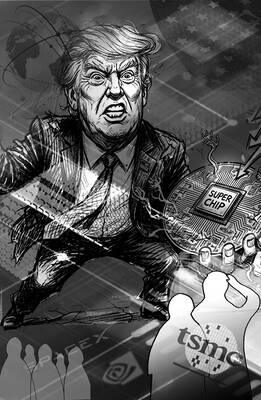
The White House’s decision to take a 9.9 percent stake in Intel Corp is looking like very shrewd business indeed. Since the government bought in at US$20.47 a share last August, the US chipmaker’s surging stock price has delivered the US a US$43 billion return. One of the reasons the investment has so far proved so sound is that the White House has made sure of it. According to The Wall Street Journal, Howard personally pushed deals on Intel’s behalf with some of the most lucrative clients imaginable. They include Nvidia Corp, the company at the heart of the AI
A single photograph can cut through a lot of noise, but it can also be used to misrepresent the truth. At the very least, it can concentrate the mind on something that requires further investigation. On Monday last week, Ma Ying-jeou Foundation CEO Tai Hsia-ling (戴遐齡) and former National Security Council secretary-general King Pu-tsung (金溥聰) held a news conference in which they showed a photograph of former foundation CEO Hsiao Hsu-tsen (蕭旭岑), now Chinese Nationalist Party (KMT) deputy chairman. In the image Hsiao is seated next to Xiamen Taiwan Businessmen Association chairman Han Ying-huan (韓螢煥). The two men were holding
I first met Professor Ray Jiing (井迎瑞) as a film and documentary student at Shih Hsin University’s (SHU) Department of Radio Television and Film in 1988. The following year, he went on to become the director of the Chinese Taipei Film Archive — forerunner of the Taiwan Film and Audiovisual Institute (TFAI). Over his eight-year tenure, Jiing rescued and restored over 200 classic Taiwanese films. In 1997, he established the Graduate Institute of Studies in Documentary and Film Archiving at Tainan National University of the Arts (TNNUA), and I joined the program in his third cohort of students. Beyond a
A recent report concerning a student who is suing his teacher posed the question in its headline: Does failing a student in two subjects constitute bullying? The college student in Chiayi County apparently sought NT$2 million (US$63,603) in state compensation, but a court dismissed the case. The first reaction of many might have been to ask: What has happened to students nowadays? Some say that teachers have lost their authority, while others say students are overindulged. Some even start reminiscing over the days when “whatever the teacher says goes.” However, the real issue might be overlooked if emotional reactions like that are the


 RSS
RSS